












Contents
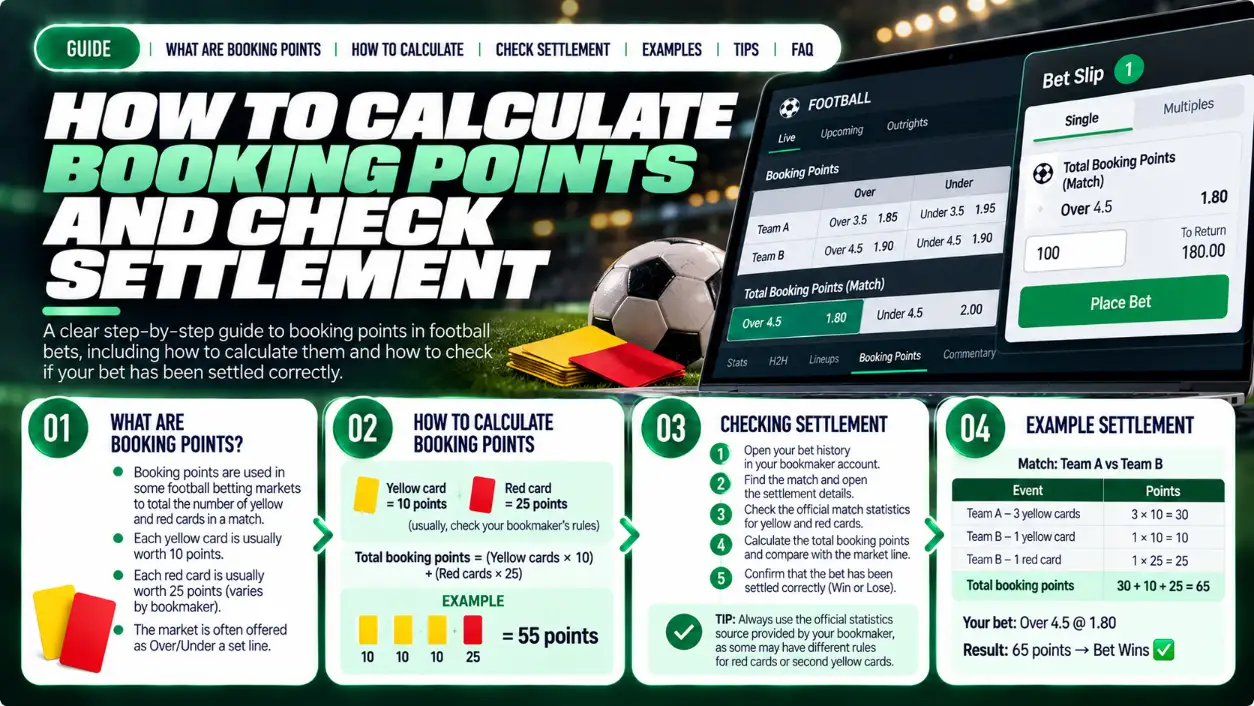
Booking points in betting are the total of the values a named sportsbook assigns to cards in a particular market. They are not a universal football scoring system. Before checking settlement, establish the card values, eligible events and settlement period.
For example, Cloudbet's rules, under “Booking points markets”, assign 10 points to a yellow card and 25 to a red card or a sending-off following a second yellow. The second yellow leading to the red is not counted separately, and the maximum is 35 points per player. These rules are used for the teaching example below, not presented as standard rules for every sportsbook.
All external rules cited here were checked on 14 October 2026. Cloudbet's page has no stated version date; other source-version limits are noted alongside the relevant explanations. The match example and betting-slip conditions below are constructed scenarios, not records of a real fixture.
Does the accepted slip cover match or team booking points?
Sum one team's events for a team total, or both teams' events for a match total, as specified on the accepted slip. These figures are a didactic breakdown of the same later event journal—not actual accepted bets or proof any operator offers all these markets. A player-carded selection is different and needs its own rules; do not extend this calculation to player booking points.
| Scope | Events to sum | Points |
|---|---|---|
| Team A | A1 | 35 |
| Team B | B1 + B2 + B3: 10 + 25 + 10 | 45 |
| Match | Both teams: 35 + 45 | 80 |
Check the accepted slip and operator rules for:
- Exact market name.
- Selected team or both teams.
- Units: booking points or card count.
- Period.
- Total line.
- Equality and settlement rule.
Constructed guide to checking market, team, units, period, line and settlement rules
Constructed diagram, not a sportsbook screenshot. Operator-specific rules govern settlement.
How booking points differ from total cards
Booking points and total cards calculated under a named market's rules use different units. You cannot automatically convert points into card units by dividing by 10.
BetWright's rules distinguish the two markets:
- Bookings Points: 10 for a yellow, 25 for a red and a maximum of 35 per player.
- Total Bookings: 1 for a yellow, 2 for a red and a maximum of 3 per player.
The BetWright page is dated 19 July 2024; this article uses the accessible text checked on 14 October 2026.
Under bet365's “Number of Cards” rules, a yellow also counts as 1 and a red as 2. The second yellow is ignored, with a maximum of 3 per player. The full rule text was checked on 14 October 2026; no actual betting slip was tested.
Two sets of events illustrate the difference:
| Same eligible events | Points under the 10/25 system | Card units under the 1/2 system |
|---|---|---|
| Four yellows to different players | 40 | 4 |
| Three yellows to different players and a straight red to another player | 55 | 5 |
The second row gives 55 points, not 50. This mathematical comparison assumes the same events are eligible in both columns. It does not mean different sportsbooks have identical eligibility rules, and there is no fixed conversion factor.
Which events and match periods count?
Filter events under the market rules before assigning points. A card being shown does not necessarily mean it contributes to the betting total.
Before adding the values, record:
- The exact market name and units: booking points or card units.
- The match period covered.
- Who received each card and that person's status at the time.
- Whether a second yellow is listed separately from the resulting red.
For the example below, Cloudbet's booking-points rules are used to include cards during the regular 90-minute period and exclude cards after the match or to nonplayers, including already-substituted players, managers and the bench. Adjacent general player-scoring prop rules are not applied to this market.
Stoppage time is part of the 90-minute period; extra time is a separate period. BetWright's general football rules explicitly state that 90 minutes includes stoppage or injury time but excludes extra time and penalty shootouts unless stated otherwise. This is the named source's rule, not a claim that all sportsbooks use identical conditions.
In the constructed 90-minute example, a card at 90+3 before the final whistle is therefore included, while a card in extra time at 105 minutes is excluded. Both occur after the clock reaches 90, but they belong to different periods.
A card excluded from betting settlement may still be a valid football sanction. IFAB Law 12 permits cautions and sendings-off for substitutes, substituted players and team officials, and the referee's authority continues after the match. IFAB does not set booking-point values. The latest available page was accessed on 14 October 2026; its exact seasonal version was not established.
How to count a player's second yellow
Under the rules used here, a first yellow followed by a sending-off gives the player 35 points: 10 + 0 + 25 = 35. The second yellow leading to the red does not add another 10.
For the hypothetical player A1:
| Event | Points |
|---|---|
| First yellow | 10 |
| Second yellow leading to a sending-off | 0 |
| Resulting red | 25 |
| A1 total | 35 |
This applies Cloudbet's rules, which cap each player at 35 points. If the event source lists the second yellow and red on separate lines, keep both in your journal for checking, but do not count the second yellow again.
Worked journal: from cards to 80 points
The constructed example totals 80 booking points: 10 + 10 + 25 + 25 + 10. Zero-point rows are retained so you can see why some events do not change the total.
A and B are placeholder teams. The player IDs below identify fictional participants, not real footballers. Events are filtered using the Cloudbet rules described above for the designated 90-minute market, with stoppage time included and extra time excluded. All values are whole numbers, so no rounding is needed.
| Time | Person | Event | Points counted | Reason for inclusion or exclusion |
|---|---|---|---|---|
| 12 | A1 | First yellow | 10 | Eligible player and period |
| 33 | B1 | Yellow | 10 | Eligible player and period |
| 61 | A1 | Second yellow | 0 | Does not add another 10 when followed by a red |
| 61 | A1 | Resulting red | 25 | Sending-off following the second yellow |
| 70 | B2 | Straight red | 25 | Eligible player and period |
| 80 | Coach A | Yellow | 0 | Card to a team official is excluded |
| 88 | A3 | Yellow after being substituted | 0 | Player had already been substituted |
| 90+3 | B3 | Yellow | 10 | Stoppage time before the final whistle |
| After the final whistle | B4 | Yellow | 0 | Post-match card is excluded |
| 105 | A4 | Yellow | 0 | Extra time is outside the designated 90-minute market |
| Total | — | — | 80 | — |
Constructed booking-points ledger showing 80 points, excluded events and a comparison with 7 card units
Constructed example, not a sportsbook screenshot. The comparison between booking points and card units assumes the same eligible events.
The per-player summary shows how those same events produce different totals:
| Player | Points | Card units |
|---|---|---|
| A1 | 35 | 3 |
| B1 | 10 | 1 |
| B2 | 25 | 2 |
| B3 | 10 | 1 |
| Total | 80 | 7 |
The card-unit column uses 1 for a yellow, 2 for a red and a maximum of 3 per player, without counting the second yellow separately. With matching event eligibility, the result is 7 units, not 80 / 10. This table demonstrates the calculation method; it does not establish identical eligibility rules across operators.
How to compare 80 points with your betting slip
Settlement depends on the exact threshold and the contract's treatment of equality. A label such as “total 80” is not enough to establish the result.
The following are hypothetical conditions applied to the calculated total of 80. A push at equality is not confirmed here for any of the named operators.
| Hypothetical betting-slip condition | Result at 80 points | Explanation |
|---|---|---|
| Over 79.5 | Win | 80 is greater than 79.5 |
| Over 80.5 | Loss | 80 is less than 80.5 |
| 80+ | Win | The condition means 80 or more, including equality |
| Over 80.0 in a two-way market explicitly specifying a push at equality | Stake returned | The total equals the threshold, triggering the stated push condition |
| Exactly 80 in a three-way Under / Exactly / Over 80 market | Win | The total matches the exact-total selection |
| Over 80 in the same three-way market | Loss | At 80, the separate Exactly 80 selection wins |
Here, “Over 80” means more than 80, while “80+” means 80 or more. Check the contractual meaning rather than guessing from the number's appearance.
A push under an equality condition and a void bet have different settlement grounds. Neither is a win.
How to check the return in ToolsGambling
The odds converter checks return arithmetic once the result is known; it does not decide which cards count. It has no match, card or market-rules fields, so it cannot settle a card dispute or predict cards.
To reproduce the example, open the odds converter:
- Choose “Decimal” as the odds format.
- Enter 1.90 in “Odds value”.
- Enter 100 in “Stake”.
- Leave the optional estimated win chance field empty.
For a winning bet, the results are:
| Measure | Amount in units |
|---|---|
| Stake | 100 |
| Decimal odds | 1.90 |
| Total return, including stake | 190.00 |
| Net profit | 90.00 |
The interface displays the gross return under “Total return” and net profit under “Profit”. The calculation is 100 × 1.90 = 190.00; subtracting the original stake leaves 90.00. No currency is selected, so these are unit amounts. Returns are shown to two decimal places; this example requires no rounding adjustment.
Local ToolsGambling odds converter showing odds of 1.90, a stake of 100, total return of 190.00 and profit of 90.00
Screenshot of the real local ToolsGambling interface on localhost. This is not production-site testing or sportsbook-account testing.
A losing ordinary single loses the 100-unit stake. If the explicitly stated contract provides a push at equality, 100 units are returned with no net profit. That is not the winning return of 190.00.
Assuming no push and no additional costs, odds of 1.90 imply 100 / 1.90 = 52.63%, rounded to two decimal places. This is a price-implied probability, not an established probability of the card outcome, a margin-free probability or proof of betting value.
For more on formats and returns, see how betting odds work.
What to check if settlement does not match
Compare the accepted betting slip, eligible events and exact rules; if the discrepancy remains, send support the specific difference. Start with your bet's conditions rather than a general match-statistics card total.
- Betting slip and units: Find the exact market name, selection and threshold. Make sure you are comparing booking points with points, not with card units.
- Period: Check whether each event falls within the selected 90-minute period or another specified period. Do not confuse stoppage time with extra time.
- People and events: Build a journal for each eligible player. Mark already-substituted players, team officials and events after the final whistle separately.
- Second yellow: Check that it has not been assigned extra points alongside the resulting red.
- Settlement source: If the market's rules specify an event source, compare your journal with it. If no single source is named, check the market and operator's settlement rules and ask support what evidence was used to settle the bet. Third-party statistics do not, by themselves, change the betting-slip conditions.
- Equality and return: Establish whether the contract provides a push at equality, and distinguish total return from net profit.
If the issue remains unresolved, send support the accepted betting slip, the relevant rule and a short journal of the disputed events. Identify which row you believe should be included or excluded and how that changes the total. This helps explain the discrepancy clearly, but does not guarantee a settlement reversal or a response time.
Frequently Asked Questions
Under BetWright's general rules, bets whose results can already be determined at abandonment stand; other bets are void. Apply this alongside the specific market conditions, not as a rule for every sportsbook. Source: https://support.betwright.com/en/articles/9630811-football-betting-rules — page dated 19 July 2024; accessible text checked 14 October 2026.
No. Check the individual player-card market's participation conditions separately. Team or match-total rules do not, by themselves, determine how that selection is settled.
Look for the relevant provision in your exact market conditions. If it does not explain the situation, send support your accepted betting slip and a description of the disputed event. The rules cited here do not establish a universal approach to these cases.
Evgeniy Volkov
Verified ExpertFullstack developer with a background in mathematics. I build the calculators and game-style tools on ToolsGambling with Pixi.js and modern web tech, and every result uses transparent probability formulas you can verify yourself.