












Contents
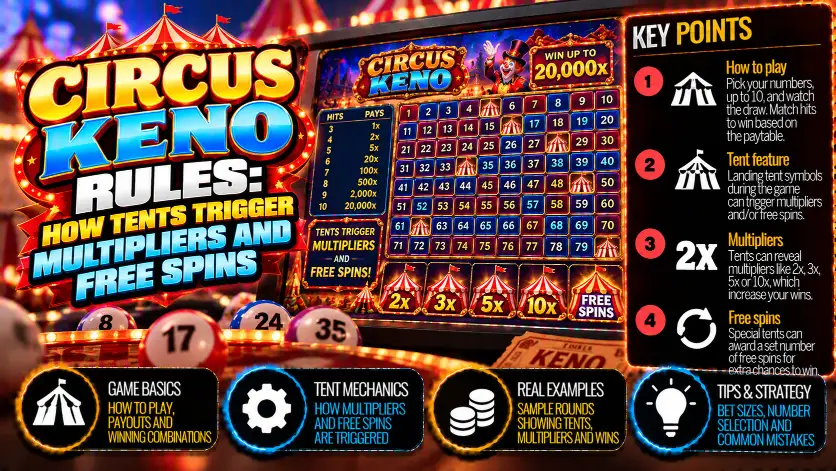
In Circus Keno you pick 2 to 10 numbers from 80, and the game places six tent markers on numbers you did not pick: two green, two purple and two blue. A pair of tents of one color gives a multiplier; two pairs, five tents or six tents give free spins. For 10 picks at a $2 stake, the Wizard of Odds pay table gives a theoretical return (RTP) of 96.01%: 0.425 from base payouts, 0.081 from multipliers and 0.454 from bonuses. We recalculated the base and multipliers ourselves and checked the bonus arithmetic against the same source's tables.
The example below is one pay table for a $2 stake; other machines can differ. Without multipliers, the return before bonuses would be 0.425 instead of 0.506.
How does a Circus Keno draw work?
You pick 2 to 10 numbers from 80, then 20 balls are drawn. The game randomly places six tent markers on numbers you did not pick: two green, two purple and two blue.
A tent marker is a colored symbol on a number. Catches—drawn numbers matching your picks—determine the base payout, while drawn numbers with tent markers determine multipliers and free-spin triggers. These rules, the tent combinations below and the pick-10 pay table come from Wizard of Odds, “Circus Keno”.
Circus Keno is a U1 Gaming game for multi-game machines. For the basic ticket structure and how pay tables depend on the game format, see how to play keno: ticket and paytable.
Which tent combinations give a multiplier?
A pair of tent markers of the same color gives a multiplier. Markers of the other colors raise it, as shown below.
| Tent markers drawn | Multiplier |
|---|---|
| One pair of the same color | 2x |
| One pair of the same color plus one marker of another color | 3x |
| One pair of the same color plus one marker of each of the other two colors | 4x |
A single marker does not form a pair. Two pairs trigger free spins and, by our calculation, add no multiplier; our totals match the Wizard of Odds figures, which supports this (see below).
Which combinations trigger free spins?
Two pairs give 4 free spins, five tent markers give 7, and all six give 20. Free spins keep the same stake and spot count as the triggering draw. Each free spin includes two spinner bonuses (extra balls, a multiplier or extra free spins) drawn from two tables; we took those distributions from Wizard of Odds rather than recreating them.
| Tent markers drawn | Free spins |
|---|---|
| Two pairs | 4 |
| Five markers | 7 |
| Six markers | 20 |
Diagram: which tent marker hits give a 2x, 3x or 4x multiplier and which give 4, 7 or 20 free spinsSame-color pairs give a multiplier; two pairs or more markers give free spins. Total return with 10 spots: 96.01% by the Wizard of Odds tables.
With 10 spots, our calculated trigger frequencies are 0.57% of rounds for 4 free spins, 0.31% for 7 free spins and 0.01% for 20 free spins.
What are the pay table and return with 10 spots?
Our base payout (0.425) and multiplier contribution (0.081) match the Wizard of Odds tables; before bonuses they give 0.506 of the stake. Adding the source's bonus figure (0.454) gives 0.960, or 96.01%.
If a machine had no multipliers, the return before bonuses would be just 0.425 instead of 0.506. The bonus component (0.454) is larger than the multiplier component and matters more for the total.
| Component | Calculated return | Rounded to 0.01 |
|---|---|---|
| Base payout | 0.425 of the stake | 0.43 of the stake |
| Multiplier contribution | 0.081 of the stake | 0.08 of the stake |
| Combined | 0.506 of the stake | 0.51 of the stake |
Our base calculation is 0.42526 against 0.425261 in the source; our multiplier contribution is 0.08118 against 0.081177. The match to six decimals means two pairs and five tents get no multiplier; if they did, the contribution would rise by about 0.001 of the stake.
The table below is the Wizard of Odds pay table for a $2 stake at 10 picks. Payouts are gross multiples of the stake: 1 means the stake comes back with no profit; 0 means it is lost.
| Catches | Gross payout, multiple of stake |
|---|---|
| 10 | 10000 |
| 9 | 2000 |
| 8 | 178.5 |
| 7 | 35.5 |
| 6 | 7 |
| 5 | 2 |
| 4 | 1 |
| 3–0 | 0 |
A long-run return says nothing about the result of any single draw. Compare variants using their own pay tables, as explained in video keno paytables.
How often do tents, multipliers and free spins occur?
Our calculation gives at least one multiplier in 16.2% of rounds and at least one free-spin trigger in 0.89% of rounds with 10 spots. The table shows the corresponding frequencies for every available spot count.
| Spots | At least one multiplier | At least one free-spin trigger | At least one tent marker drawn |
|---|---|---|---|
| 2 | 19.6% | 1.38% | 87.1% |
| 3 | 19.2% | 1.31% | 86.6% |
| 4 | 18.8% | 1.24% | 86.2% |
| 5 | 18.3% | 1.18% | 85.8% |
| 6 | 17.9% | 1.12% | 85.3% |
| 7 | 17.5% | 1.06% | 84.8% |
| 8 | 17.1% | 1.00% | 84.3% |
| 9 | 16.7% | 0.95% | 83.8% |
| 10 | 16.2% | 0.89% | 83.3% |
Drawing at least one tent marker does not necessarily give a multiplier or trigger free spins: those require specific color combinations.
What have we not verified?
We checked the bonus component arithmetically: the Wizard of Odds average win per bonus, weighted by the tent-pattern frequencies on the same page, gives 0.454, which matches its summary. The per-spin spinner distributions come from that source and we did not verify them independently.
The source adds a separate random bonus worth about 0.5025% of the return but does not analyze it; we left it out. We also assume tent placement is uniform and independent of the drawn numbers, which the source does not state explicitly.
Pay tables can differ between versions, and Wizard of Odds explicitly states that the pay table depends on the stake. Check your machine’s rules before applying this example.
How can you check the calculation yourself?
Start with your machine’s pay table, calculate the base catch probabilities, then account for tent markers and multipliers separately. Free-spin frequency alone is not enough to calculate the bonus return.
- Find the pay table in the machine’s rules. Record the stake, spot count and payout for each catch count. Do not use the example table if your machine shows different values.
- Calculate the base probabilities using combinations. For each catch count, count the ways to draw matching numbers from your picks and the remaining drawn numbers from those you did not pick. This is a hypergeometric calculation; 7-spot keno odds illustrates it for a fixed spot count.
- Check the base probabilities separately. The keno odds calculator handles standard 80-number, 20-ball keno with your own pay table. It can check catch probabilities, but it does not model Circus Keno tent markers or bonuses.
- Account for multipliers separately. For each tent combination, apply the relevant multiplier rule to the base payout. Check whether multipliers are available and how two pairs are treated.
- Do not treat trigger frequency as the free-spin return. The bonus component depends on payouts during free spins, which follow the spinner tables; check those against your machine's rules.
Frequently Asked Questions
No. Tent markers are placed randomly after your picks, on numbers you did not pick. Which numbers you choose does not change the odds.
They require specific tent combinations. With 10 spots, our calculation gives at least one free-spin trigger in about 0.89% of rounds.
No. Wizard of Odds says the pay table depends on the stake amount; check your machine’s pay table.
Evgeniy Volkov
Verified ExpertFullstack developer with a background in mathematics. I build the calculators and game-style tools on ToolsGambling with Pixi.js and modern web tech, and every result uses transparent probability formulas you can verify yourself.