












Contents
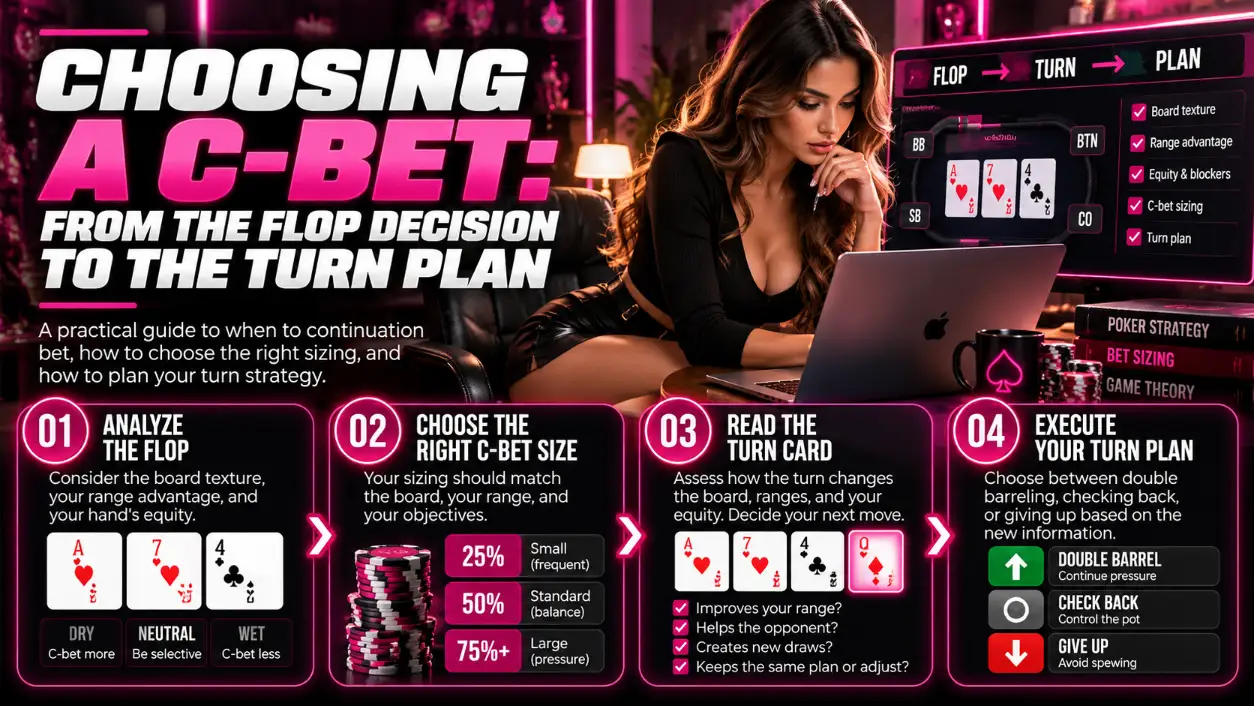
A continuation bet, or c-bet, is a flop bet made by the last preflop aggressor. Do not bet automatically: bet for a clear purpose, such as getting calls from weaker hands or taking down the pot when your opponent folds. Whether to check or bet—and how much to bet—depends on the board, ranges, position, and stacks. There is no universal sizing.
A range is a set of possible hands, not one known hand. Before betting, compare your possible strong hands and bluffs with the hands your opponent could still hold. Then consider which hands will respond to your chosen size and what you will do on the next card.
The Hand: Who Acts and How Much Is in the Pot?
The button faces the flop decision: they were the last preflop aggressor and are in position against the big blind.
Our example is a six-max no-limit hold’em cash game. Here, bb means one big blind. There is no ante or rake.
- The small blind (SB) posts 0.5 bb, and the big blind (BB) posts 1 bb.
- The button (BTN) and BB each start the hand with 100 bb.
- BTN holds Q♠J♠ and opens to 2.5 bb.
- SB folds, leaving 0.5 bb in the pot.
- BB calls to 2.5 bb, adding 1.5 bb.
- The flop is K♠7♦2♣. BB checks.
The pot before BTN’s decision is P = 0.5 + 2.5 + 2.5 = 5.5 bb. Each player has 97.5 bb remaining. That is the effective stack on the flop: in a heads-up pot, it is limited by the smaller available stack. The original 100 bb refers to the start of the hand, not the amount left after preflop.
BTN’s possible hands include Kx, overpairs, broadway hands, and hands that missed. BB can have Kx, 7x, 77 and 22, low pocket pairs, and unpaired hands. These are illustrative hand classes, not exact ranges with specified frequencies. For a refresher on positions, see the six-max cash game basics. To build starting ranges, use the preflop range charts, but assess the flop decision separately.
Teaching diagram showing BTN opening Q♠J♠ to 2.5 bb and BB calling, with flop K♠7♦2♣, a 5.5 bb pot, and a 97.5 bb effective stackTeaching diagram with no ante or rake: the flop pot is 5.5 bb and the effective stack is 97.5 bb. This is an illustration, not an actual game screenshot or a solver result.
When Should You Check or Bet?
Check when an immediate bet offers insufficient benefit; bet when you can explain which responses make it worthwhile. Being the preflop raiser alone does not decide the action.
With Q♠J♠ on K♠7♦2♣, you have no made pair. Before betting, ask three questions:
- Which weaker hands might call?
- Which hands might your opponent fold, and how valuable would those folds be?
- Which turn cards would support continuing, and which would require a new plan?
Checking costs nothing now and does not make your opponent fold. Because BB has already checked, checking back ends the flop betting round and lets you see the turn. Checking does not mean giving up on the pot: you retain the option to act later.
Betting can gain value over checking by making your opponent fold a hand with meaningful equity or future bluffing opportunities, but it requires committing chips. A larger bet risks more and changes BB’s call price. Their response can also change—you cannot assume they react identically to every size.
Check, 1.8 bb, or 3.7 bb: Comparing the Numbers
In this hand, the smaller bet needs fewer folds to break even as a pure bluff, while the larger bet raises the call price. This is an arithmetic comparison, not a recommendation for the optimal action with Q♠J♠.
The table assumes BB calls without raising. For a check, it shows the pot after flop betting ends.
| BTN action | Chips committed now | Percentage of pot | BB’s required equity to call | Pure-bluff fold threshold | Turn pot | Remaining effective stack |
|---|---|---|---|---|---|---|
| Check | 0 bb | — | — | — | 5.5 bb | 97.5 bb |
| Bet 1.8 bb | 1.8 bb | 32.7% | 19.8% | 24.7% | 9.1 bb | 95.7 bb |
| Bet 3.7 bb | 3.7 bb | 67.3% | 28.7% | 40.2% | 12.9 bb | 93.8 bb |
Percentages are rounded to one decimal place. All amounts assume no ante or rake.
BB’s Call Price
The call price tells you how much equity BB needs for a break-even call in a simplified one-street model. Equity here means the expected share of the pot at showdown; it does not include the benefit of making an opponent fold.
If P is the pot before the bet and B is the bet size, required equity is B / (P + 2B). This call-price calculation covers a single street and assumes no further betting:
- Facing 1.8 bb: 1.8 / 9.1 = 19.8%.
- Facing 3.7 bb: 3.7 / 12.9 = 28.7%.
This is an equity requirement, not BB’s actual hand equity. Estimating actual equity requires a separate hand-versus-range assessment. For more on the caller’s perspective, see pot odds and implied odds.
The Pure-Bluff Fold Threshold
The pure-bluff threshold tells you how often an opponent must fold for a zero-equity bet to break even in a simplified model. It does not tell you how often BB will actually fold.
The formula is B / (P + B). It assumes heads-up play, zero equity when called, and no later-street value. The result is the break-even bluff threshold, not your opponent’s actual fold frequency.
- For 1.8 bb: 1.8 / 7.3 = 24.7%.
- For 3.7 bb: 3.7 / 9.2 = 40.2%.
For illustration, assume BB folds 30% of the time against each size, and the bettor has zero equity when called. The bet’s expected value is then:
- 1.8 bb: 0.30 × 5.5 − 0.70 × 1.8 = +0.39 bb.
- 3.7 bb: 0.30 × 5.5 − 0.70 × 3.7 = −0.94 bb.
The identical 30% responses are a toy assumption. In real play, an opponent’s response is unlikely to remain identical as the size changes. Q♠J♠ also has equity and future options, so these results cannot select the optimal action for our hand.
What Should You Plan on the Turn After a Call?
After a call, reassess the new card, BB’s range, and the pot size; a second barrel is not mandatory. A second barrel is a turn bet following a flop bet.
Compare two possible turns:
- T♠ turn: Q♠J♠ gains a flush draw and an open-ended straight draw: an ace or a nine completes a straight. This gives the hand more possibilities, but it neither guarantees a win nor dictates a bet.
- 4♥ turn: Those draws do not appear. You need to reassess the reasons for betting rather than carry the flop plan forward automatically.
After a call of 1.8 bb, the pot is 9.1 bb and the remaining effective stack is 95.7 bb. After a call of 3.7 bb, those amounts are 12.9 bb and 93.8 bb. Your next decision must account for these updated amounts.
How Do Board Texture and Game Conditions Change the Decision?
Carry over the reasoning, not a specific bet size. Board texture—the combination of community cards and the possibilities they create—changes how the ranges interact.
K♠7♦2♣ is rainbow and disconnected. More connected boards offer more straight possibilities; a monotone flop has three cards of the same suit. However, a draw-heavy board does not automatically require a large bet. GTO Wizard’s discussion of c-bet sizing shows how sizing varies with the specific board texture and why even draw-heavy flops do not always call for a large bet.
These situations require separate analysis:
- Out of position: You must act before your opponent.
- Multiway pots: You need to assess possible responses from multiple ranges.
- 3-bet pots: The ranges and the relationship between pot size and stacks differ.
- Tournament stacks and games with rake: The assumptions in our example no longer match the playing conditions.
None of these situations establishes a universal c-bet frequency or mandatory size.
How to Repeat the Calculation in ToolsGambling
In the pot odds calculator, enter the pot before the bet and the amount the opponent must call. To compare our two sizes, change only the second field.
- Enter 5.5 in the pot-size field, labeled “Pot size (before bet)” / “Current pot size.”
- Enter 1.8 in the “Bet to call” field.
- Compare the results: required equity 19.8%, pure-bluff success threshold 24.7%, and pot after call 9.1.
- Replace the bet with 3.7, keeping the prebet pot at 5.5.
- The corresponding results are 28.7%, 40.2%, and a pot after call of 12.9.
The fixed $ glyph in the interface is display formatting only. Here, you are entering values in bb: there is no currency conversion, and the figures do not represent a dollar pot.
ToolsGambling local preview comparing a 5.5 bb pot with bets of 1.8 and 3.7 bb, required equity of 19.8% and 28.7%, and pure-bluff thresholds of 24.7% and 40.2%Composite of unchanged crops from the ToolsGambling local preview captured on October 16, 2026, not a live casino hand. The $ glyph is interface formatting; the entered values represent bb.
The calculator checks the arithmetic. It cannot estimate an opponent’s range, their actual fold frequency, or the best c-bet action. The practical sequence remains: decide what a bet is meant to achieve, compare its cost with checking, and plan what happens after a call.
Frequently Asked Questions
The break-even fold threshold for a pure bluff is a calculated boundary under stated assumptions, not a prediction of an opponent's behavior. Estimating their actual fold frequency requires separate data.
No. Checking completed your flop decision; a turn bet belongs to the next betting round. Assess it using the new card, the opponent's range, and the current pot.
Evgeniy Volkov
Verified ExpertFullstack developer with a background in mathematics. I build the calculators and game-style tools on ToolsGambling with Pixi.js and modern web tech, and every result uses transparent probability formulas you can verify yourself.