












Contents
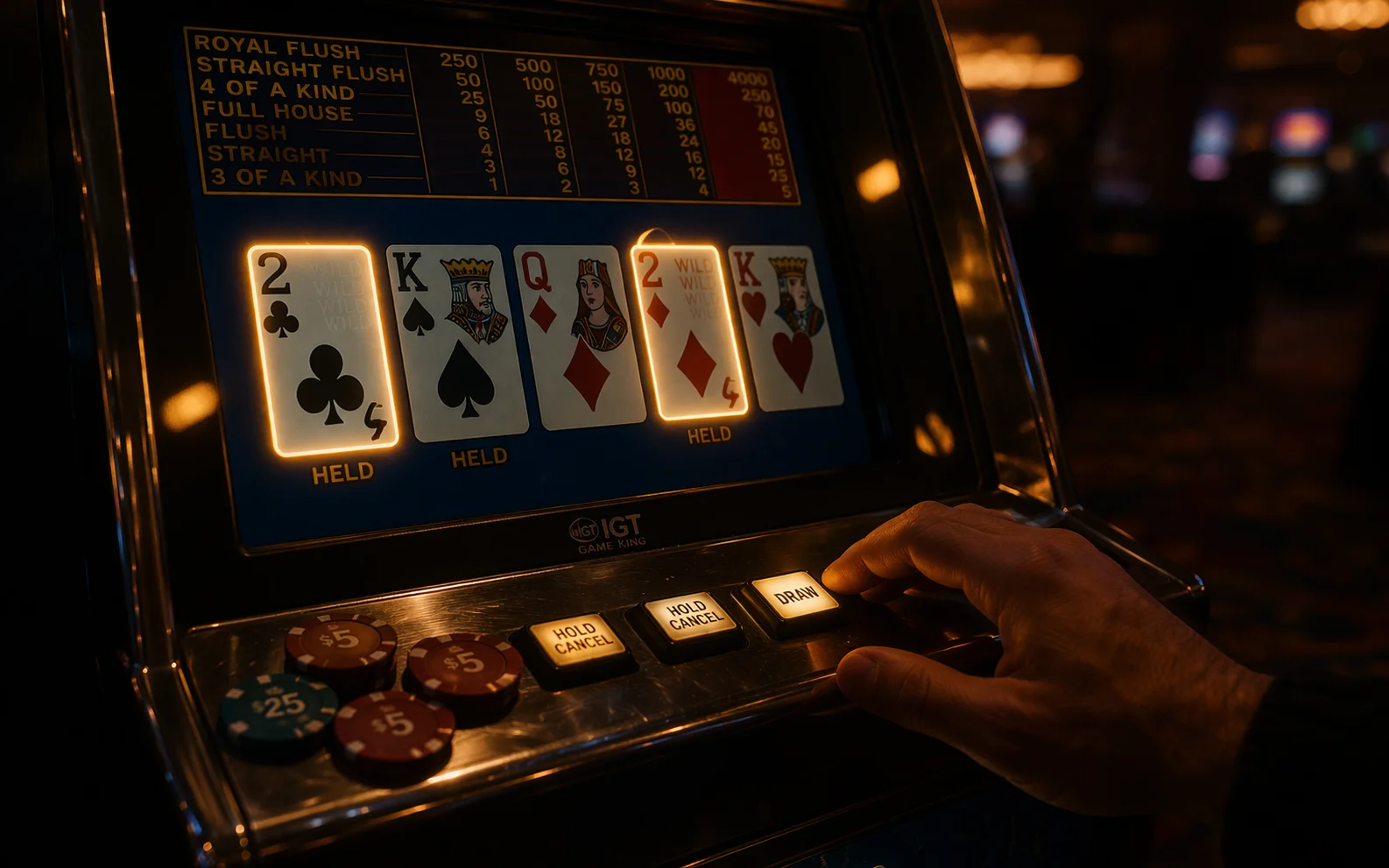
Picture this: you sit down at a video poker machine, feed in a twenty, and notice the game says "Deuces Wild" across the top. You get dealt K♠ 7♦ 2♥ 9♣ 2♠. Two deuces staring right at you. Your instinct from Jacks or Better screams "hold the deuces and the king." But in Deuces Wild, that king is worthless dead weight, and keeping it just cost you money.
Deuces Wild is the only widely available video poker game where the math actually favors the player. Full pay machines return 100.76% with optimal strategy, that's a 0.76% edge in your pocket. No card counting, no team play, no heat from the pit boss. Just you, a pay table, and 40 rules that separate winners from everyone else.
The problem? Most Deuces Wild strategy guides online are either 800-word summaries that skip the critical details, or they cover only the full pay variant that barely exists anymore. In 2026, you're far more likely to encounter Not So Ugly Deuces, Illinois Deuces, or a short-pay machine designed to drain your bankroll. You need a strategy that handles all of them.
In the next 18 minutes, you'll get the complete strategy for every variant, an interactive tool to check any hand, and the three mistakes that cost casual players 1-2% of their total return. Let's get into it.
TL;DR, Deuces Wild Quick Strategy
Key Numbers You Need to Know
| Metric | Value |
|---|---|
| Full Pay RTP | 100.76% (player advantage!) |
| NSUD RTP | 99.73% (0.27% house edge) |
| Minimum Paying Hand | Three of a Kind |
| Wild Cards | All four 2s |
| Strategy Rules (Optimal) | ~40 decisions |
| Strategy Rules (Simple) | ~20 decisions |
| Variance | 25.8 (moderate) |
| Best Machine Identifier | 4-of-a-Kind pays 5-for-1 |
The 5-Second Decision Tree
Here's the cheat sheet version. Count your deuces, then follow the top priority:
| Deuces | #1 Priority | #2 Priority | Default |
|---|---|---|---|
| 4 | Hold all four deuces (1000 coins!) | , | , |
| 3 | Hold all three + wild royal cards | Hold three deuces only | Never split |
| 2 | Hold two + wild royal / five-of-a-kind | Hold two deuces only | Draw three |
| 1 | Hold deuce + made hand | Hold deuce + strong draw | Hold deuce, draw four |
| 0 | Natural royal / straight flush | Four to royal > full house | See full table below |
That "0 deuces" row is where 90% of the strategy complexity lives. The other four rows are almost automatic. Master the zero-deuces decisions, and you've essentially cracked the game.
How Deuces Wild Works (And Why It Breaks Normal Strategy)
If you've played any standard video poker, Jacks or Better, Double Bonus, even Triple Double Bonus, Deuces Wild will feel familiar for about 30 seconds. Then it starts breaking every rule you know.
Hand Rankings in Deuces Wild vs Standard Poker
The pay table looks nothing like what you're used to:
| Hand | Full Pay Payout (per coin) | Jacks or Better Equivalent |
|---|---|---|
| Natural Royal Flush | 250 | 250 (same) |
| Four Deuces | 200 | , (doesn't exist) |
| Wild Royal Flush | 25 | , |
| Five of a Kind | 15 | , (doesn't exist) |
| Straight Flush | 9 | 50 |
| Four of a Kind | 5 | 25 |
| Full House | 3 | 9 |
| Flush | 2 | 6 |
| Straight | 2 | 4 |
| Three of a Kind | 1 | 3 |
Notice anything? Full house pays just 3-for-1 instead of 9. Flush pays 2 instead of 6. These dramatic reductions fund the wild card payouts, four deuces at 200 coins and five of a kind at 15 (a hand that doesn't even exist in standard poker).
Why Natural Royal Beats Wild Royal
A natural royal flush (no deuces involved) pays 250 coins per coin bet. A wild royal, same hand but with one or more deuces substituting, pays only 25 coins. That's a 10x difference, and it changes everything about how you play draws.
When you're holding three to a natural royal (say A♠ K♠ Q♠ plus two random cards), the EV of drawing two cards is significantly higher than if one of those royals were a deuce. This is why the strategy separates "natural" draws from "wild" draws at every level.
The "Minimum Hand" Misconception
In Jacks or Better, a pair of jacks is money. In Deuces Wild, even two pair pays nothing. The minimum paying hand is three of a kind at 1-for-1 (you get your bet back). This fundamentally changes hand evaluation, a pair of kings isn't a "paying hand you should protect." It's a draw that needs improvement to have any value at all.
This single difference is why Jacks or Better strategies will absolutely wreck your bankroll in Deuces Wild. The games share a deck, but they share almost nothing strategically.
Complete Pay Table Comparison (2026)
Not all Deuces Wild machines are created equal. The difference between the best and worst pay tables is nearly 6%, that's the gap between a player advantage and a house edge bigger than most slot machines.
Full Pay Deuces Wild (100.76% RTP)
The holy grail. Full Pay Deuces Wild is one of exactly two common video poker games where the player has a mathematical edge (the other is full pay Dream Card Deuces Wild at 100.97%).
| Hand | Full Pay Payout |
|---|---|
| Natural Royal | 250 |
| Four Deuces | 200 |
| Wild Royal | 25 |
| Five of a Kind | 15 |
| Straight Flush | 9 |
| Four of a Kind | 5 |
| Full House | 3 |
| Flush | 2 |
| Straight | 2 |
| Three of a Kind | 1 |
The identifying marks: 5-for-1 on four of a kind and 9-for-1 on straight flush. If either number is lower, you're not on full pay. Use the RTP calculator to check the exact return of any pay table you encounter.
Not So Ugly Deuces (NSUD), 99.73%
NSUD is the most realistic "good" Deuces Wild game you'll actually find in 2026. The name comes from the video poker community's habit of rating machines by attractiveness, "ugly" means bad pay table, and this one is "not so ugly."
| Hand | NSUD Payout | vs Full Pay |
|---|---|---|
| Four of a Kind | 4 | -1 |
| Full House | 4 | +1 |
| Everything else | Same | Same |
The trade: you lose 1 coin on quads but gain 1 on full houses. Net effect: -1.03% RTP. Still excellent at 99.73%, that's a house edge of just 0.27%, comparable to the best blackjack tables with perfect basic strategy.
Illinois Deuces & Other Short-Pay Variants
Here's where most players lose without realizing it. These variants look similar on the surface but hemorrhage value:
| Variant | Key Payout Changes | RTP | House Edge |
|---|---|---|---|
| Illinois Deuces | 4-of-Kind: 4, SF: 6, FH: 3 | 98.91% | 1.09% |
| Colorado Deuces | 4-of-Kind: 4, SF: 8, FH: 3 | 98.45% | 1.55% |
| Airport Deuces | 4-of-Kind: 4, SF: 6, FH: 2 | 97.58% | 2.42% |
| Short Pay | 4-of-Kind: 4, SF: 9, FH: 3, Fl: 2 | 94.82% | 5.18% |
That "Airport Deuces" name isn't a joke, airports, cruise ships, and tourist-trap casinos love short-pay machines because players don't check the pay table. Always look before you play.
How to Identify Your Machine's Pay Table in 10 Seconds
Quick identification method:
- Check Four of a Kind: If it pays 5-for-1 → possible Full Pay. If 4-for-1 → some variant of short pay.
- Check Straight Flush: 9-for-1 = Full Pay or Short Pay. 8-for-1 = Colorado. 6-for-1 = Illinois or Airport.
- Check Full House: 4-for-1 = NSUD. 3-for-1 = Full Pay, Illinois, or Airport. 2-for-1 = the worst variant.
Use the house edge calculator to plug in any pay table and get the exact RTP before you start playing.
| Paytable Variant | Return to Player (%) |
|---|---|
| Full Pay (25/15/9/5/3) | 100.76 |
| NSUD (25/15/9/4/4) | 99.73 |
| Illinois (16/13/4/3/2) | 98.91 |
| Colorado Deuces | 98.45 |
| Airport Deuces | 97.58 |
| Short Pay (25/15/9/4/3) | 94.82 |
Optimal Strategy by Number of Deuces
This is the core of the article, and the core of the game. Every hand in Deuces Wild starts with one question: how many deuces do I have? The answer determines which strategy table to use.
The strategy works as a priority list: start at the top, find the first rule that matches your hand, and follow it. Skip everything below it. If nothing matches, you hit the default at the bottom.
0 Deuces: The 13-Priority Hierarchy
No deuces is the most common scenario (~67% of hands) and the most complex to play correctly. Here's the complete priority list for Full Pay:
| Priority | If You Have... | Action |
|---|---|---|
| 1 | Natural Royal Flush | Hold all 5 |
| 2 | Four to Natural Royal | Hold 4, draw 1 |
| 3 | Straight Flush (made) | Hold all 5 |
| 4 | Four of a Kind | Hold all 5 |
| 5 | Full House | Hold all 5 |
| 6 | Three to Natural Royal | Hold 3, draw 2 |
| 7 | Flush | Hold all 5 |
| 8 | Straight | Hold all 5 |
| 9 | Four to Straight Flush | Hold 4, draw 1 |
| 10 | Three of a Kind | Hold 3, draw 2 |
| 11 | Four to Flush | Hold 4, draw 1 |
| 12 | Pair | Hold 2, draw 3 |
| 13 | Four to Straight | Hold 4, draw 1 |
| , | Nothing matches | Discard all 5 |
The big surprise: three to a natural royal (Priority 6) beats a flush (Priority 7) and a straight (Priority 8). That means if you hold A♠ K♠ J♠ 8♠ 3♠, a made flush, you should break it to draw two cards to the royal. The expected value of the royal draw is higher than the guaranteed 2-coin flush payout.
When to Break a Paying Hand (And When Not To)
This is the most counterintuitive part of Deuces Wild strategy and the part that separates experts from amateurs:
Break it:
- Flush → three to a natural royal (EV: ~3.2 vs 2.0)
- Straight → three to a natural royal (EV: ~3.2 vs 2.0)
- Full House → NEVER break a full house with 0 deuces
Don't break it:
- Four of a kind → always hold (EV: 5.0)
- Straight Flush → always hold (EV: 9.0)
- Full House → always hold (EV: 3.0), it's Priority 5 for a reason
The key insight: breaking a paying hand is only correct when the draw target pays significantly more AND you have enough outs. Three to a royal meets both criteria. Two to a royal does not.
1 Deuce: Wildcards Change Everything
One deuce shows up in about 24% of hands. Strategy simplifies considerably because the deuce guarantees at least a high pair:
| Priority | If You Have... | Action |
|---|---|---|
| 1 | Wild Royal Flush | Hold all 5 |
| 2 | Five of a Kind | Hold all 5 |
| 3 | Straight Flush (made) | Hold all 5 |
| 4 | Four of a Kind | Hold all 5 |
| 5 | Four to Wild Royal | Hold 4, draw 1 |
| 6 | Full House | Hold all 5 |
| 7 | Four to Straight Flush | Hold 4, draw 1 |
| 8 | Three of a Kind | Hold 3, draw 2 |
| 9 | Three to Wild Royal | Hold 3, draw 2 |
| , | Nothing matches | Hold deuce only, draw 4 |
The default says it all: if nothing on the priority list matches, just hold the lone deuce and draw four new cards. That single deuce has an EV of ~4.55 coins per 5-coin bet, better than holding any random pair or incomplete draw alongside it.
2 Deuces: Guaranteed Three of a Kind
Two deuces (~8% of hands). You're already guaranteed at least three of a kind, which pays 1-for-1. Strategy is short:
| Priority | If You Have... | Action |
|---|---|---|
| 1 | Wild Royal Flush | Hold all 5 |
| 2 | Five of a Kind | Hold all 5 |
| 3 | Straight Flush (made) | Hold all 5 |
| 4 | Four of a Kind | Hold all 5 |
| 5 | Four to Wild Royal | Hold 4, draw 1 |
| , | Nothing matches | Hold both deuces only, draw 3 |
With two deuces, the default EV is ~10.30 coins. That's better than holding three of a kind (EV: ~5.00) or even a made straight (2 coins). Always default to holding just the two deuces unless you have one of the top 5 priorities.
3 Deuces: Hold Tight, You Already Won
Three deuces (~1% of hands). You're guaranteed a minimum of four of a kind (25 coins). Strategy is trivially simple:
| Priority | If You Have... | Action |
|---|---|---|
| 1 | Wild Royal Flush | Hold all 5 |
| 2 | Five of a Kind | Hold all 5 |
| , | Nothing matches | Hold all three deuces, draw 2 |
That's it. Three rules. Hold three deuces and draw two unless you already have a wild royal or five of a kind. Don't get cute, the EV of holding three deuces alone (~27.0 coins) crushes everything except those two completed hands.
4 Deuces: Jackpot, Just Hold Everything
Four deuces appear roughly once every 4,900 hands, roughly every 8 hours of play. When it happens:
Hold all four deuces. Period. Four deuces pays 200 coins per coin bet (1,000 on max bet). There is no draw in the game that can improve on this. The fifth card is irrelevant.
This is the second-highest paying hand after the natural royal flush. At $1.25 per hand (quarter machine, max bet), four deuces is a $250 payout. At $5 per hand, it's $1,000, often enough to trigger a hand pay at many casinos.
Simple vs Intermediate vs Optimal Strategy
Not everyone wants to memorize 40+ rules. Here's how the three strategy levels compare and when each makes sense.
Simple Strategy (~99.5% Return)
Simple strategy condenses the game into roughly 20 rules by grouping similar hands. Key simplifications:
- Treat all "four to a straight flush" hands the same (optimal differentiates by gaps)
- Ignore some marginal three-to-a-royal situations
- Simplified 0-deuce hierarchy (13 levels instead of the full 22)
Cost: ~1.26% lower return than optimal. At $1.25/hand and 600 hands/hour, that's roughly $9.50/hour in expected loss compared to a slight profit with optimal play.
Best for: Casual players, beginners, anyone who plays less than 2 hours per session. The mental energy saved may be worth more than the mathematical cost.
Intermediate Strategy (~100.3% Return)
Intermediate adds ~10 additional rules to the simple version, mostly around 0-deuce scenarios:
- Differentiate between open-ended and inside straight flush draws
- Include three-to-a-royal-flush with specific gap patterns
- Break certain flushes for royal draws (the counterintuitive play mentioned earlier)
Cost: ~0.46% lower than optimal, but you're already in positive EV territory. At 600 hands/hour on a quarter machine, you're earning roughly $2.25/hour instead of $5.70/hour.
Best for: Regular players who visit weekly and want positive EV without memorizing every edge case.
Full Optimal Strategy (100.76% Return)
The complete strategy covers ~40 distinct decision points. The extra rules compared to intermediate involve:
- Exact straight flush draw priorities (with 0, 1, or 2 gaps)
- Rare three-to-a-royal scenarios where suit matters
- Specific "four to a straight" distinctions based on high cards
In simple words: for every $100 you put through the machine with optimal play on full pay, you get back $100.76 on average. Over thousands of hands, that edge adds up.
Is the Extra 0.4% Worth Memorizing 40+ Rules?
Let's do the math. If you play 600 hands/hour at $1.25/hand:
| Strategy | Return | Hourly EV |
|---|---|---|
| Simple | 99.50% | -$3.75 |
| Intermediate | 100.30% | +$2.25 |
| Optimal | 100.76% | +$5.70 |
The jump from simple to intermediate is worth $6.00/hour. The jump from intermediate to optimal adds $3.45/hour. For most recreational players, intermediate is the sweet spot, you're making money and the rules are manageable.
For serious grinders who play 20+ hours per week, the kind of players who also study PFR stats in live poker, optimal is non-negotiable. That extra 0.46% translates to $69/week at quarter denomination and $276/week at dollar denomination.
Interactive Strategy Checker
Test any hand against optimal Full Pay Deuces Wild strategy. Select your five cards and see exactly what to hold, what to discard, and why.
Use this tool to drill the counterintuitive plays, especially the 0-deuce scenarios where breaking a flush for a royal draw goes against every instinct from standard poker. After 50-100 hands of practice, the correct plays start feeling natural.
Common Mistakes That Kill Your RTP
These three errors account for the majority of the gap between average players and optimal strategy. Fix these alone and you'll recover most of the EV you're leaving on the table.
Mistake #1: Holding a Kicker with Three of a Kind
In Triple Double Bonus, holding a kicker with three Aces is a brilliant play. In Deuces Wild, it's pure poison.
Why it's wrong: Deuces Wild has zero kicker bonuses. Four of a kind pays the same 5-for-1 regardless of what the fifth card is. By holding an extra card, you reduce your draw from 2 cards to 1, cutting your chance of hitting four of a kind (or better) roughly in half.
Example: You hold 2♥ 7♦ 7♣ 7♠ J♠. Wrong play: hold all four non-deuces. Right play: hold only the three 7s and draw two. The J♠ adds nothing, dump it.
Mistake #2: Breaking a Straight to Chase a Flush
With 0 deuces, a made straight pays 2 coins. A four-to-a-flush draw has an EV of only about 1.2 coins. Breaking a guaranteed 2-coin payout for a 1.2-coin draw is throwing money away.
The exception: Breaking a straight IS correct if you have three to a natural royal flush. That draw's EV (~3.2) beats the straight's guaranteed 2.0. But four to a flush? Never worth it.
Mistake #3: Keeping a Single Ace (It's Not Jacks or Better)
This is the #1 Jacks-or-Better habit that bleeds into Deuces Wild. In JoB, a single ace is valuable because a pair of aces pays 1-for-1. In Deuces Wild, a pair of aces pays nothing. Zero. Nada.
Correct play with 0 deuces and no draws: Discard all five cards. A fresh five-card draw (EV: ~1.78) beats holding a single ace (EV: ~1.50) every time. This feels terrible, but the math doesn't care about feelings.
The only time a high card matters is when it's part of a draw: A♠ K♠ Q♠ (three to a royal) or A♠ K♠ Q♠ J♠ (four to a royal). On its own, that ace is just another card in the deck.
Deuces Wild vs Jacks or Better: Which Should You Play?
This is one of the most common questions from video poker players, and the answer depends on what you're optimizing for.
Side-by-Side Comparison
| Metric | Deuces Wild (Full Pay) | Jacks or Better (9/6) |
|---|---|---|
| RTP | 100.76% | 99.54% |
| House Edge | -0.76% (player edge!) | 0.46% |
| Min Paying Hand | Three of a Kind | Pair of Jacks |
| Strategy Rules | ~40 | ~32 |
| Variance | 25.8 | 19.5 |
| Hit Frequency | ~44% | ~45% |
| Royal Flush Frequency | 1 in 49,000 | 1 in 40,000 |
| Availability (2026) | Rare | Common |
When Deuces Wild Is Objectively Better
Deuces Wild wins when:
- You want positive EV. It's the only standard video poker game where perfect play produces a mathematical edge. Blackjack card counting can do this too, but with far more heat and effort.
- You can find full pay or NSUD. If you can only find Illinois Deuces (98.91%), Jacks or Better at 9/6 (99.54%) is actually the better game.
- You handle variance. Deuces Wild pays nothing on two pair, which means longer losing streaks between wins. Your bankroll needs to absorb that volatility.
Jacks or Better wins when:
- You want lower variance and more frequent small wins
- You're on a short session with limited bankroll
- The only Deuces Wild machines available are short-pay
If you can find Full Pay or NSUD Deuces Wild and you know the strategy, it's the superior game. Period. For everything else, solid Jacks or Better play is the safer choice.
Bankroll & Session Management for Deuces Wild
Even with a positive expected return, you need enough bankroll to survive the variance. Deuces Wild's moderate volatility (25.8) means significant session-to-session swings.
Recommended Bankroll by Denomination
| Denomination | Max Bet | Session (2 hrs) | Trip (8 hrs) |
|---|---|---|---|
| $0.05 | $0.25 | $100 | $300 |
| $0.25 | $1.25 | $400 | $1,200 |
| $0.50 | $2.50 | $750 | $2,400 |
| $1.00 | $5.00 | $1,500 | $5,000 |
These numbers assume a 5% risk of ruin (meaning 95% confidence you won't bust your session bankroll). For a more conservative 1% risk of ruin, multiply by 1.5x. Check the exact numbers for your situation with the poker variance simulator.
Variance Reality Check
On Full Pay with optimal strategy, you have a positive edge, but the edge is tiny. Here's what that looks like in practice:
- Per hour (600 hands at $1.25): Expected profit of $5.70, with a standard deviation of ~$62
- Per session (2 hours): Expected profit of $11.40, with swings of ±$88
- Per trip (8 hours): Expected profit of $45.60, with swings of ±$175
That means even on full pay with perfect strategy, you'll have losing sessions roughly 45% of the time. The edge only becomes reliably visible over hundreds of hours. This is why bankroll management matters even when the math is on your side, and why the how to grow a small bankroll approach requires patience above all.
If variance makes you uncomfortable, check your comfort level with the blackjack strategy flashcards approach: learn the decisions cold first, then add real money gradually. The same principle applies to Deuces Wild, drill the strategy checker tool above until the plays are automatic, then hit the machines.
New to optimal play? Start with our video poker calculator and Jacks or Better trainer to build the habit of always knowing your best hold.
Frequently Asked Questions
Use the 0-4 deuces priority system. With no deuces, prioritize natural royals and four-to-a-royal draws. With one deuce, hold it plus any made hand. With 2+, hold all deuces. Full Pay returns 100.76% with optimal play — one of the only positive-EV casino games.
Full pay Deuces Wild returns 100.76% with optimal strategy, making it one of the only video poker games with a positive player expectation. Full Pay pays 25-for-1 on four deuces, 15-for-1 on wild royal, 9-for-1 on five of a kind.
Deuces Wild has a higher RTP (100.76% vs 99.54%) but requires completely different strategy. The tradeoffs: higher variance, more complex decisions, and the minimum paying hand is three of a kind instead of a pair of jacks.
Top priorities with 0 deuces: natural royal flush, four to a natural royal, any made straight flush or better, three to a natural royal, full house, flush, straight. Never hold a single high card — unlike Jacks or Better, lone aces and kings have no special value.
Extremely rare. Found primarily in select Las Vegas locals casinos (Station Casinos, Boyd Gaming), some downtown properties, and a handful of tribal casinos. Online, check regulated sites in NJ, PA, MI, and WV for IGT and Microgaming versions.
Not So Ugly Deuces is a Deuces Wild variant returning 99.73% with optimal play. Pay table: 25/15/9/4/4. More common than full pay and still an excellent game — only 0.27% house edge.
Always hold the deuce. A single deuce has an EV of about 4.55 coins per 5-coin bet. Discarding all five with one deuce is a major mistake costing approximately $0.50 per hand at quarter denomination.
On full pay: negative 0.76% (player advantage). On NSUD: 0.27%. On Illinois Deuces: 1.09%. On short pay: 5.18%. The spread between best and worst pay tables is nearly 6%.
Not practically. Single-hand video poker deals from a fresh virtual 52-card deck every hand. Multi-hand variants use a shared deck but the advantage from tracking is negligible — under 0.01%.
For $0.25 denomination (5 coins = $1.25 per hand): minimum $400 for a 2-hour session. For $1 denomination: at least $1,500. Deuces Wild variance is moderate (~25.8), lower than Triple Double Bonus but higher than Jacks or Better.
Simple strategy covers about 20 rules and returns ~99.5%. Optimal strategy has 40+ rules and returns 100.76%. The 1.26% gap translates to about $15 per 1,000 hands at $1.25 per hand.
Unlike bonus poker variants, Deuces Wild has no kicker bonuses. Holding an extra card with three of a kind reduces your draw from 2 cards to 1, cutting your chances of improvement roughly in half for zero additional payout.
The three costliest errors: holding a single high card (Jacks or Better habit), keeping a kicker with three of a kind, and breaking a paying straight to chase a flush. Combined, these mistakes cost 1-2% of total return.
Check the Four of a Kind payout: Full Pay shows 5-for-1. Then check Straight Flush: should be 9-for-1. Quick test: four of a kind pays 25 coins on a 5-coin max bet, and straight flush pays 45 coins.
Yes, through licensed online casinos in regulated US states (NJ, PA, MI, WV) and internationally. Look for games from IGT, Microgaming, or Realtime Gaming. Always verify the pay table before playing — online versions often use short-pay tables.
Evgeniy Volkov
Verified ExpertFullstack developer with a background in mathematics. I build the calculators and game-style tools on ToolsGambling with Pixi.js and modern web tech, and every result uses transparent probability formulas you can verify yourself.