












Contents
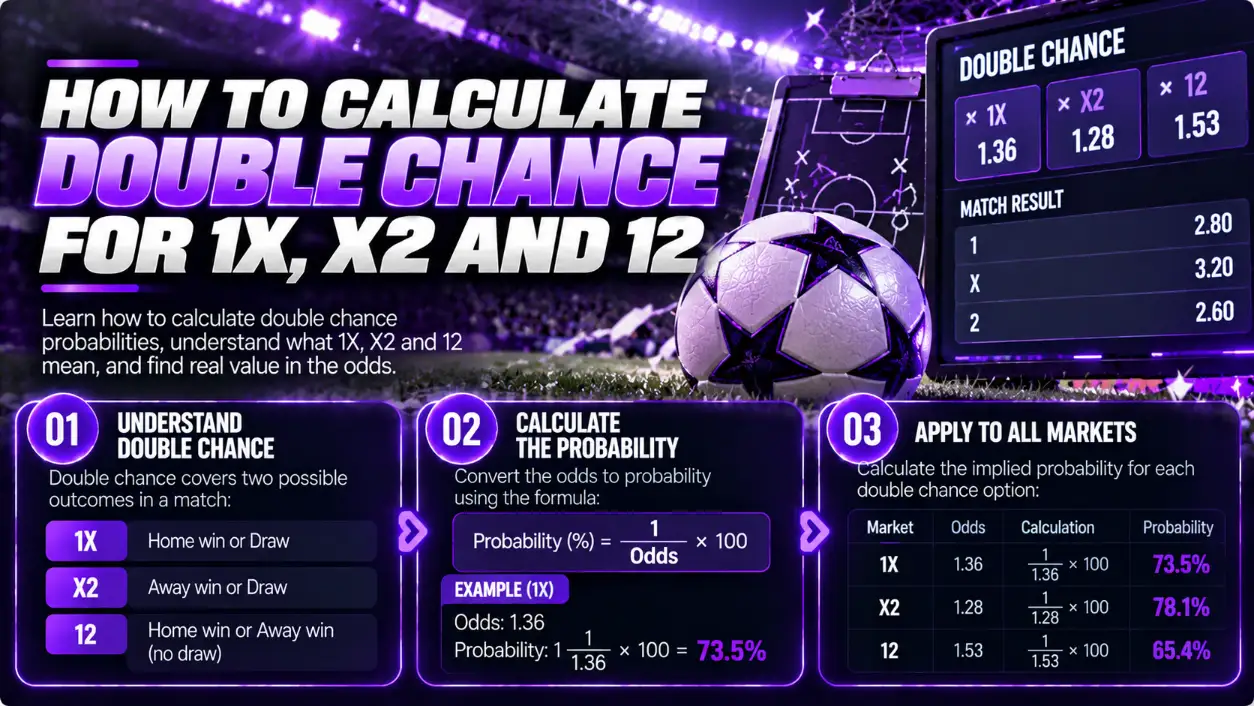
Double chance covers two of the three match outcomes: 1X means home or draw, X2 means draw or away, and 12 means either team to win. For a 2.10 / 3.30 / 3.60 line, proportional margin removal gives estimates of 73.7% for 1X, 54.9% for X2 and 71.3% for 12. These are estimates derived from bookmaker odds using one method, not known true probabilities or a promise of a worthwhile bet.
How do 1X, X2 and 12 settle?
A double chance selection wins if the result falls within its two covered outcomes; otherwise, it loses. For one hypothetical Home vs Away match, the three possible scorelines below settle as follows:
| Final score | Base outcome | 1X | X2 | 12 |
|---|---|---|---|---|
| 2-1 | Home win (1) | Win | Loss | Win |
| 1-1 | Draw (X) | Win | Win | Loss |
| 0-1 | Away win (2) | Loss | Win | Win |
In each row, two double chance selections win and one loses. However, a double chance bet is still one selection at one accepted price: covering two outcomes does not produce a double payout.
Check the settlement period, inclusion of extra time, cancellation conditions and team listing order on the exact betslip and in the chosen operator’s rules. Many operators settle match-result markets on regular time—two halves plus stoppage time—excluding extra time and penalties unless stated otherwise. The selection 1 usually means the home or first-listed team. The operator’s rules determine what happens if a match is cancelled, abandoned or postponed, whether that means a void bet and refund or another settlement rule, so check them before betting.
How do you calculate estimates from 2.10 / 3.30 / 3.60?
Convert each decimal price into an implied probability using 1/O, remove the margin from the complete 1X2 market, then add the estimates for the two covered outcomes. You do not add the odds themselves.
This example assumes one coherent bookmaker snapshot: the same market, time and settlement rules. The decimal odds are Home 2.10, Draw 3.30 and Away 3.60. Calculations retain unrounded values unless stated otherwise; displayed probabilities and odds are rounded as shown.
Step 1: Calculate implied probabilities and overround
Implied probability is q = 1/O, where O is decimal odds. It represents the probability implied by the price, not an independently measured probability of the outcome.
| Outcome | Calculation | Implied probability |
|---|---|---|
| Home win (1) | q1 = 1/2.10 | 47.6190% |
| Draw (X) | qX = 1/3.30 | 30.3030% |
| Away win (2) | q2 = 1/3.60 | 27.7778% |
The book total for the complete market is:
S = q1 + qX + q2 = 105.6999% ≈ 105.70%
The 1X2 overround is the amount by which this total exceeds 100%:
S − 100% = 5.6999 percentage points
Rounded for display, the overround is 5.70%. This describes the source line, not the bookmaker’s actual profit or the margin in a separately quoted double chance market. The raw implied probabilities are not fair probabilities.
Step 2: Remove the margin proportionally
Divide each raw implied probability by the total S. The result is a proportional no-vig estimate.
| Outcome | Formula | Proportional no-vig estimate |
|---|---|---|
| Home win (1) | p1 = q1/S | 45.0512% |
| Draw (X) | pX = qX/S | 28.6689% |
| Away win (2) | p2 = q2/S | 26.2799% |
The proportional method assumes a particular allocation of margin. It does not reveal the bookmaker’s underlying model or establish true probabilities. Other margin-removal methods can produce different estimates.
Step 3: Add the estimates for the selected pair
Add the two relevant no-vig probability estimates, then take the reciprocal of that combined estimate to obtain no-vig odds under the proportional method.
| Double chance | Calculation | Probability estimate | Rounded no-vig odds |
|---|---|---|---|
| 1X | p1 + pX | 73.7201% → 73.7% | 1.36 |
| X2 | pX + p2 | 54.9488% → 54.9% | 1.82 |
| 12 | p1 + p2 | 71.3311% → 71.3% | 1.40 |
Adding the raw implied probabilities for 1X before removing margin gives 77.9221%. That is not a no-vig estimate: it still contains the effect of the source market’s margin.
The three combined estimates total 200%, not 100%, because each base outcome appears in exactly two pairs. A home win appears in 1X and 12, a draw in 1X and X2, and an away win in X2 and 12. These overlapping selections are not a complete set of mutually exclusive outcomes, so subtracting 100% from their total does not measure margin. The displayed one-decimal estimates may differ slightly from the exact total because of rounding.
How do you repeat the calculation in ToolsGambling?
Enter the three source odds, select 1X, and enter a stake of 100 with offered odds of 1.32. The calculator shows a chance estimate of 73.7% and a total return of 132 if the selection wins.
- Open the ToolsGambling double chance calculator.
- Enter
2.10in Home (1). - Enter
3.30in Draw (X). - Enter
3.60in Away (2). - Select
1Xunder Double chance market. - Enter
100in Stake. - Enter
1.32in Offered odds · optional.
For the selected 1X market, the results are:
| Measure | Result |
|---|---|
| Proportional no-vig chance estimate | 73.7% |
| UI price labelled “fair” — a no-vig estimate under the proportional method only | 1.36 |
| Total return if the bet wins | 132 |
| Net profit if the bet wins | 32 |
| Offered-price comparison with the proportional benchmark | −2.6% |
| Source 1X2 margin | 5.70% |
Total return includes the stake: 100 × 1.32 = 132. Net profit is 132 − 100 = 32. These amounts apply if 1X wins; if Away wins, the stake of 100 is lost.
If you leave Offered odds · optional blank, the tool calculates an illustrative return at the tool’s own rounded no-vig price. That is not a bookmaker price available to you.
What does the −2.6% comparison mean?
With this line and the proportional method, 1.32 is below the 1.3565 benchmark, displayed as 1.36. Expected return ≈ 73.72% × 1.32 − 1 ≈ −2.7% of the stake, so under these assumptions the bet does not pass the value check.
The interface shows −2.6% because it compares the offered odds against the benchmark already rounded to 1.356: 1.32/1.356 − 1. The comparison using the unrounded benchmark is about −2.7%.
The input is a bookmaker line, and proportional margin removal is an assumption. The source line may be biased, while a separately offered double chance market may carry a different margin. Market snapshots may also differ in timing or settlement rules. These limitations matter when applying the conclusion.
How does double chance differ from draw no bet?
A draw wins a 1X or X2 bet, whereas draw no bet (DNB) refunds the stake when the match is drawn. They have different settlement terms and are not two names for the same market.
The 12 selection, by contrast, loses on a draw. For a fuller explanation of the refund condition, see the draw no bet guide.
Evgeniy Volkov
Verified ExpertFullstack developer with a background in mathematics. I build the calculators and game-style tools on ToolsGambling with Pixi.js and modern web tech, and every result uses transparent probability formulas you can verify yourself.