










Contents
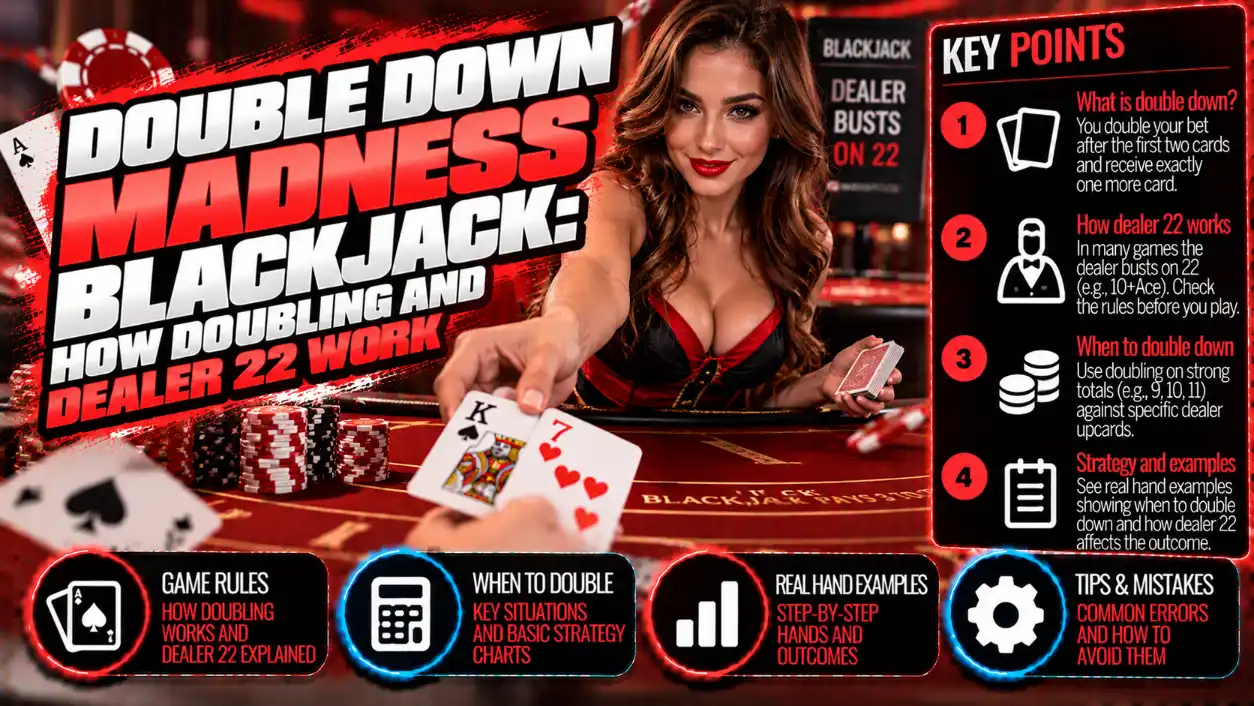
Double Down Madness is a blackjack variant by Light & Wonder that lets players double at any point in a hand, and when the dealer lands on 22, every standing wager pushes. Wizard of Odds puts the main-game house edge at 0.95% under its first blackjack paytable.
Our Push 22 side bet calculation ranges from 5.9% to 11.8% under these assumptions, with the paytable making the biggest difference: 50/20/8 versus a flat 11 to 1. The table’s paytable and house rules matter more than the variant’s name. A $10 bet followed by four doubles adding $10, $20, $40 and $80 puts $160 at risk.
What the variant is
Double Down Madness is blackjack with redoubling and a special dealer-22 rule. You start with one card and can double at any point, including on the first card, then keep playing after doubling. In exchange, you cannot split pairs or surrender, and a dealer total of 22 does not produce the usual main-game win.
The main-game push and the Push 22 side bet are separate outcomes. A push returns your standing wager without profit. Push 22 pays only if you placed that separate side bet and the dealer finishes on 22.
The right play depends on the table’s rules. A blackjack basic strategy chart explains that principle, but an ordinary chart should not automatically be applied to a game with redoubling.
Rules that differ from standard blackjack
The central differences are continued play after doubling, dealer-22 pushes, no splitting and no surrender. Other conditions also affect how the game plays.
| Rule | Double Down Madness | What it means for you |
|---|---|---|
| Starting hand | One card to you, two to the dealer | You can double on that first card |
| Dealer blackjack | Checked before you act when the upcard is an ace or ten-value card; main wagers lose | The hand ends before you can act |
| Doubling | Allowed at any point, including with three or more cards | Doubling need not end your turn |
| Redoubling | Allowed; an additional wager cannot exceed the current wager | Your exposure can grow quickly |
| Doubling on a single ace | One card, then stand | This exception ends further play |
| Splitting | Not allowed | A pair remains one hand |
| Surrender | Not allowed | You cannot give up the hand for a partial refund |
| Dealer 22 | Standing, non-busted wagers push | You receive your stake back, not a main-game win |
| Soft 17 | Dealer hits in Wizard and Maryland rules; configurable in Nevada | Check the posted dealer rule |
| Insurance | Pays 2 to 1 | It is settled separately |
| Even money | Not offered under Nevada rules | That option is unavailable |
| Decks | Six or eight under Wizard and Maryland rules; 1, 2, 4, 6 or 8 in Nevada | Check the shoe configuration |
If surrender is part of your usual decision-making, when to give up a hand in blackjack describes the option this variant removes.
How a hand plays out
You play against the dealer’s upcard, then the dealer completes the hand and settles the wagers. The special settlement occurs when the dealer reaches 22.
- Place your main wager. Place Push 22 separately if you want that side bet.
- Review your cards and the dealer’s upcard. The ability to double later does not require you to add money now.
- Hit, stand or double down. After doubling, you may continue taking cards or redouble, except when doubling on a single ace.
- Let the dealer finish. H17 means the dealer hits soft 17; S17 means the dealer stands on soft 17.
- Check the settlement. Dealer 22 returns standing, non-busted main-game wagers. With Push 22 in play, the dealer still draws to settle it even after a player busts.
The Nevada Gaming Control Board rules of play specify dealer drawing, the configurable soft-17 rule and dealer-22 settlement.
Doubling at any point: how much is at risk
Four full doubles turn an initial $10 wager into $160 at risk. Each additional wager in this example equals the entire current wager, the maximum the rules allow.
| Stage | Added wager | Total at risk |
|---|---|---|
| Initial wager | $10 | $10 |
| First double | $10 | $20 |
| Second double | $20 | $40 |
| Third double | $40 | $80 |
| Fourth double | $80 | $160 |
The arithmetic is $10 initially plus $150 in additional wagers. This assumes full doubling at every stage, not smaller permitted additions. It illustrates the rules, not a strategy or a reason to keep adding money.
The Push 22 side bet and paytables
Push 22 wins when the dealer finishes on 22, but its payout depends on the posted paytable. Chapter 10 of the Maryland Standard Rules lists paytables A and B; Wizard describes a flat payout.
| Paytable | Suited / same color / other | House edge |
|---|---|---|
| Wizard — flat payout | 11 to 1 / 11 to 1 / 11 to 1 | 11.8% |
| Maryland A | 50 to 1 / 20 to 1 / 8 to 1 | 5.9% |
| Maryland B | 50 to 1 / 20 to 1 / 7 to 1 | 11.7% |
Educational diagram: Push 22 side bet house edge is 11.8% at 11 to 1 for any 22, 5.9% on Maryland Paytable A and 11.7% on Paytable B
Educational diagram from our simulation: 300 million hands, six decks, dealer hits soft 17. Paytables from Wizard of Odds and Maryland Standard Rules.
Payouts shown as “to 1” represent profit; a winning stake is also returned. Side bet edges are rounded to the nearest tenth of a percent.
A side bet must be judged by its paytable, as explained in Match the Dealer rules, payouts and odds. The same distinction appears in Buster Blackjack side bet payouts: two paytables for one side bet can produce different edges.
Working out the side bet edge
Our simulation gives the dealer a 7.35% chance of finishing on 22 with six decks and H17. It used 300 million hands, with a sampling error of about ±0.05 points per edge; player cards are not removed from the shoe.
The mutually exclusive winning categories were:
- Suited 22: 0.33% of hands.
- Same color 22, excluding suited: 1.17%.
- Other 22: 5.85%.
The calculation weights each category by its payout and accounts for losing outcomes. House edge is measured against total initial Push 22 wagers, not the money committed to the main game. Rounded category percentages are for explanation, not for reproducing the full-precision result.
| Assumption | Value | Maryland A edge |
|---|---|---|
| Hits soft 17 | Six decks; dealer 22 probability 7.35% | 5.9% |
| Stands on soft 17 | Six decks; dealer 22 probability 7.26% | 6.8% |
| Eight decks | H17; dealer 22 probability 7.35% | 5.7% |
Under these assumptions, the edge is 5.9% under this paytable, Maryland A’s 50/20/8; under 11 to 1, it is 11.8%. The paytable moves the result more than the dealer rule or deck count.
What moves the main-game edge
The blackjack paytable version is the assumption that changes the main-game figure most. Wizard of Odds gives 0.95% for version 1 and 2.07% for versions 2 and 3, using six decks and a cut card. It also reports a rounded dealer-22 probability of 7.35% and a flat-payout Push 22 edge of 11.76%, consistent with the rounded 11.8% above.
| Version | Blackjack payout | Main-game house edge |
|---|---|---|
| 1 | Suited 2 to 1; non-suited 3 to 2 | 0.95% |
| 2 | Any blackjack 3 to 2 | 2.07% |
| 3 | Suited 3 to 1; non-suited 1 to 1 | 2.07% |
Wizard’s adjustments are −0.03 percentage points for a continuous shuffler and +0.03 percentage points for eight decks. Main-game and side bet edges are separate measures; they cannot simply be added without accounting for wager sizes.
Limits and mistakes
Check the table’s actual rules and paytable before betting. Nevada’s rules also describe other side bets (Matchmaker Madness, War Is Madness, Progressive Madness, House Money); this article covers only Push 22. The Maryland rules do not define “suited” and “same color” for hands of three or more cards. Our calculation assumes all cards share one suit or one color, respectively, with suited hands counted separately.
Busted main-game wagers lose, including additional wagers; a later dealer 22 does not restore them. Push 22 is settled independently.
House edge describes a long-run mathematical disadvantage, not the outcome of your next hand. There is no guaranteed profit, and no betting system removes that disadvantage.
FAQ
What does “double at any point” mean in Double Down Madness?
You can double with any number of cards, starting with your first one. Further draws and later redoubles are permitted after a double, subject to the single-ace exception.
What do players get back when the dealer makes 22?
Players still in the hand recover both their original stake and their added main-game wagers, without winnings. A separately placed Push 22 wager is settled separately by its paytable.
Why does the Push 22 house edge differ between tables?
Wizard’s table pays you 11 to 1 for any dealer 22. Maryland’s tables pay 50 / 20 / 8 or 50 / 20 / 7 to 1 for suited, same-color or other dealer 22, respectively. The higher payouts in the 50/20/8 table roughly halve the side bet’s house edge compared with the flat payout: 5.9% against 11.8%.
Can a system win at this variant?
A betting sequence can produce a winning session, but it cannot turn the game’s underlying disadvantage into a reliable source of profit.
Frequently Asked Questions
You can double with any number of cards, starting with your first one. Further draws and later redoubles are permitted after a double, subject to the single-ace exception.
Players still in the hand recover both their original stake and their added main-game wagers, without winnings. A separately placed Push 22 wager is settled separately by its paytable.
Wizard’s table pays you 11 to 1 for any dealer 22. Maryland’s tables pay 50 / 20 / 8 or 50 / 20 / 7 to 1 for suited, same-color or other dealer 22, respectively. The higher payouts in the 50/20/8 table roughly halve the side bet’s house edge compared with the flat payout: 5.9% against 11.8%.
A betting sequence can produce a winning session, but it cannot turn the game’s underlying disadvantage into a reliable source of profit.
Evgeniy Volkov
Verified ExpertFullstack developer with a background in mathematics. I build the calculators and game-style tools on ToolsGambling with Pixi.js and modern web tech, and every result uses transparent probability formulas you can verify yourself.