












Contents
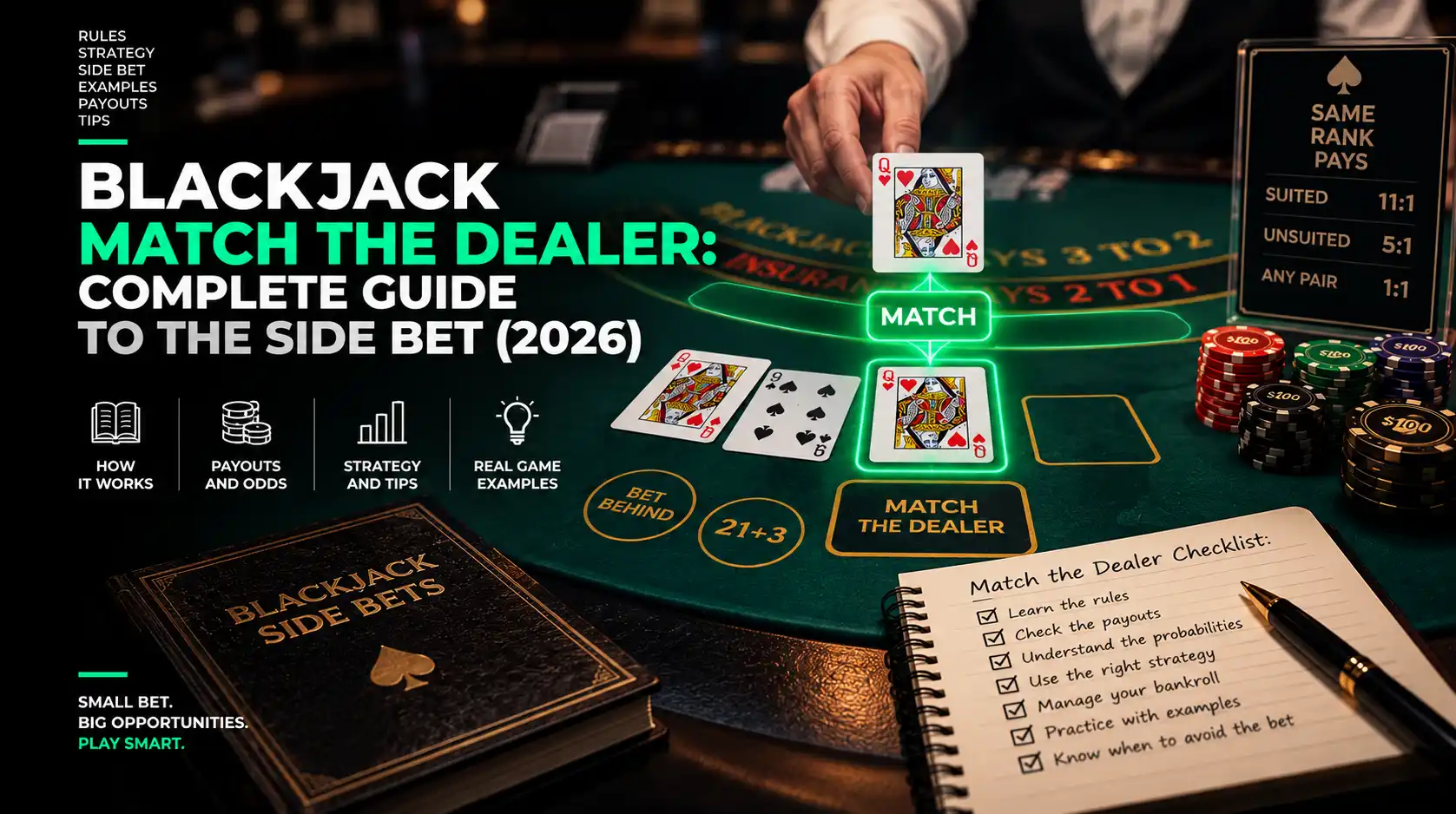
Match the Dealer is an optional blackjack side bet that compares each of your first two cards with the dealer’s upcard by rank. A suited match has the same rank and suit; a non-suited match has the same rank but a different suit. The exact betting rules and payouts depend on the specific game.
At a glance
Match the Dealer pays for matching cards, not for winning the main blackjack hand. To evaluate it, first check the deck count and paytable: both affect the mathematical result.
In the six-deck model below, the probability of at least one match is 14.266155%. With per-card payouts of 4:1 for a non-suited match and 11:1 for a suited match, the house edge is 4.061819%, rounded to 4.06%. These figures describe that model, not every Match the Dealer game.
When to place the bet and how it is settled
Place the side bet before the cards being compared are dealt, at the betting stage specified by the game’s rules. Settlement uses your first two cards and the dealer’s upcard; check the particular rules for settlement timing and whether a main wager is required.
The side bet is settled separately from the main blackjack wager. A match does not mean your blackjack hand wins, and no match does not mean it loses. The DraftKings Pennsylvania rules discussed below require a main wager, but that requirement should not be assumed for every version.
What counts as a match, and what do the payouts mean?
A match requires the same rank. Sharing a suit qualifies for the suited category only when the ranks also match.
If the dealer’s upcard is the seven of hearts, a seven of spades is a non-suited match, while another seven of hearts is a suited match. An eight of hearts is not a match. Likewise, a ten, jack, queen and king are different ranks, even though each has a blackjack point value of ten.
In the six-deck model, each matching card earns its own payout. If both player cards match, those payouts are added together. For a particular game, verify the paytable’s two-match categories rather than assuming this method applies.
Odds-to-one payouts describe profit, not the total amount returned. At 4:1, a winning $1 side bet earns $4 profit plus the returned $1 stake, for a $5 total return. At 11:1, one suited match earns $11 profit plus the returned $1 stake. These examples use the six-deck model’s schedule; they are not universal payouts.
Exact probabilities for the six-deck model
The probability of at least one match is 14.266155% in the six-deck model. The figures below are calculated probabilities, not observed playing results.
The assumptions are six complete standard 52-card decks and a fixed dealer upcard. Removing that upcard leaves 311 cards: 5 suited matches, 18 non-suited matches and 288 cards that do not match. The player’s two cards are drawn without replacement, giving C(311, 2) = 48,205 unordered pairs.
Each outcome’s probability is its qualifying pair count divided by 48,205. For example, two suited matches use C(5, 2) pairs; a mixed match uses 5 × 18 pairs. This accounts for the dependence between the two draws rather than treating them as independent.
| Outcome for the player’s first two cards | Probability |
|---|---|
| No match | 85.733845% |
| One non-suited match | 10.754071% |
| One suited match | 2.987242% |
| Two non-suited matches | 0.317395% |
| One suited and one non-suited match | 0.186703% |
| Two suited matches | 0.020745% |
| At least one match | 14.266155% |
Probabilities are rounded to six decimal places. The final row combines all matching outcomes; it is a total, not an additional outcome.
The six-deck schedule—4:1 per non-suited match and 11:1 per suited match—is covered in the Wizard of Odds analysis. An independent enumeration of the card combinations reproduces the house edge below. This calculation assumes the stated full-deck composition; it does not establish the probabilities for a depleted shoe, a different deck count or a modified card set, nor does the source establish availability at any particular table.
How the payouts produce the house edge
For this six-deck model, the house edge is 4.061819%, and the expected return is 95.938181% of the amount wagered. Rounded to two decimal places, those figures are 4.06% and 95.94%.
The calculation weights each possible net result by its exact probability:
- No match loses the entire $1 side bet.
- A winning outcome adds the profit payouts for the matching cards and returns the original stake once.
- The main blackjack wager is excluded.
For two non-suited matches, the profit is two 4:1 payouts, or $8 on a $1 side bet. A mixed outcome pays 11:1 plus 4:1, or $15 profit. The net results for the six outcome rows are therefore −1, 4, 11, 8, 15 and 22 times the stake. Multiplying these by their unrounded probabilities and summing gives the expected net result; its negative is the house edge.
An expected return of 95.94% does not mean you will receive that percentage back in a particular session. It is the model’s long-run mathematical average. Match frequency, expected return and house edge measure different things: neither frequent wins nor a large individual payout establishes a positive expected result.
A different paytable: DraftKings Pennsylvania rules
The specific DraftKings Pennsylvania rules document describes eight standard decks, requires a main wager and lists the following payouts. It is an example of one operator’s rules, not a universal schedule or a claim of current availability.
| Outcome | Profit payout, odds-to-one |
|---|---|
| One non-suited match | 3:1 |
| One suited match | 14:1 |
| Two non-suited matches | 6:1 |
| One suited and one non-suited match | 17:1 |
| Two suited matches | 28:1 |
Source: DraftKings Match the Dealer Blackjack rules for Pennsylvania. The evidence used here was indexed PDF text; direct retrieval returned HTTP 403, and no publication date was visible in the document.
This is not the six-deck paytable analyzed above. Neither the 14.266155% match probability nor the 4.061819% house edge should be carried over to it: the deck count and payouts differ.
What to check at your table
Open the game’s rules sheet and compare it with the posted paytable before using any published house-edge figure. The side bet’s name alone does not identify its rules.
Check these details:
- Deck count: Does it match the model you are using?
- Every payout category: Find the rows for one and two matches, including suited, non-suited and mixed outcomes.
- Payout convention: Are the figures profit odds-to-one, or total returns including the stake?
- Main-wager requirement: Must you place a blackjack wager to make the side bet?
- Card set and game variation: Do either change the matching or settlement rules?
- Betting and settlement timing: Follow that game’s rules rather than another operator’s example.
If any relevant detail differs, the house edge given in this guide is not established for your table.
How to estimate expected loss with the calculator
The house edge calculator estimates expected return and expected loss when you already know the house edge. It uses the value you enter; it does not calculate card probabilities, analyze payouts or determine the side bet’s edge.
To reproduce the local example:
- Select the custom house-edge option and enter 4.06%.
- Enter a bet size of $1.
- Select “By rounds” and enter 100.
Local English house edge calculator input: custom house edge 4.06%, a $1 bet and 100 rounds
Local calculator inputs: rounded house edge of 4.06%, a $1 bet and 100 rounds.
With those inputs, the calculator shows $100 total wagered, $95.94 expected return and −$4.06 expected loss, equivalent to an expected loss of about $0.0406 per round.
Local English calculator result: house edge 4.06%, $100 total wagered, $95.94 expected return and −$4.06 expected loss
The result uses the entered 4.06% house edge, not the more precise 4.061819% figure.
This estimate assumes a constant side-bet stake and the entered house edge. It excludes the main blackjack wager and does not predict the outcome of those 100 rounds. The screenshots show a local demonstration of the tool, not a real gambling session.
Frequently Asked Questions
Yes. Each of the player's first two cards is compared with the dealer's upcard. In the six-deck model described here, payouts for matching cards are added together. Check the two-match categories in your game's paytable before applying that rule.
No. The side bet and the main blackjack wager have separate settlement conditions. A matching card does not determine whether the main hand wins or loses.
No. That is the rounded probability of at least one match in the six-deck model. With its specified payouts, the house edge is 4.06%.
No. You must enter an already established house edge. The calculator estimates expected return and expected loss; it does not calculate card probabilities or analyze a paytable.
No. Deck count, payouts and main-wager requirements depend on the specific game's rules. The figures in these examples cannot automatically be applied to another table.
Evgeniy Volkov
Verified ExpertFullstack developer with a background in mathematics. I build the calculators and game-style tools on ToolsGambling with Pixi.js and modern web tech, and every result uses transparent probability formulas you can verify yourself.