










Contents
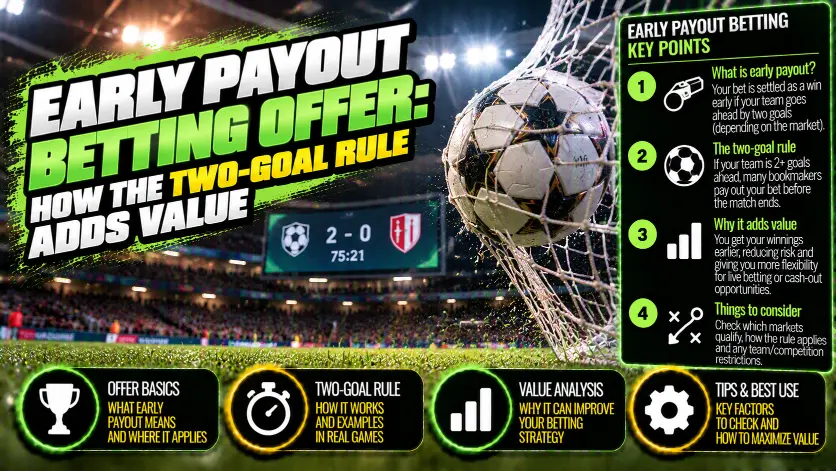
An early payout on a football bet is a rule that settles a win bet on a team as a winner once that team leads by two goals, even if the opponent later levels the score. In the base calculation it adds about 1.45 percentage points to the win probability (46.4% → 47.9%); calculated fair odds move from 2.154 to 2.089. The calculation uses simplified scoring assumptions (90 minutes without added time, no red cards, constant scoring rates), not a prediction of a particular match.
The uplift depends both on the goal-rate level (a scale of 0.8–1.2 gives 1.97%–4.40%) and on the balance between the teams (2.54%–5.73% in the scenario table). The 3.13% uplift is therefore a result of the stated assumptions, not a fixed margin for every fixture.
What is early payout on a football bet?
Early payout replaces the need for a final-time victory with an alternative winning condition: the backed team reaches a two-goal lead during the match.
According to Goal.com’s bet365 review dated 26 January 2026, an eligible win bet settles as a winner once that lead is reached, even if the opponent later equalises or wins.
Educational diagram: three scorelines during a match and when a win bet settles as a winner under the two-goal ruleEducational diagram based on the article text, not an operator interface. The bet wins once the backed team leads by two goals, even if the final result differs.
This guide concerns football. Blackjack early payout is a different product with the same term; its rules do not carry over to sports betting.
Why does early payout matter?
It adds wins when the backed team leads by two goals but fails to win the match. If the team wins anyway, the offer creates no additional payout.
Early payout is not the same as cash out. The cash-out calculator evaluates a cash-out offer’s fair value and the bookmaker margin skimmed from it; it does not calculate the two-goal offer.
| Feature | Early payout | Cash out | Plain win bet |
|---|---|---|---|
| Who decides? | The operator’s qualifying rule determines settlement | You accept an available offer | You choose the bet; the result determines settlement |
| When does it trigger? | When the qualifying two-goal lead is reached | When an offer is available and you accept it | When the market result is determined |
| What counts as a win? | A team victory or meeting the offer’s condition | An agreed settlement amount, not necessarily a net profit | The backed team wins |
| What should you check? | Eligible bets, market, exclusions and limits | Offered amount and settlement conditions | Market, odds and settlement rules |
The key distinction is a player’s decision versus a preset rule. The cash-out offer guide explains how to assess the decision to accept an offered amount.
How does the rule work at bookmakers?
Goal.com’s bet365 review dated 26 January 2026 describes eligible pre-match single win bets, accumulators and Bet Builder selections on the Full Time Result market. This is a review-based account, not a verification of the operator’s own terms.
- Single win bet: the eligible bet settles as a winner when the backed team leads by two goals.
- Accumulator or Bet Builder: the relevant selection is marked as won; the other legs continue. One qualifying selection does not win the entire bet.
- Draw selection: according to the bookmaker-ratings.ru review, an old page whose deadline is 31 December 2018, the offer does not apply to draw bets. Goal.com does not describe this point; check the current terms in the operator’s app.
- Cash out: Goal.com states that cashing out before full time does not make the bet invalid. That statement does not establish a right to an additional payment after cash out; the settlement interaction needs checking separately.
For other sports, Goal.com lists thresholds of 15 points for rugby and 18 points for NBA.
As a historical comparison only, BettingOdds’ article dated 4 November 2020 reported that Paddy Power then limited its offer to singles, with a £2,500 maximum payout. Those restrictions are not evidence of current terms or another operator’s rules.
How do you calculate the offer’s value?
Add the probability of winning the match to the probability of reaching a two-goal lead and not winning. These events do not overlap, and their sum, q, is the probability that the bet settles as a winner.
The worked calculation assumes independent Poisson goal processes, 90 minutes without added time, no red cards and constant scoring rates. In the base scenario, the team’s goal rate is 1.5 and its opponent’s is 1.1.
Under these assumptions:
- P(win) = 0.46424, approximately 46.4%.
- P(two-goal lead and no win) = 0.01455, approximately 1.45%.
- q = 0.47879.
- Calculated fair odds: 2.154 without the offer and 2.089 with it.
- Relative uplift in value: 3.13%.
Calculated fair odds are the reciprocal of the stated probability, not a verified market price. To convert 2.154 into approximately 46.4%, use the implied probability calculator.
The following scenarios all use odds of 1.50 and a 10-unit stake, with the same assumptions stated above.
| Scenario | P(win) | P(two-goal lead and no win) | q | Gain per 10 units at odds 1.50 | Relative uplift |
|---|---|---|---|---|---|
| Base: team λ 1.5, opponent λ 1.1 | 0.46424 | 0.01455 | 0.47879 | 0.218 | 3.13% |
| Even: λ 1.3 and 1.3 | 0.36804 | 0.01607 | 0.38411 | 0.241 | 4.37% |
| Weaker team: λ 1.1 and 1.5 | 0.27809 | 0.01593 | 0.29401 | 0.239 | 5.73% |
| Stronger team: λ 1.8 and 1.0 | 0.56148 | 0.01426 | 0.57574 | 0.214 | 2.54% |
“Gain” means the increase in expected payout compared with the same bet without the offer—not the payout on every bet or its total expected net profit. With the stake unchanged, the increase in expected net profit equals the increase in expected payout. “Relative uplift” is q / P(win) − 1.
Probabilities are given to five decimal places; the gain per 10 units to three.
The sensitivity table scales both base goal rates together while keeping the other assumptions unchanged.
| Goal-rate scale | Relative uplift in value |
|---|---|
| 0.8 | 1.97% |
| 0.9 | 2.53% |
| 1.0 | 3.13% |
| 1.1 | 3.76% |
| 1.2 | 4.40% |
Under these assumptions, the offer adds a few percent to the fair-price value of the bet, but it does not make a 1.50 bet profitable. The base q, rounded to 0.479, remains below the break-even probability of 0.6667 (1/1.50).
The 1.50 odds come from the Goal.com example and do not match the calculation: it gives win probabilities from 28% to 56%, while 1.50 implies 66.7%. So the point of the calculation is the uplift relative to the fair price, not the expected profit of a 1.50 bet.
What should you do before placing a bet?
Check that your exact bet qualifies, then assess the odds rather than treating the promotion as a reason to bet.
- Open the offer’s current terms in the operator’s app. Check its validity period, eligible competitions, Full Time Result market, payout limits and exclusions. Make sure the bet is pre-match.
- Match the terms to your bet type. Confirm whether your single, accumulator or Bet Builder is covered and which selection is settled as a winner.
- Check the interaction with cash out. Establish how accepting an offer affects subsequent settlement.
- Assess expected value at the offered odds. The value bet calculator can help check expected value at your odds, but you must estimate the probability including early payout separately.
If you are evaluating cash out instead, the tool heading is “Cash out calculator”. Its “Cash-out margin (%)” field and results “Fair value” and “Margin skimmed” concern cash-out valuation, not the probability of a two-goal lead.
Availability depends on the operator and the bettor’s country. Check the legality of betting in your region.
What are the limits and common mistakes?
The main mistake is treating improved terms as proof of a profitable bet. An offer can reduce an expected loss without turning it into an expected profit.
Keep the measures separate: 1.45 percentage points is the extra win probability, 3.13% is the relative uplift in value, and q = 0.47879 is the total probability that the bet is settled as a winner. Confusing them exaggerates what the offer changes.
Another mistake is carrying one operator’s limits over to another: Paddy Power’s historical maximum payout does not set a limit for bet365, and a review does not replace the current terms in the app.
The Poisson calculation cannot predict a specific match. Tactical changes, red cards or other shifts in match conditions can make its estimates unsuitable. The 90-minute assumption does not replace the operator’s settlement rules.
Frequently Asked Questions
No. Early payout follows a qualifying condition set by the operator; cash out requires you to accept an available offer to close the bet.
Goal.com’s bet365 review dated 26 January 2026 describes all three for eligible Full Time Result selections. In an accumulator or Bet Builder, the qualifying selection is marked as won while the other legs continue.
An eligible win bet remains settled as a winner if the backed team already reached a two-goal lead. The older bookmaker-ratings.ru review says a selection backing the draw does not win under this offer.
Read the offer’s current terms in the operator’s app. Match your bet against the eligible market, bet type, lead threshold, payout limits, exclusions and validity period rather than relying on the promotion’s headline.
Evgeniy Volkov
Verified ExpertFullstack developer with a background in mathematics. I build the calculators and game-style tools on ToolsGambling with Pixi.js and modern web tech, and every result uses transparent probability formulas you can verify yourself.