










Contents
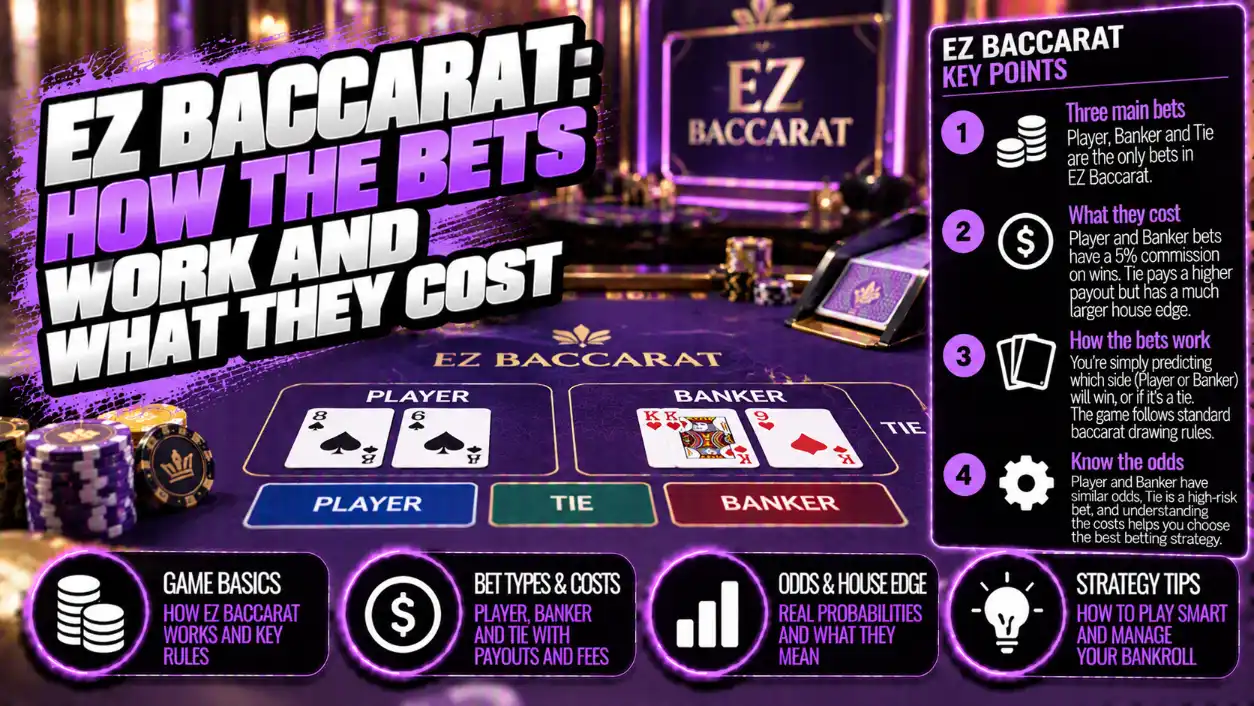
EZ Baccarat is a version of baccarat with no 5% banker commission: when the banker wins with three cards totaling 7, the banker bet is pushed, and the house edge on that bet is 1.02%, against 1.06% in standard baccarat. All headline figures below assume 8 decks and a tie payout of 8 to 1.
One caveat concerns the tie payout: at 9 to 1, the tie house edge falls to 4.84%, while the banker stays at 1.02%. This is a what-if calculation: the documents used here do not list a 9 to 1 tie payout. Using 6 decks barely changes the banker figure: it remains 1.02% after rounding.
The main change concerns how a winning banker bet is settled, not how cards are drawn. Dragon 7 and Panda 8 are separate side bets with their own winning conditions. Under these rules the banker is the cheapest main bet by house edge; this is a cost comparison, not a promise of profit.
How does EZ Baccarat differ from regular baccarat?
EZ Baccarat replaces the commission on winning banker bets with a push when the banker wins with three cards totaling 7. Other winning banker bets pay 1 to 1 without commission.
A push means the stake is returned, with no win or loss on that bet. In standard baccarat with a 5% commission, a banker win pays 0.95 to 1. EZ Baccarat removes that deduction but also removes the winning payment on a banker three-card 7. Both changes matter when comparing the games.
The player and tie bets retain their usual conditions: a player win pays 1 to 1, and a tie pays 8 to 1. When the round ends in a tie, banker and player bets push.
Payouts in this guide describe profit relative to the stake. Returning the original stake is not profit.
| Rule or bet | Standard baccarat with 5% commission | EZ Baccarat |
|---|---|---|
| Banker wins without a three-card 7 | Pays 0.95 to 1 after commission | Pays 1 to 1 without commission |
| Banker wins with three cards totaling 7 | Banker bet wins, subject to commission | Banker bet pushes |
| Player wins | Pays 1 to 1 | Pays 1 to 1 |
| Tie | Pays 8 to 1 | Pays 8 to 1 |
| Banker and player bets on a tie | Push | Push |
The EZ Baccarat column follows the California regulator’s official EZ Baccarat rules. The exception changes the settlement of the banker bet; it does not turn the round into a player win.
How is a round played?
A round follows standard baccarat rules: check for a natural first, then draw third cards where the rules require them. EZ Baccarat does not introduce a player decision about drawing a card to avoid the banker push.
A natural is a total of 8 or 9 on the first two cards. If there is no natural, the usual drawing rules determine what happens next. The guide to how to play baccarat explains naturals and third-card draws.
It helps to separate the round into two stages. First, the cards determine which hand wins or whether there is a tie. Then each wager is settled according to its own conditions. The special banker rule applies at settlement: the banker has won the round, but a qualifying banker bet receives a push instead of a winning payment.
You therefore do not need a different drawing system for EZ Baccarat. The distinction to remember is the banker settlement exception.
What does a banker push on a three-card 7 mean?
When the banker wins with three cards totaling 7, the banker stake is returned, while the player and tie bets lose. A Dragon 7 side bet wins on that same result.
Consider a round in which the banker wins with three cards totaling 7 and the player finishes with a lower total. This example assumes an actual banker win—not simply any banker hand containing three cards totaling 7.
| Bet in this round | Result | Settlement |
|---|---|---|
| Banker | Push | Original stake returned, with no profit |
| Player | Loss | Stake lost |
| Tie | Loss | Stake lost |
| Dragon 7 | Win | Pays 40 to 1 |
| Panda 8 | Loss | Stake lost |
If the banker stake was $40, the same $40 is returned. There is no winning payment of 1 to 1: the net profit on the banker bet is zero.
Each bet is settled separately. A winning side bet does not change the result of the main bet, and the banker push does not protect a player or tie wager.
This is also the distinction between a push and a tie. A push describes the settlement of a particular bet; a tie describes the result of the round. Here, the banker bet pushes even though the banker won the round.
How much does the casino keep on each bet?
Under the 8-deck rules with a tie paying 8 to 1, the house edge is 1.02% on banker, 1.24% on player and 14.36% on tie. Dragon 7 and Panda 8 have higher house edges than either banker or player.
House edge is the expected loss as a share of the amount wagered over the long run, not a deduction from every individual stake. The explanation of how house edge works covers that distinction. Here, it provides a common basis for comparing bets with different payouts.
| Bet | Payout | House edge, rounded | Exact calculation figure |
|---|---|---|---|
| Banker | 1 to 1, except for the three-card 7 push | 1.02% | 1.0183% |
| Player | 1 to 1 | 1.24% | 1.2351% |
| Tie | 8 to 1 | 14.36% | 14.3596% |
| Dragon 7 | 40 to 1 | 7.61% | 7.6113% |
| Panda 8 | 25 to 1 | 10.19% | 10.1876% |
Chart: five EZ Baccarat bets with payout and house edge for eight decksEducational chart based on the California BGC EZ Baccarat rules and the Wizard of Odds 8-deck table. It is not a casino interface.
The rounded 8-deck figures of 1.02% for banker, 7.61% for Dragon 7 and 10.19% for Panda 8 also appear in the independent Wizard of Odds outcome table.
The exact calculation uses a table of 4,998,398,275,503,360 outcomes. For the main bets, those outcomes fall into these categories:
| Outcome | Number of outcomes | Banker bet settlement |
|---|---|---|
| Banker wins without a three-card 7 | 2,179,619,555,108,870 | Wins at 1 to 1 |
| Banker wins with a three-card 7 | 112,633,011,329,024 | Push |
| Tie | 475,627,426,473,216 | Push |
| Player wins | 2,230,518,282,592,250 | Loss |
The probability of a banker win with a three-card 7 is 2.25%; the tie probability is 9.52%, and the player-win probability is 44.62%. To calculate house edge, each outcome is assigned its net winning payment, returned stake or loss, weighted by its probability. A large payout alone therefore says little about a bet’s expected cost.
A separate simulation of 10^8 hands with 8 decks produced the following results:
| Bet | Simulated house edge, 8 decks | Simulated house edge, 6 decks |
|---|---|---|
| Banker | 1.024% | 1.019% |
| Player | 1.231% | 1.234% |
| Tie | 14.42% | 14.43% |
| Dragon 7 | 7.57% | 7.64% |
| Panda 8 | 10.20% | 10.19% |
Simulation is a numerical cross-check, not a replacement for the exact outcome calculation. A finite run can finish close to the calculated percentage without matching its final digits.
To express the percentage as money, the house edge calculator can convert house edge into expected loss on a stake. For a $40 banker wager under the 8-deck EZ Baccarat rules:
$40 × 1.0183% ≈ $0.41 expected loss.
The monetary result is rounded to cents. It is a mathematical average for that amount wagered, not a forecast of the next round or a fee charged on the bet.
For comparison, the expected loss is $0.49 on a $40 player bet, $0.72 on a $5 tie bet, $0.76 on a $10 Dragon 7 bet and $0.51 on a $5 Panda 8 bet. These stakes differ, so compare the percentages when judging the relative cost of the bets.
What changes the conclusion?
The tie payout, deck count and choice between EZ settlement and a 5% banker commission affect different parts of the comparison. Under the rules examined here, none changes the conclusion that banker is the lowest-cost main bet by house edge.
| Change in rules | What changes | What stays the same |
|---|---|---|
| Tie pays 9 to 1 instead of 8 to 1 | Tie house edge falls to 4.84% | Banker remains at 1.02%; player is unchanged |
| 6 decks replace 8 decks | Banker house edge changes only slightly | Rounded banker house edge remains 1.02% |
| EZ rules replace the 5% banker commission | Banker house edge falls from 1.06% to 1.02% | Main player and tie payout conditions remain unchanged |
The exact standard-baccarat banker figure is 1.0579%, compared with 1.0183% under these EZ rules. The rounded difference is 0.04 percentage points: a small reduction in expected loss, not the removal of the casino’s advantage.
With a tie payout of 8 to 1, the tie house edge is about 14 times the banker house edge; the ratio is 14.1. Even at 9 to 1, tie remains more expensive than banker and player, although it no longer has the highest house edge among all five bets.
How do Dragon 7 and Panda 8 work?
Dragon 7 and Panda 8 are side bets with separate winning conditions and higher house edges than banker or player. They do not replace the main bets.
Dragon 7 pays 40 to 1 when the banker wins with three cards totaling 7. The base rules allow it only alongside a player or banker wager. Its win probability is 2.25%, about 1 round in 44; the detailed calculation is in the Dragon 7 analysis.
Panda 8 pays 25 to 1 when the player has a three-card total of 8 and the banker has 7 or less, regardless of the banker’s card count. It loses on all other outcomes. Its win probability is 3.45%.
These Panda 8 conditions come from the California Bureau of Gambling Control’s EZ Baccarat Panda 8 rules, Rev 06/15/12, published on oag.ca.gov. That document requires a player or banker wager alongside Panda 8. The base EZ Baccarat document does not describe this separate variant, and casino offerings can vary, so check Panda 8 availability, payout and eligibility before wagering.
What are the limits of the calculation and tools?
No betting strategy, progression or change in stake size removes the house edge shown here. The calculation describes expected results under specific rules, not a way to make the game profitable. The figures assume no collection fee; the California document allows fees on base wagers and limits payoffs to the amount of the player-dealer’s wager, so a specific table can cost more.
A short winning streak does not change the expectation, and a short losing streak does not disprove the calculated percentage. Actual session results can differ substantially from a long-run average.
The baccarat simulator covers the standard game: banker pays 0.95 to 1 after the 5% commission, player pays 1 to 1 and tie pays 8 to 1. The corresponding house edges are 1.06%, 1.24% and 14.36%.
That simulator does not implement EZ rules or Dragon 7. It cannot be used to test the EZ banker push because the same winning banker hand is settled differently in the standard game.
Primary sources
The California Bureau of Gambling Control’s official EZ Baccarat document establishes the base payout rules, the banker three-card 7 exception and the Dragon 7 wagering condition.
The same regulator’s separate EZ Baccarat Panda 8 rules, Rev 06/15/12, establish the Panda 8 winning condition, payout and accompanying-wager requirement.
Wizard of Odds provides an independent 8-deck mathematical analysis for checking the banker and side-bet house-edge figures. It is an outcome analysis, distinct from the regulator’s rules documents.
Frequently Asked Questions
It changes banker settlement rather than introducing a new drawing system: a specific winning banker hand returns the stake instead of paying a win.
For the banker bet under these rules, it has a slightly lower expected cost. The game’s name does not make every available wager cheaper.
You recover the original banker stake without profit. It is a settlement exception, not a declaration that the round ended in a tie.
Not materially in the 8-deck and 6-deck comparisons here. Banker remains the lowest-house-edge main bet.
No. Managing stake size does not turn the negative expectation of these bets into a positive one.
Evgeniy Volkov
Verified ExpertFullstack developer with a background in mathematics. I build the calculators and game-style tools on ToolsGambling with Pixi.js and modern web tech, and every result uses transparent probability formulas you can verify yourself.