










Contents
Face Up Blackjack is a blackjack variant in which both dealer cards are dealt face up, all ties lose and a player blackjack pays 6 to 5. Wizard of Odds puts the house edge at 1.06% under basic strategy; our simple-strategy calculation gives about 11.6%.
The extra information comes with restrictions: ties lose, the natural blackjack payout is reduced and there is no surrender. The edge depends on your strategy and the table’s rules. The biggest assumption in our calculation is that ties lose: changing them to pushes gives 2.31% instead of 11.62%.
What is Face Up Blackjack?
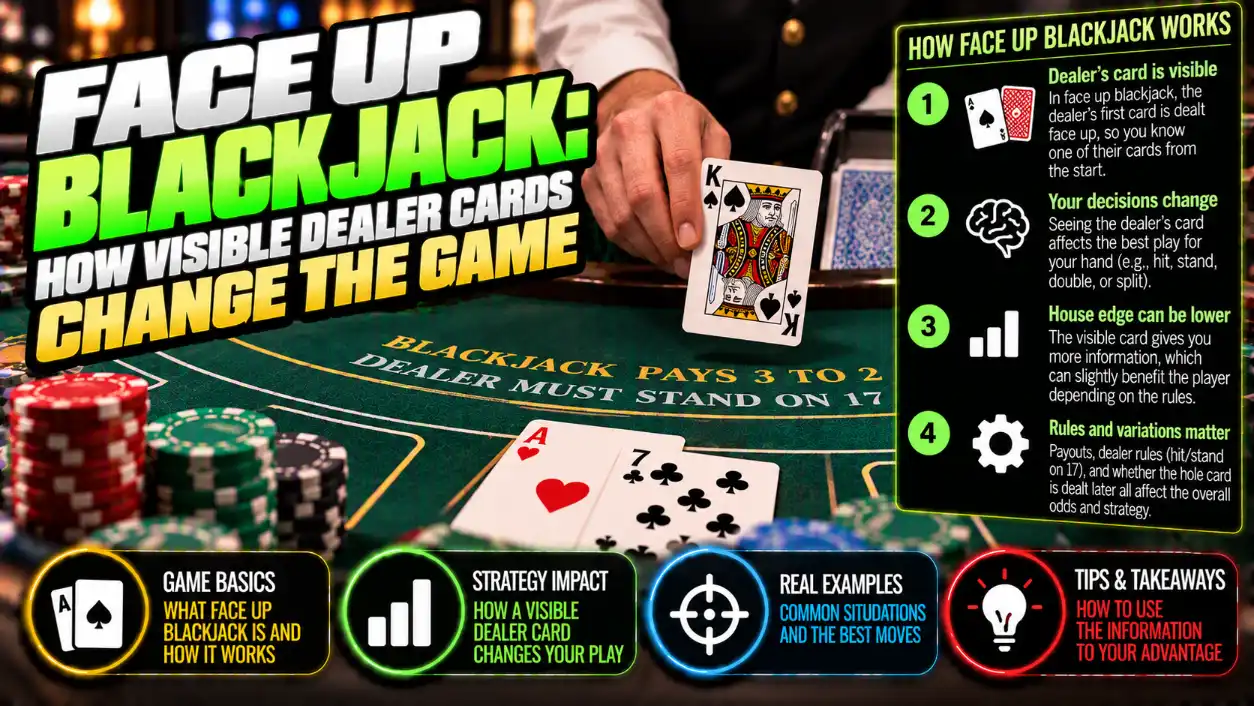
Face Up Blackjack is described by Wizard of Odds as a version of Double Exposure. You see the dealer’s entire starting hand before deciding what to do with yours.
The game was offered at Golden Nugget in Las Vegas as of September 2024, per Wizard of Odds. That is historical context, not confirmation of current availability.
Standard blackjack also has rule variations, so this comparison uses common arrangements rather than a universal standard.
| Rule | Standard blackjack | Face Up Blackjack, Wizard rules |
|---|---|---|
| Dealer’s starting cards | Usually one upcard and one hidden card | Both face up |
| Ties | Usually push | All ties lose |
| Natural blackjack | Table-dependent; commonly 3:2 | 6:5 |
| Surrender | Table-dependent | Not allowed |
| Doubling | Table-dependent | Hard 10 and 11 only |
| Re-splitting | Table-dependent | Not allowed |
Who does it suit, and what should you check?
This variant is relevant if you want to understand how seeing more cards changes blackjack decisions. Visible dealer cards do not, by themselves, make the game favorable to you.
Check tie settlement, natural blackjack payouts and doubling restrictions together. The difference between 1.06% and 11.62% is not a contradiction: the figures describe different decision strategies, not interchangeable estimates for any table.
How does a round work?
You receive your starting hand with both dealer cards visible, then choose among the actions permitted for your hand: hit, stand, double or split.
Under Wizard’s rules, you may double only on hard 10 or 11. A hard total has no ace counted as 11. You may split once, with no re-split, and doubling after a split is allowed.
The dealer hits soft 17, meaning a total in which an ace counts as 11. Wizard also says that, when you choose your action against a dealer soft 18–20, you should treat the dealer’s hand as hard.
A blackjack basic strategy chart depends on the table’s rules. That tool has no mode with both dealer cards up, so it cannot replace the dedicated Face Up Blackjack charts.
How do the payouts and house-edge numbers work?
A winning natural blackjack pays 6:5 under Wizard’s rules, while all ties lose. Wizard of Odds reports a 1.06% house edge under basic strategy for its version, including doubling only on hard 10–11.
A natural blackjack is an ace and a ten-point card in your first two cards. With six decks, our calculation gives a player natural in 4.75% of rounds, or 4.749% before rounding. A player natural without a dealer natural occurs in 4.53%; both have naturals in 0.22%.
The cost of replacing 3:2 with 6:5 is:
0.3 × 4.53% = 1.36% of the initial wager per round.
This assumes the same rules otherwise and applies the payout difference to player naturals without dealer naturals. The displayed probabilities are rounded; 1.36% comes from the exact calculation, not a fresh multiplication of rounded figures.
For ties, the distinction is direct: matching non-busted totals lose your wager here. With a push, the wager would instead be returned.
Our simulation used 1,000,000 rounds and random seed 107. Assumptions: a dealer natural ends the round at once, so the player cannot double or split; a player natural is paid at once without playing out the dealer hand; after splitting aces the player may draw freely; 21 after a split pays 1:1; the shoe is reshuffled when 60 or fewer cards remain. Its simple strategy is this rule set, not basic strategy or optimal play. It looks only at the dealer’s first card and ignores the second face-up card:
- Stand on hard 17+ and soft 18+.
- Double hard 10 or 11 on the first two cards.
- Split aces and eights once, with no re-split.
- Stand on hard 12–16 against a dealer 2–6.
- Hit otherwise.
Each changed-rule result below is compared with the Wizard baseline, not with the preceding row.
Educational card: Face Up Blackjack rules and our figures
Educational card. Rules from Wizard of Odds; the 1.36% and 11.62% figures are our calculations, with a simple strategy.
| Variant | House edge | 95% CI | Change |
|---|---|---|---|
| Wizard rules: 6:5, ties lose, double on 10–11 | 11.62% | 11.40–11.84% | Baseline |
| 3:2 natural instead of 6:5 | 10.26% | 10.04–10.49% | −1.36 percentage points |
| Ties push instead of losing | 2.31% | 2.09–2.52% | −9.31 percentage points |
| Doubling allowed on 9–11 | 12.26% | 12.03–12.50% | +0.64 percentage points |
The confidence intervals describe simulation uncertainty under the chosen assumptions, not uncertainty about whether the rules or strategy were specified correctly.
How do the rule versions compare?
Wizard and Nevada agree that both dealer cards are visible and all ties go to the dealer. They differ in their description of doubling, and Nevada’s text does not state a natural blackjack payout. Do not substitute 6:5 from Wizard for it.
| Rule | Wizard | Nevada |
|---|---|---|
| Doubling | Hard 10 and 11 only | 9–11, depending on house rules |
| Splitting | One split; no re-split; double after split allowed | One split; double after split allowed |
| Natural blackjack payout | 6:5 | Not stated |
| Ties | All ties lose | Dealer wins all ties |
| Surrender | Not allowed | Not stated in the text |
The Nevada Rules of Play specify visible dealer cards, dealer wins on ties, one split and doubling on 9–11 depending on house rules. Its wording (“hits until reaching a hard 17-21”) does not address soft totals directly; for soft 17 it implies a draw, while under Wizard’s rules the dealer stands on soft 18–20.
Only one split is allowed here; for the reasoning behind splitting pairs at all, see why not every pair is split. Surrender means giving up the hand before further play and losing half the wager. Wizard permits no surrender; the explanation of when surrender is and isn't available distinguishes that restriction from tables offering it.
Nevada also lists optional 2-Card Bonus and 4-Card Bonus side bets. Our calculation excludes them.
What are the limits and common mistakes?
The 1.06% basic-strategy edge cannot be applied to the simple strategy above or to every table with visible dealer cards. Wizard has six decision charts; the relevant chart, not the headline percentage alone, determines the action. Our 11.62% comes from a strategy that ignores the dealer’s second card, so it does not describe play that uses both cards.
Under these assumptions, with basic strategy and Wizard’s rules the edge is about 1%. Our simple-strategy results show that pushing ties reduces the edge substantially, but they do not establish that it falls close to zero under basic strategy. Paying 3:2 naturals lowers, rather than raises, the edge by 1.36 percentage points in our calculation.
Likewise, the 12.26% result does not prove that permission to double on nine is inherently harmful. It is a result for the tested rule-and-strategy combination, not an optimal-strategy comparison.
Six 52-card decks are standard for the described variant. A different deck count requires a separate assessment; how the deck count changes the edge explains why deck count matters.
How do you check the table’s rules?
Read the table rules and resolve these five points before matching the game to any published percentage:
- Doubling: hard 10–11 only, or also nine? Is doubling after splitting allowed?
- Splitting: one split only, with no re-split?
- Natural blackjack: is the payout explicitly stated?
- Ties: does the wager lose or push? This is the largest single difference in our comparison.
- Surrender: is it unavailable, as in Wizard’s version?
Match the complete rules and decision strategy to the calculation. The game’s name and visible dealer cards are not enough to identify its house edge.
Frequently Asked Questions
You can see the dealer’s complete starting hand before making your decision, rather than just one upcard. There is no hidden dealer hole card, but the dealer’s later draws still follow fixed rules.
Losing ties are part of the variant’s rules. In our simple-strategy calculation, changing ties from losses to pushes reduces the house edge from 11.62% to 2.31%, a difference of 9.31 percentage points.
You receive less net profit for the same winning natural blackjack. With six decks, our exact calculation puts the cost at 1.36% of the initial wager per round.
The Nevada text allows doubling on 9–11 depending on house rules, so you must check the particular table. Wizard’s version allows doubling only on hard 10 and 11.
Evgeniy Volkov
Verified ExpertFullstack developer with a background in mathematics. I build the calculators and game-style tools on ToolsGambling with Pixi.js and modern web tech, and every result uses transparent probability formulas you can verify yourself.