










TG
file-metadata.sys
SectionCasino
AuthorEvgeniy Volkov
PublishedFeb 13, 2026
Read Time14m
DifficultyAdvanced
Status
Verified
CategoryStrategies
Should You Split 10s in Blackjack? EV Math (2026)

Should You Split 10s in Blackjack? EV Math (2026)

should you split 10s in blackjacksplitting 10s blackjackwhen to split 10ssplit 10s vs dealer 6blackjack split strategydo card counters split 10sblackjack expected valuesplit tens blackjack
> Contents

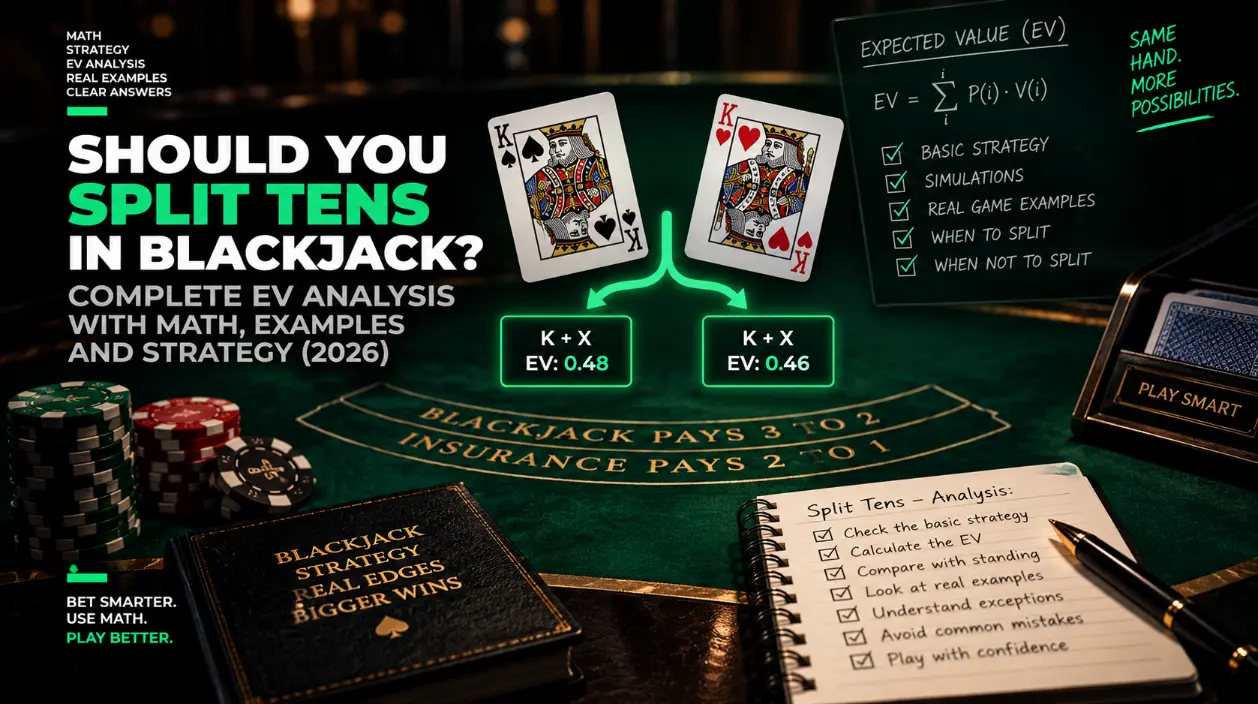
Should You Split 10s in Blackjack? The Complete EV Math (2026)

Picture this: you're sitting at a $25 blackjack table, and the dealer slides you two face cards — a King and a Queen. Beautiful. You've got 20. Then you glance at the dealer's upcard: a 5. The weakest card in the deck for them.

A voice in your head whispers: "What if I split these and win both hands? That's $50 profit instead of $25."

Here's the short answer that will save you thousands of dollars over your lifetime: don't split 10s. Ever. Well, almost ever — and this article explains exactly why, when the rare exceptions apply, and the math behind every scenario. Updated with complete expected value tables for 2026.

If you've been tracking your blackjack session results and wondering whether splitting 10s could improve your numbers, the data is crystal clear.

TL;DR — Should You Split 10s?

The Quick Answer for Every Player Type

Player TypeSplit 10s?Why
Casual playerNever20 wins ~85% of the time. Don't touch it.
Basic strategyNeverNegative EV in every single scenario.
Card counterRarelyOnly at true count +5 or higher vs 5/6.
TournamentSometimesLast-hand desperation when behind on chips.

The Bottom Line

Standing on 20 earns you an average of +$0.65 per dollar bet. Splitting 10s drops that to roughly +$0.35. Every single time you split 10s instead of standing, you're voluntarily handing the casino an extra $0.30 per dollar on the table. Over hundreds of hands, that's a massive leak in your game.

Why Splitting 10s Is Almost Always Wrong

Your 20 Is a Powerhouse Hand

Let's put 20 in perspective. In a standard 6-deck blackjack game (dealer stands on soft 17), here's how 20 stacks up:

ScenarioResult
Dealer busts (28.4% of hands)You win
Dealer makes 17You win
Dealer makes 18You win
Dealer makes 19You win
Dealer makes 20Push
Dealer makes 21You lose

That's a lot of winning. The only way you lose is if the dealer hits exactly 21 — and even with a favorable upcard, that doesn't happen often enough to worry about.

Win Rate of Standing on 20: ~85%

When you exclude pushes (ties), standing on 20 wins approximately 85% of resolved hands across all dealer upcards. That's not a "pretty good" hand — that's a dominant position. For comparison:

  • Standing on 19 wins ~72% of resolved hands
  • Standing on 18 wins ~55% of resolved hands
  • Standing on 17 wins ~40% of resolved hands

The jump from 18 to 20 is enormous. Why would you voluntarily break up a hand that wins 85% of the time?

What Actually Happens When You Split

When you split two 10s, you create two new hands, each starting with a single 10-value card. Here's the reality:

  1. You double your risk — instead of one $25 bet, you now have two $25 bets (total $50 at risk)
  2. Each hand is decent but not great — starting with 10 gives you about a 57-63% win rate per hand
  3. You can't get 20 back — even if one hand improves, you've lost the guaranteed strength of 20
  4. Bust risk appears — with a 10 start, hitting to 12-16 puts you in danger territory

Think of it this way: you're trading a luxury sedan for two used bicycles. Sure, you have "more" — but each one is worth a lot less.

The Expected Value Breakdown (Updated 2026)

Here's where the math gets undeniable. Expected value (EV) tells you exactly how much you gain or lose per dollar bet, on average, for each decision. These numbers are from combinatorial analysis of standard 6-deck blackjack (S17, DAS allowed).

EV of Standing on 20 vs Each Dealer Upcard

Dealer ShowsEV (Stand on 20)Interpretation
2+$0.64You profit 64 cents per dollar
3+$0.66Solid win
4+$0.69Dealer weak, you dominate
5+$0.71Near-best scenario
6+$0.70Dealer likely busts, but you win anyway
7+$0.77Dealer often makes 17, you crush it
8+$0.79Best scenario — dealer can't reach 20 easily
9+$0.59Dealer has a shot at 19-20, still very profitable
10+$0.55Toughest matchup, still solidly positive
A+$0.60After insurance check, still strong

Key insight: There is no dealer upcard where standing on 20 is unprofitable. Not one. The worst case (+$0.55 vs dealer 10) is still a great position — you're making 55 cents on every dollar.

EV of Splitting 10s vs Each Dealer Upcard

Now here's what happens when you split:

Dealer ShowsEV (Split 10s)EV (Stand)You Lose
2+$0.47+$0.64-$0.17
3+$0.50+$0.66-$0.16
4+$0.54+$0.69-$0.15
5+$0.57+$0.71-$0.14
6+$0.56+$0.70-$0.14
7+$0.40+$0.77-$0.37
8+$0.34+$0.79-$0.45
9+$0.16+$0.59-$0.43
10+$0.13+$0.55-$0.42
A+$0.07+$0.60-$0.53

Side-by-Side Comparison: The Damage

Look at that chart. The green bars (standing) tower over the red bars (splitting) for every single dealer upcard. There is no scenario — none, zero — where splitting 10s beats standing in a standard game.

The worst split is against dealer Ace: you throw away $0.53 per dollar bet. On a $25 table, that's $13.25 in expected value burned on a single hand.

How Much Money You Lose by Splitting

The expected value formula makes it simple:

EVloss=EVstandEVsplitEV_{loss} = EV_{stand} - EV_{split}

In plain English: subtract what you'd earn splitting from what you'd earn standing. The difference is money you're lighting on fire.

Across all dealer upcards (weighted by frequency), splitting 10s costs you approximately $0.30 per dollar bet compared to standing. At a $25 table playing 70 hands per hour, if you split 10s every time you got them (~9% of hands), you'd lose an extra $47 per hour compared to basic strategy.

That's roughly $190 extra lost in a 4-hour session. For one bad decision.

When Card Counters Actually Split 10s

Everything above applies to normal play. But card counting changes the math — and sometimes, rarely, splitting 10s becomes the right move.

True Count Thresholds You Need

Card counters use the true count to measure how favorable the remaining deck is. For splitting 10s, you need an extremely high true count:

Dealer UpcardTrue Count to SplitHow Often This Happens
4+6 or higher~1-2% of hands
5+5 or higher~3-4% of hands
6+5 or higher~3-4% of hands
2, 3+7 or higherVery rare (<1%)
7-ANever splitNot at any count

At a true count of +5, there are significantly more 10-value cards left in the shoe. This means:

  • Each split hand is more likely to make 20
  • The dealer (showing 5 or 6) is more likely to bust
  • The EV gap between standing and splitting shrinks enough to flip

Why a 10-Rich Deck Changes the Math

Here's the key insight. In a normal shoe, each 10-start hand wins about 60% of the time. But at a true count of +5:

  • More 10s remaining means your 10+10 = 20 happens more often on each split hand
  • Dealer bust rate jumps from ~42% to ~48% against a 5 or 6
  • Your split hand EV increases while your stand EV stays roughly the same (20 is already strong)

At some point, the split EV actually exceeds the stand EV. That crossover happens around true count +5 for dealer 5/6.

The Hi-Lo System and Splitting Decisions

Using the popular Hi-Lo counting system:

  1. Count cards normally (2-6 = +1, 7-9 = 0, 10-A = -1)
  2. Divide running count by remaining decks to get true count
  3. If true count is +5 or higher and dealer shows 5 or 6 → split 10s
  4. If true count is +6 or higher and dealer shows 4 → split 10s
  5. All other situations → stand on 20

Most counters memorize this as a simple index play. It's one of the more dramatic deviations from basic strategy.

Real Casino Floor Examples

Here's what this looks like in practice. You're at a 6-deck shoe game. The shoe started with 312 cards. You've been counting for 4 decks (208 cards dealt), and your running count is +10.

  • Remaining decks: approximately 2
  • True count: +10 ÷ 2 = +5
  • Dealer shows: 6
  • Your hand: King-Queen (20)

At this point — and only at this point — a mathematical case exists for splitting. Your split EV at TC +5 vs dealer 6 is approximately +$0.72, compared to stand EV of +$0.70.

But notice something: even when splitting is "correct," the edge is tiny — about $0.02 per dollar bet. Compare that to the $0.14 you'd lose splitting at a neutral count. The risk-reward ratio is terrible, which is why many professional counters skip this play entirely.

Should You Split 10s vs Dealer's 6?

This is the single most tempting scenario, and the one that gets players into trouble. Let's break it down thoroughly.

The Most Tempting Scenario Explained

The dealer's 6 is the weakest upcard in blackjack. Dealers bust approximately 42% of the time when showing a 6. So the logic goes: "The dealer's probably busting anyway — why not split and win two hands?"

Here's why that logic fails:

  1. You already win when dealer busts — standing on 20 with dealer busting gives you the same profit as one hand won
  2. When dealer doesn't bust (58% of the time), your 20 still beats most made hands
  3. Your split hands face real risk — each 10-start hand can end up at 12-16, where you're in trouble

What the Numbers Actually Say

Against dealer 6, here are the cold hard numbers:

DecisionOutcome ProbabilityExpected Value
Stand on 20Win 83%, Push 11%, Lose 6%+$0.70
Split 10sComplex (two hands)+$0.56

You win 83% of the time by standing. Even in the "best" scenario for splitting, you're leaving $0.14 per dollar on the table. On a $100 bet, that's $14 in expected value thrown away.

And remember — the dealer's 6 is the best case for splitting. Against every other upcard, the gap is even wider.

Tournament Blackjack: The One Exception

There's exactly one situation where splitting 10s is a legitimate strategic decision: tournament blackjack.

When Splitting 10s Is Actually Smart

In tournament play, you're not playing against the house — you're trying to end up with more chips than the other players at your table. This completely changes the math.

Scenario: It's the last hand. You have $500 in chips. Your opponent has $650. The minimum bet is $25 and the maximum is $500.

If you bet $200 and stand on 20, you can win up to $700. But if your opponent also bets big and wins, you still lose the round.

If you bet $200 and split 10s, your total action is $400. If you win both hands: $900 in chips — a much bigger swing that gives you a better chance of overtaking your opponent.

Last Hand Desperation Math

The key formula for tournament splits:

  • Chips needed to win: Opponent's stack + their likely bet
  • Can you get there with one hand? If yes → stand
  • Do you need extra action? If yes → consider splitting

Tournament pro advice: splitting 10s on the last hand is acceptable when the chip deficit is between 1x and 2x your bet size. Outside that range, it's either unnecessary (you can win with one hand) or insufficient (even two wins won't close the gap).

Chip Count Strategy

Chip DeficitBest MoveWhy
Less than 1x betStandOne win is enough to overtake
1x to 2x betConsider splitNeed extra action to close gap
More than 2x betStand & bet maxSplitting won't help enough

Common Myths About Splitting 10s

"I've Seen People Win Both Hands"

Of course you have. With each split hand winning roughly 60% of the time, the probability of winning both is about 36%. That means one in three splits "works out." But here's what you're not seeing: the other two times, you either lose money or lose even more than if you'd just kept your 20.

The math doesn't care about your best memory of a double win. It cares about the average across thousands of decisions. And that average clearly says: stand.

"The Dealer Shows 5, I Should Split"

This is the second most common mistake after splitting vs 6. Yes, the dealer's 5 is weak (bust rate ~43%). But the same logic applies — your 20 is already crushing it.

The EV difference: standing gives you +$0.71, splitting gives you +$0.57. That's $0.14 per dollar you're giving away. The dealer's weak upcard helps you more when you keep your 20 than when you split into two uncertain hands.

"Splitting 10s Shows Bold Strategy"

This one's the opposite of true. Splitting 10s doesn't show confidence — it shows a misunderstanding of probability. The expected value math is unambiguous.

Real bold strategy is: counting cards, managing your bankroll precisely, knowing the house edge of every rule variation, and making the mathematically correct play every single time — even when it's boring. The same discipline applies to live variants like Gravity Blackjack — standing on 20 is still correct, multiplier side bets or not.

Standing on 20 isn't exciting. It's just profitable.

Frequently Asked Questions

What Pairs Should You Always Split?

Always split Aces and 8s. Aces give you two shots at 21 (the best hand), and splitting 8s turns a terrible hard 16 into two decent starting positions. The one exception: some advanced players surrender 8-8 vs dealer Ace instead of splitting. These rules are universal across all blackjack variants and table conditions.

After that, splitting decisions depend on the dealer's upcard. Check a basic strategy chart for pairs like 2s, 3s, 6s, 7s, and 9s — the optimal play varies by matchup.

How Does Card Removal Affect Splitting Strategy?

In a freshly shuffled shoe, basic strategy is clear: never split 10s. But as cards are dealt, the composition changes. If an unusually high number of low cards (2-6) have been dealt, the remaining deck is rich in 10s. This shifts the EV enough that splitting can become correct at extreme true counts (+5 or higher).

This is why card counting exists — to identify these moments. But for non-counters, the answer never changes.

What About Single-Deck vs Multi-Deck Games?

The "don't split 10s" rule is actually stronger in single-deck games. When you split two 10s in a single-deck game, you've removed two high cards from a much smaller pool — which hurts both your split hands. The card removal effect is magnified in smaller shoes.

In 6-deck and 8-deck games, removing two 10s from 312-416 cards barely matters. But the EV gap between standing and splitting is still decisive.

Can Splitting 10s Get Me Backed Off?

Splitting 10s by itself won't get you kicked out. But it's a known card counting signal. Pit bosses understand that basic strategy says never split 10s, so doing it repeatedly — especially with big bets — tells them you might be counting.

Many professional counters deliberately avoid splitting 10s even when the count supports it, specifically because the tiny EV gain isn't worth the heat and potential backing off. For context on how splitting decisions get misrepresented on social media, see our breakdown of Mikki Mase's advice on splitting 9s — a play he presents as secret knowledge that's actually been in every basic strategy chart since 1963.

Is It Worth Tracking Volatility When Splitting?

Yes, if you're serious about bankroll management. Splitting increases session volatility because you've doubled your action on a single round. Even with a positive EV, the variance from playing two hands simultaneously increases your risk of ruin.

For tournament play, this increased volatility is a feature. For cash games, it's a bug. Use a risk calculator to model how splitting decisions affect your overall bankroll trajectory.

What's the Expected Win Rate with Perfect Basic Strategy?

Using perfect basic strategy (which means never splitting 10s), the house edge in a standard 6-deck game is approximately 0.5%. That's one of the lowest edges in any casino game. Every deviation from basic strategy — including unnecessary splits — increases this edge in the casino's favor.

Splitting 10s adds roughly 0.15-0.20% to the house edge for the hands where you make that mistake. Over a lifetime of play, that's thousands of dollars.


Want to explore other casino strategies that use math instead of gut feelings?

Frequently Asked Questions

author-credentials.sysE-E-A-T
Evgeniy Volkov

Evgeny Volkov

Verified Expert
Math & Software Engineer, iGaming Expert

Over 10 years developing software for the gaming industry. Advanced degree in Mathematics. Specializing in probability analysis, RNG algorithms, and mathematical gambling models.

Experience10+
SpecializationiGaming
Status
Active

Was this article helpful?

Share Article
launch-tools.sh

Ready to Calculate Smarter?

Use our free professional calculators to make data-driven decisions.