










Contents
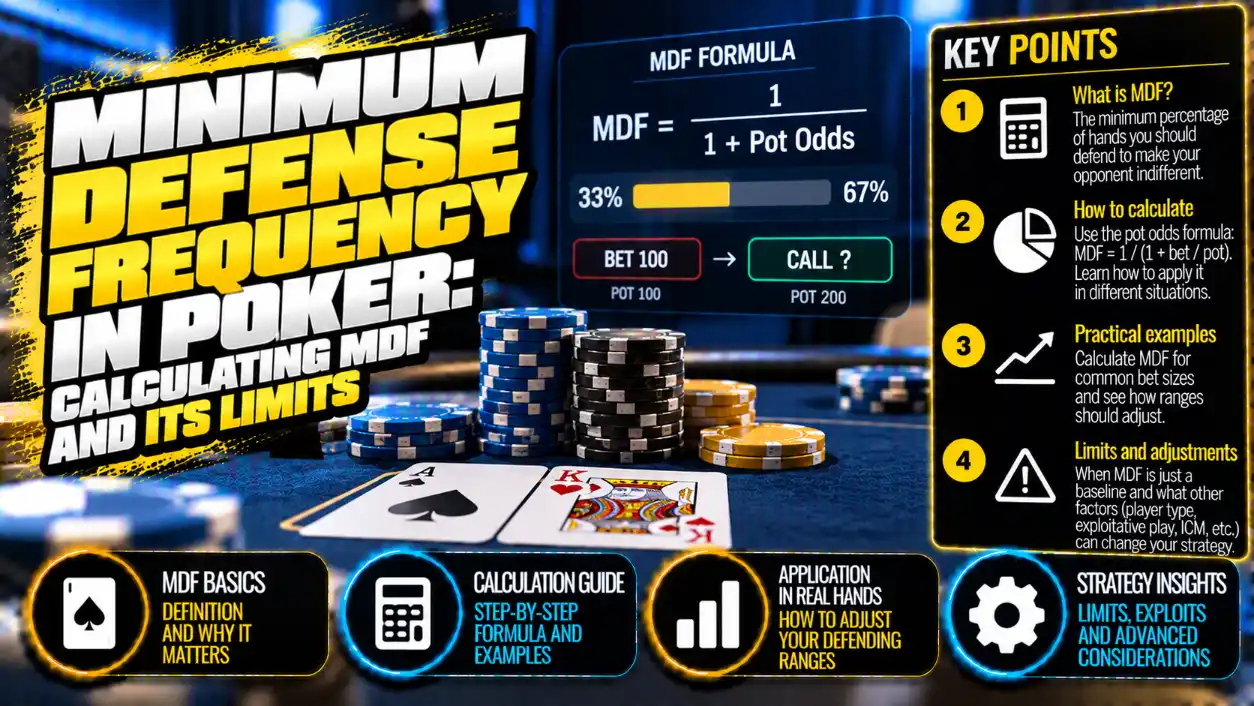
Minimum defense frequency (MDF) is the smallest share of your range you must continue with against a bet so that an opponent cannot profit by bluffing with any two cards. Against a bet of half the pot, that is 66.7%: continue with about two hands out of three.
That headline assumes no rake. Applying 5% rake to the pot reduces it to $95 and lowers MDF to 65.5% (−1.1 percentage points). Counting the opponent’s bet in the starting pot instead produces an incorrect 75.0%.
What is minimum defense frequency?
MDF describes how much of your whole range continues by calling or raising. It is not an instruction to call with a particular hand.
The aim is to deny an opponent an automatic profit from bluffing with any two cards. Smaller bet sizes require a higher MDF because the bettor risks less to win the same pot. DeucesCracked likewise states that smaller bets require you to defend a larger portion of your range.
MDF answers how much of a range should continue under the calculation’s assumptions, not which hands should make up that range.
How to calculate MDF against a bet
For a bet, divide the pot before the bet by that same pot plus the bet:
MDF = pot before the bet / (pot before the bet + bet)
The other side of the calculation is alpha (break-even fold percentage of a bluff):
Alpha = bet / (pot before the bet + bet)
At alpha, a bluff with zero equity breaks even. If the defender folds more often, that bluff makes a profit. MDF and alpha add up to 100%.
For example, assume a $100 pot before the bet, a $50 bet, no rake and a bluff that loses whenever called:
- MDF = 100 / (100 + 50) = 66.7% of the defending range.
- Alpha = 50 / (100 + 50) = 33.3% of the defending range folding.
PokerSkill gives the same formula and rounded defense benchmarks: 67% against a half-pot bet, 50% against a pot-sized bet and 33% against a bet of twice the pot. The table below uses more detailed rounding.
Why MDF is not the call threshold
MDF measures the share of your range that continues; pot odds determine the equity needed for an individual call.
In the same example, you pay $50 into the $150 pot after the opponent’s bet. The pot after your call would be $200, so the call threshold is 25% equity: 50 / 200, not the 66.7% range-defense threshold.
Use the pot odds calculator to check the 25% call threshold (50/200). The 66.7% MDF benchmark is a separate calculation. The pot odds and implied odds guide explains the call-price calculation and how possible future payments differ from the price available now.
Bet-size table and calculation diagram
Larger bets relative to the pot before the bet produce a lower MDF. Under the zero-equity-bluff assumption, the defender can fold more often without making the bluff profitable.
Every row starts with a $100 pot before the bet. MDF is the continuing share of the defender’s range; alpha is the folding share at which the bluff breaks even.
| Bet size relative to the pot before the bet | Bet amount | MDF: continuing share | Alpha: folding share |
|---|---|---|---|
| 25% | $25 | 80% | 20% |
| 33% | $33 | 75.2% | 24.8% |
| 50% | $50 | 66.7% | 33.3% |
| 67% | $67 | 59.9% | 40.1% |
| 75% | $75 | 57.1% | 42.9% |
| 100% | $100 | 50% | 50% |
| 150% | $150 | 40% | 60% |
| 200% | $200 | 33.3% | 66.7% |
Diagram of the MDF calculation: pot $100, bet $50, MDF 66.7%, alpha 33.3%Study diagram: with a $100 pot and a $50 bet, defending 66.7% of the range leaves a bluff with zero expected value.
The 33% and 67% bet sizes mean exactly $33 and $67 here, not an exact third or two-thirds of the pot.
River example with illustrative combos
Against a half-pot bet, a range of 90 equally weighted illustrative combos would continue with 60 and fold 30 to meet the MDF benchmark.
The base remains the pot before the bet: MDF = pot before the bet / (pot before the bet + bet) = 66.7% of the defending range. Alpha is 33.3% of that range folding.
For clarity, assume all continuing hands call:
| Action | Illustrative combos |
|---|---|
| Call | 60 |
| Fold | 30 |
| Whole range | 90 |
These are counts for a study example, not a list of real hands. With exactly two-thirds of the range calling, an opponent’s zero-equity bluff has zero expected value.
Choosing any 60 combos is not enough to establish a sound defense. The river bluff-catcher guide examines whether one particular hand should continue, rather than how frequently the whole range should defend.
How to calculate defense against a preflop raise
Against a preflop open, calculate the opener’s risk against the dead money they can win:
MDF = 1 − risk / (risk + reward)
Here, risk is the opener’s raise, and reward is the dead money excluding the opener’s own chips. In this example, the reward is 1.5 bb: the small blind’s 0.5 bb plus the big blind’s 1.0 bb. Assume the small blind has folded, so the big blind makes the decision; bb is the big blind as a betting unit.
For the opener, alpha = risk / (risk + reward).
| Opening raise | MDF: continuing share of the defender’s range | Alpha: folding share of the defender’s range |
|---|---|---|
| 2 bb | 42.9% | 57.1% |
| 2.5 bb | 37.5% | 62.5% |
| 3 bb | 33.3% | 66.7% |
| 4 bb | 27.3% | 72.7% |
Against a 2.5 bb open, MDF = 1 − 2.5 / (2.5 + 1.5) = 37.5% of the defending range. PokerSkill’s “Big Blind Defense” (pokerskill.com) uses the same 2.5x opening example and 37.5% result.
This is a benchmark against an attempt to win the blinds, not a ready-made big blind calling range. The preflop charts guide explains how to read the opponent’s opening range before assessing your response.
Where the calculation stops working
MDF stops being a useful defense target when the opponent bluffs too rarely: continuing merely to reach a percentage can lose money.
Consider a half-pot river bet. The defender calls with two-thirds of randomly selected bluff-catchers, each of which beats every bluff and loses to every value hand, with no ties. The table shows the expected value (EV) of that defense relative to folding, per 100 units of the pot before the bet.
| Bluff share among the opponent’s betting combos | EV per 100 units of the pot before the bet |
|---|---|
| 0% | −33.3 |
| 10% | −20 |
| 20% | −6.7 |
| 25% | 0 |
| 33.3% | +11.1 |
| 40% | +20 |
| 50% | +33.3 |
The break-even call threshold here is 25% bluffs among the opponent’s betting combos. Its formula is bet / (pot before the bet + 2 × bet). This is separate from MDF, which is 66.7% of the defender’s range against the half-pot bet.
Under these assumptions, defending at MDF loses money when the opponent’s betting range contains fewer than 25% bluffs. Bluff share describes the bettor’s range; MDF describes the defender’s range.
The calculation also has these boundaries:
- Earlier streets involve future decisions. Unlike the river, they require consideration of equity realization and possible additional payments.
- A zero-equity bluff is a simplifying assumption. If the bluffing hand can still win after a call, fold frequency alone does not settle its profitability.
- Range composition matters. Two ranges with the same continuing share need not perform equally well.
The updated Upswing Poker article (upswingpoker.com), originally published by Ryan Fee on 4 April 2017, likewise presents pot odds as usually a more practical basis than MDF for choosing a calling range against a bet.
Next steps: build and assess the defending range
The next step is to examine which hands can defend, rather than forcing your range to match a table percentage.
- Use the equity calculator to assess candidate hands against an assumed betting range. Equity helps evaluate possible defenders; it does not choose an action by itself.
- Use the range builder to assemble a defending range for study and compare its composition with the illustrative example in which 60 of 90 combos continue.
Start with the pot before the bet and the bet size, then keep the range-level MDF benchmark separate from the decision about an individual hand.
Frequently Asked Questions
No. Treat it as a range-review benchmark, not a mandatory quota. Your response depends on the opponent’s betting range and the hands available in yours.
Yes. Both calls and raises prevent the bettor from immediately taking the pot. An MDF percentage does not specify how to divide continuing hands between those actions.
No. An individual call requires pot odds and an assessment of the hand’s equity against the betting range. MDF concerns the continuing frequency of your whole range.
Yes, as a benchmark against an opening raise, using the separate risk-and-dead-money calculation. The resulting percentage is not a complete calling range without further hand analysis.
Evgeniy Volkov
Verified ExpertFullstack developer with a background in mathematics. I build the calculators and game-style tools on ToolsGambling with Pixi.js and modern web tech, and every result uses transparent probability formulas you can verify yourself.