










Contents
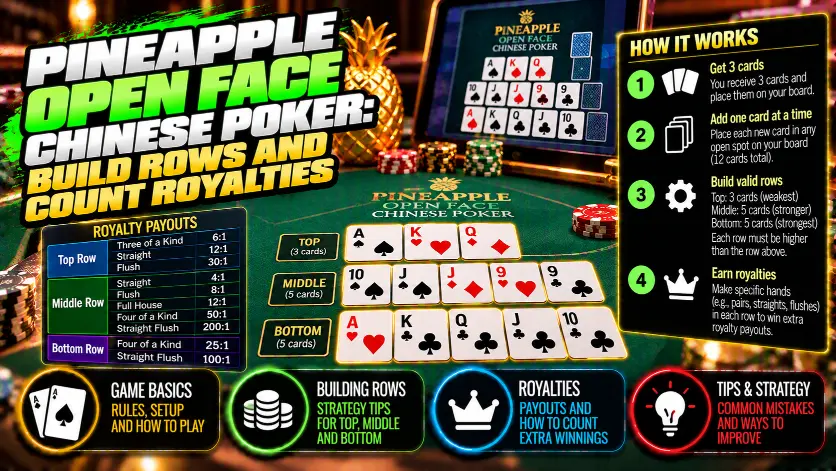
Pineapple Open-Face Chinese Poker is a variant of open-face Chinese poker in which each player builds three rows from 13 cards and earns royalties for strong rows. One random bottom row, with no choice, earns on average 0.027 royalty points; a middle row 0.096; a top row with a pair or trips 0.624 points. These figures ignore fouls and card choice; a foul voids the player's royalties.
These figures assume a random row with no card selection. This calculation gives no expected value for choosing two cards from three, so the size of that change is unknown.
What is Pineapple Open-Face Chinese Poker?
The game asks you to arrange 13 cards into three rows: three cards on top, five in the middle and five on the bottom. The bottom row must be at least as strong as the middle, and the middle at least as strong as the top.
Scoring is the same as in regular open-face Chinese poker. Pineapple changes how you receive and select cards: after the initial deal, you receive three at a time and keep two.
Why read royalties separately?
Read royalties separately because the same hand earns different points depending on its row. A straight earns 2 points on the bottom but 4 in the middle under the table below.
Royalties are bonuses for listed hands, not a substitute for a valid arrangement. Check the strength order before counting them.
How is a hand dealt?
You receive five cards first, then three at a time; from each group of three, place two cards in your rows and discard one face down.
- Place the initial five cards across the three rows.
- From the next three cards, choose two and place them in available row spaces.
- Discard the remaining card face down. Discards are not shuffled back into the deck.
- Repeat until the top row contains three cards and the middle and bottom contain five each.
The PokerNews Pineapple rules describe this discard procedure and the Fantasyland rules used here: QQ or better on top without a foul, followed by 14 cards from which you play 13.
Three rows and the strength rule: fouls
A foul occurs when the bottom row is weaker than the middle or the middle is weaker than the top. A player who fouls receives no royalties.
Check the completed arrangement in this order:
- Bottom: five cards, at least as strong as the middle.
- Middle: five cards, at least as strong as the top.
- Top: three cards.
For example, a flush in the middle above a straight on the bottom breaks the strength rule. The strong middle row does not make the arrangement valid.
Royalty table and our random-row calculation
Royalties depend on both the hand and its row. The following values come from Wikipedia’s royalty table, which also describes fouls and Fantasyland; royalty schedules can differ between tables and rooms.
| Row | Hand | Points |
|---|---|---|
| Top | Pair of sixes | 1 |
| Top | Pair of sevens | 2 |
| Top | Pair of eights | 3 |
| Top | Pair of nines | 4 |
| Top | Pair of tens | 5 |
| Top | Pair of jacks | 6 |
| Top | Pair of queens | 7 |
| Top | Pair of kings | 8 |
| Top | Pair of aces | 9 |
| Top | Three twos (222) | 10 |
| Top | Three threes (333) | 11 |
| Top | Three fours (444) | 12 |
| Top | Three fives (555) | 13 |
| Top | Three sixes (666) | 14 |
| Top | Three sevens (777) | 15 |
| Top | Three eights (888) | 16 |
| Top | Three nines (999) | 17 |
| Top | Three tens (TTT) | 18 |
| Top | Three jacks (JJJ) | 19 |
| Top | Three queens (QQQ) | 20 |
| Top | Three kings (KKK) | 21 |
| Top | Three aces (AAA) | 22 |
| Middle | Three of a kind | 2 |
| Middle | Straight | 4 |
| Middle | Flush | 8 |
| Middle | Full house | 12 |
| Middle | Four of a kind | 20 |
| Middle | Straight flush | 30 |
| Middle | Royal flush | 50 |
| Bottom | Straight | 2 |
| Bottom | Flush | 4 |
| Bottom | Full house | 6 |
| Bottom | Four of a kind | 10 |
| Bottom | Straight flush | 15 |
| Bottom | Royal flush | 25 |
Teaching diagram: expected royalty of one random row in Pineapple open-face Chinese pokerTeaching diagram. One random row, no choice: bottom 0.027 royalty points, middle 0.096, top pairs 66–AA and trips 0.624.
For a randomly dealt row with no card selection, this calculation gives:
| Row | Royalty probability | Expected royalty |
|---|---|---|
| Bottom | 0.759% | 0.027 points |
| Middle | 2.871% | 0.096 points |
| Top: pairs from sixes to aces, and trips | 11.96% | 0.624 points |
Row odds are computed by enumeration. The calculation covers 2,598,960 five-card hands: 10,200 straights, 5,108 flushes, 3,744 full houses, 624 four of a kind, 36 straight flushes and 4 royal flushes. The middle-row calculation also counts 54,912 hands with three of a kind.
For the top row, the calculation examines 22,100 three-card sets. Of these, 2,644 earn royalties: 2,592 contain pairs from sixes to aces, and 52 contain three of a kind. The expected royalty is 0.624 points.
As a worked example, a top row containing a pair of queens earns 7 points under this table, assuming the completed arrangement does not foul. A top pair of aces earns 9 points under this table if the arrangement does not foul. The random-row figures instead average the listed payouts across all enumerated sets, including those earning nothing. Percentages and expected royalties keep the rounding of the calculation.
Under these assumptions, a random row without choice earns little. If the player chooses two cards from three, then the expected royalties depend on those choices and cannot be predicted from these random-row averages. For practice with poker probabilities, try the poker math test.
How does Fantasyland work?
Fantasyland is a special mode for the next hand, reached by completing a valid arrangement with QQ or better on top.
In Pineapple Fantasyland, you receive 14 cards and use 13 to build the three rows. Qualification depends on the finished arrangement: queens on top are not enough if the rows foul. In the progressive variant described on Wikipedia, the number of cards grows with the top row: 14 cards for queens, 15 for kings, 16 for aces, 17 for three of a kind.
What should you check before play?
Before playing, confirm the royalty schedule and Fantasyland conditions at your table, then check each completed arrangement against them.
- The top row has three cards; the middle and bottom have five each.
- The bottom is at least as strong as the middle, and the middle at least as strong as the top.
- Each royalty comes from the agreed table rather than an assumed payout.
- Any Fantasyland qualification comes from a valid arrangement.
Keep different poker calculations separate. Tournament decisions are a different task, covered by the ICM trainer. Likewise, 3-shot poker is another poker game with a different calculation base.
Limits of the calculation
This calculation describes one random row, not the result of a complete hand. It does not model card selection, allocation between rows or the likelihood of completing a valid arrangement.
Expected royalties are not net profit and do not replace the full scoring between players. If the player chooses cards according to the royalty table while preserving the required strength order, then those decisions need a separate evaluation.
Pineapple Hold’em is a different game and is not covered here. The calculation also excludes 2-7 open-face Chinese poker and natural hands.
Frequently Asked Questions
No. After receiving three cards, place two in your rows and discard the other face down. Discarded cards do not return to the deck.
No. If the rows break the required strength order, that player receives no royalties, even for a strong individual row.
The calculation enumerates all 22,100 three-card sets. Royalties come from 2,644 of them: 2,592 with a pair from sixes to aces and 52 with three of a kind. Points follow the Wikipedia table: a pair of kings earns 8, a pair of aces 9, and three of a kind from 222 to AAA earns 10 to 22. The average across all sets is 0.624 points.
No. The calculation describes a row built without card selection. In play, you choose two cards from three and distribute them among the rows. Results also depend on avoiding fouls and on the table rules.
Evgeniy Volkov
Verified ExpertFullstack developer with a background in mathematics. I build the calculators and game-style tools on ToolsGambling with Pixi.js and modern web tech, and every result uses transparent probability formulas you can verify yourself.