










Contents
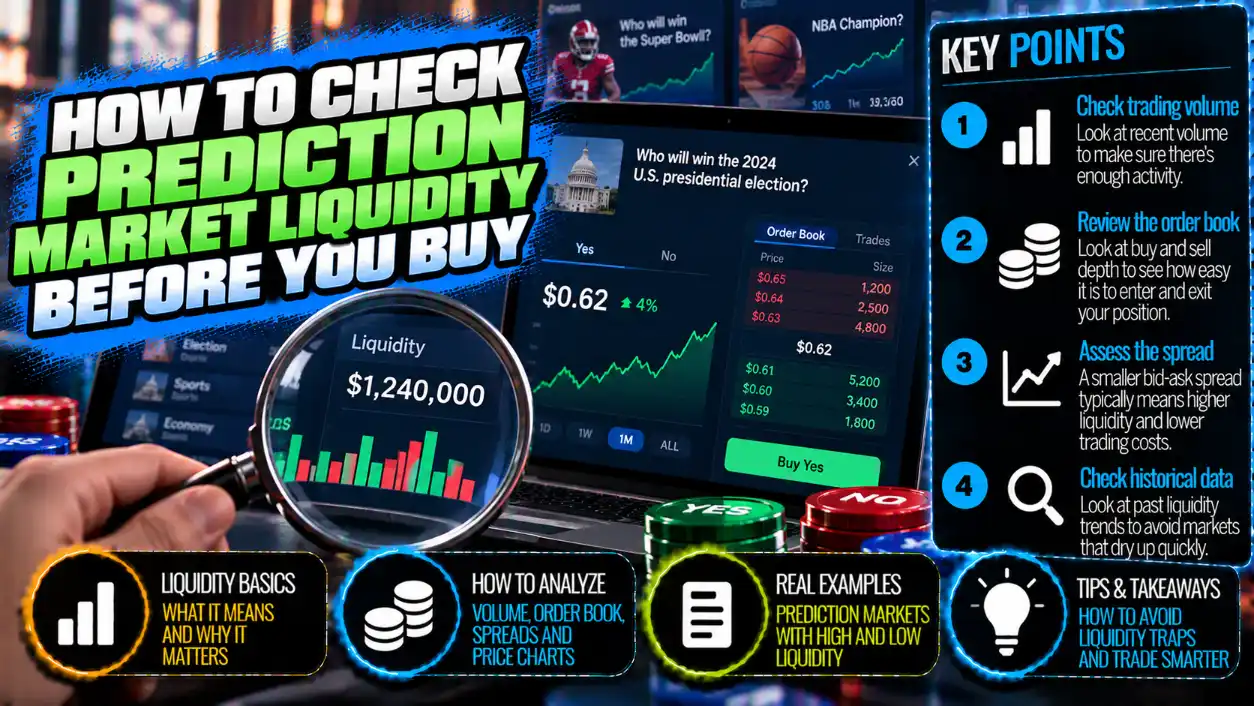
Prediction market liquidity is how easily you can buy or sell an event contract near its quoted price without moving that price. In the illustrative order book below, buying 600 YES contracts quoted at 0.42 fills at an average of 0.43, so the price on screen is not the price you pay.
The order book is hypothetical; real prices and order book depth change constantly. The calculation describes execution against a fixed set of orders, not a future purchase on a particular platform.
What prediction market liquidity is
Liquidity means being able to buy or sell your intended quantity near the current price. It is specific to the size and direction of your trade: enough available contracts for a small purchase does not necessarily mean enough for a larger one on comparable terms.
An event contract is linked to a defined outcome. Its payout, expiry, settlement rules and fees depend on the contract’s terms. Before assessing liquidity, establish exactly what outcome the contract describes and how it will be settled. A well-populated order book cannot resolve uncertainty about what you are buying.
For a useful liquidity check, look beyond the best price to the quantity available there and at subsequent price levels. If the cheapest offer covers only part of your purchase, the remaining contracts must come from more expensive offers.
The practical question is therefore not simply whether a contract is liquid. Ask what average fill price is available for your intended quantity, and what buying interest exists if you later want to sell. Those questions connect liquidity to an actual decision rather than a general impression of market activity.
Why check the order book before buying?
Check the order book so you can compare your probability estimate with the average fill price of the whole purchase, rather than just the cheapest offer. Using only the top quote can overstate the advantage available at your intended size.
In this example, an assumed probability of 0.47 gives a displayed edge of 5 percentage points against the best ask of 0.42. Buying 600 contracts at an average fill price of 0.43 reduces the executable edge to 4 percentage points before fees. The main assumption is the probability estimate: changing it from 0.47 to 0.45 reduces that executable edge from 4 to 2 percentage points. Under these assumptions, the estimate materially changes the decision even when execution stays the same.
Checking the opposite side matters too. Sellers offering many contracts do not establish that there are enough buyers for a later sale. Entering and exiting a position use different sides of the order book.
This makes the order book a practical test of your proposed purchase. Your estimate supplies the reason you might buy; available opposing orders determine the prices at which that purchase can actually happen.
How to read the order book
Read both sides, then check the bid-ask spread, midpoint and order book depth. As a buyer, you use the asks to assess entry conditions and the bids to assess a possible sale.
- Asks are offers to sell contracts at specified prices. A purchase matches against these offers.
- Bids are offers to buy contracts at specified prices. These are relevant when you want to sell.
- Bid-ask spread is the difference between the best ask and the best bid.
- Midpoint is the average of the best bid and best ask.
- Order book depth is the quantity available at each price level.
Polymarket’s documentation, in its Order book section, defines the spread and midpoint this way. The information was checked on 25 October 2026; the page showed no publication date.
In the hypothetical example, the best ask is 0.42 and the best bid is 0.40. The bid-ask spread is 0.02, and the midpoint is 0.41. These describe different aspects of the same book: the best ask is the cheapest available offer to a buyer, while the midpoint is a reference between the two sides.
Orders execute only against opposing orders. The guide to how a betting exchange trade works explains that matching principle in another market context. A similar matching mechanism does not by itself make an event contract the same as a sportsbook wager.
Read quantities alongside prices rather than scanning the price column alone. A narrow bid-ask spread with little quantity behind it can offer less usable liquidity for your purchase than the headline quote suggests.
Calculation on a hypothetical order book
Buying 600 YES contracts in this order book crosses three ask levels and produces an average fill price of 0.43. Only part of the purchase is available at the best ask of 0.42.
| Level | Ask price | Contracts offered for sale | Bid price | Contracts offered to buy |
|---|---|---|---|---|
| Best | 0.42 | 200 | 0.40 | 250 |
| Next | 0.43 | 300 | 0.39 | 400 |
| Deeper | 0.45 | 500 | 0.36 | 600 |
Illustrative schematic: three ask levels and an average fill of 0.43 against a best ask of 0.42Illustrative example on a hypothetical order book: buying 600 contracts crosses three levels for an average price of 0.43.
In this example a YES contract pays $1 if the outcome occurs, prices are in dollars per contract, and costs are in dollars (84 = $84). The purchase uses the sellers’ offers in price order:
- 200 contracts at 0.42 cost 84.
- 300 contracts at 0.43 cost 129.
- The remaining 100 contracts at 0.45 cost 45.
The total cost is 258, giving an average fill price of 0.43. This assumes that the displayed offers remain available until execution and that the order can fill at all the stated levels. Fees are excluded.
Here slippage means the average fill price minus the best ask: 0.43 − 0.42 = 0.01. The average fill price is therefore 0.01 above the best ask and 0.02 above the midpoint. Keep these reference points separate when discussing slippage. The first comparison measures the increase over the cheapest offer; the second measures the distance from the midpoint between the best quotes.
Kalshi’s help article Quick Orders, dated 10 March 2026, describes the same general execution mechanism: a large order can span multiple prices, and the order panel shows the average price.
Average fill price and executable edge
Executable edge here means your estimated probability minus the average fill price. With an assumed probability of 0.47 and an average fill price of 0.43, the executable edge is 4 percentage points, and the expected value before fees on 600 contracts is $24.
That is a conditional mathematical expectation, not promised profit. Accurate execution calculations do not establish that the underlying probability estimate is correct.
The sensitivity table changes one assumption at a time relative to the main calculation. The scenarios are alternatives, not changes to combine, and all expected values exclude fees.
| Assumption | Value | Average fill price | Displayed edge, pp | Executable edge, pp | Expected value before fees |
|---|---|---|---|---|---|
| Main calculation | Probability estimate 0.47; buy 600 | 0.43 | 5 | 4 | $24 |
| Lower probability estimate | 0.45 instead of 0.47 | 0.43 | 3 | 2 | $12 |
| Smaller purchase | 200 contracts, top level only | 0.42 | 5 | 5 | $10 |
| Larger purchase | 900 contracts, reaching the 0.45 level | 0.4367 | 5 | 3.33 | $30 |
| Thinner top level | 100 contracts at 0.42 | 0.435 | 5 | 3.5 | $21 |
Figures keep the precision of the calculation: for the purchase of 900 contracts, the average fill price is shown as 0.4367 and the executable edge as 3.33 percentage points. Other rows retain their stated precision. Extra decimal places do not imply comparable certainty about a future execution price.
Under these assumptions, increasing the purchase size raises total expected value in money but reduces the executable edge per contract. Comparing only the final dollar amount would miss that trade-off. The table also separates changes in your assessment of the event from changes in execution conditions.
What to do before buying
Before buying, set an acceptable price and executable-edge threshold, inspect the available quantity, and repeat the calculation for your intended size. If controlling the execution price is essential, use a limit order rather than assuming the entire purchase will fill at the current best ask.
Use this sequence when reviewing a contract:
- Write down your probability estimate. Keep it independent of the quote you are evaluating. Simply adopting the market price and then comparing it with itself provides no independent basis for an edge.
- Set an acceptance threshold. Decide what average fill price and executable edge would still satisfy your assessment before changing the order size.
- Inspect the asks. Work through the offered quantities in price order until you reach your intended purchase quantity. Account for each level used.
- Inspect the bids separately. Assess potential selling conditions from buyers’ orders, not from the offers you would use to buy.
- Choose a price limit where available. A limit order controls the acceptable execution price. Set that limit with reference to the individual fills you are willing to accept.
- Recalculate after changing the quantity or observing a changed book. The average fill price for 200 contracts is not a suitable estimate for a purchase of 900.
Do not confuse the maximum price for an individual fill with the average price of the whole purchase. In the main example, the average is 0.43 even though some contracts are bought at 0.45. A purchase limit of 0.43 would therefore fill only 500 of the 600 contracts. A simpler rule for each level: buy it while its price is below your estimate minus your threshold. At an estimate of 0.47 with a 0.01 threshold, the 0.45 level still qualifies; at an estimate of 0.45 it gives zero edge, and at an estimate of 0.44 a negative one.
If the resulting average fails your threshold, reassess the quantity or leave the order unplaced. The purpose of the calculation is to test the proposed trade, not to find a justification for completing it.
Limits and common mistakes
Trading volume, platform availability and the displayed price answer different questions; none replaces a current liquidity check. Keep them separate from the execution calculation and from the contract’s legal and financial terms.
Trading volume is not liquidity. Trading volume records completed trades, while order book depth describes currently available offers. Heavy past activity does not establish that your intended quantity can now be bought or sold near the displayed price. Use past activity as context, not as a substitute for checking available orders.
Platform access is not permission to trade. Being able to open a website or view a contract does not establish that you may participate. Check applicable restrictions and access requirements separately. A prediction market should not automatically be treated as a locally licensed sportsbook.
A price is not a measured probability. A contract price of 0.42 can be read as an implied probability, but it remains a market assessment rather than an established measurement of the outcome’s likelihood. The implied probability calculator continues the explanation of that concept; do not apply a formula intended for a different odds format directly to an event contract price.
If a quote uses another format, convert it to an implied probability (0–1) with the odds converter and compare that with the price. The guide to how to read betting odds explains why a quoted price, probability and payout are distinct.
Check fees in the platform’s current terms. Fees are not included in the calculation; check the platform’s current terms. No verified tariff is used here, so the example is not a calculation of net profit after fees.
Frequently Asked Questions
No. Treat it as a reason to inspect the quantities behind the quotes, not as a complete liquidity test. The relevant question is whether those quantities cover the purchase you intend to make.
No. The midpoint is a calculated reference, not an offer. In this example, there is no ask at the midpoint, so it is not an available purchase price in the displayed book.
Because it can exhaust cheaper offers and reach more expensive levels. This happens when the purchase exceeds the available quantity at the better prices and the order permits execution further into the book.
No. It restricts the execution price but does not create opposing offers. Depending on available depth, the order may fill only partially or remain unfilled.
Evgeniy Volkov
Verified ExpertFullstack developer with a background in mathematics. I build the calculators and game-style tools on ToolsGambling with Pixi.js and modern web tech, and every result uses transparent probability formulas you can verify yourself.