









Contents
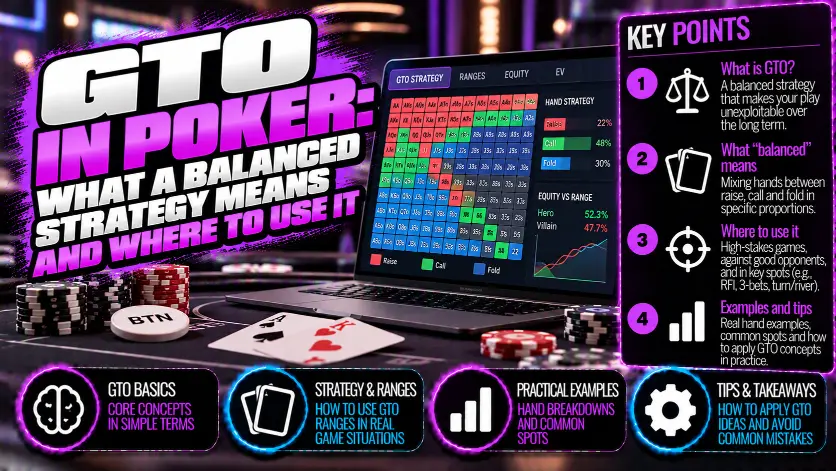
GTO in poker is a strategy that is hard to exploit: a player mixes actions at frequencies that leave the opponent no profit from adjusting. On a river with a $100 pot and a $50 bet, a caller is indifferent when 25% of the bettor’s bets are bluffs.
Equilibrium gives this guarantee only in a two-player zero-sum game, where one player’s gain equals the other’s loss. Rake, more than two players and an incomplete description of the game remove that guarantee. GTO does not promise profit, constant wins or protection from mistakes in your own decisions.
What GTO Means
GTO (Game Theory Optimal) means choosing actions at frequencies that prevent an opponent from gaining by changing their strategy against you. It concerns how you bet, check, call and fold across a range, not just which action you choose with one hand.
This is not a list of unconditional instructions such as “always bet a strong hand.” The same hand in the same situation may use different actions at different frequencies. Mixing serves a strategic purpose: it prevents predictable choices from giving an opponent a profitable response.
Separate the goal from the tool used to study it. GTO is a strategic benchmark; a solver is software that searches for a solution under specified conditions. A solver result does not become a universal instruction simply because it is presented as GTO.
The useful starting questions concern ranges. Which hands could reach this decision? Which would bet, and at what size? What would they do against a call or raise? An isolated action tells you little without the hands and frequencies behind it.
Why a Strategy Has to Be Balanced
A strategy needs appropriate action frequencies so that betting or checking does not reveal too much about hand strength. If you bet only strong hands, an opponent can fold more comfortably. If you bluff too often, they can benefit by calling more often.
A value bet aims to get called by a worse hand. A bluff serves a different purpose: getting a better hand to fold. When both use the same bet size, the caller must assess their relative presence in the betting range. Merely including some bluffs does not establish that the frequencies are appropriate.
Checking needs the same scrutiny. If every strong hand bets and only weak hands check, an opponent can attack those checks. The question is not whether one particular check looks reasonable, but whether the entire range taking that action can withstand pressure.
Mixing does not mean choosing every action equally often. Nor does being unpredictable automatically make a strategy sound. Randomly changing decisions can still leave clear weaknesses if the wrong hands enter each action or the frequencies make an opponent’s response too profitable.
Nash Equilibrium in Plain Language
A Nash equilibrium is a set of strategies where no player can improve their expected result by changing their strategy alone while everyone else keeps theirs unchanged. In a two-player zero-sum game, this provides the basis for protection against profitable adjustments.
Imagine both players have selected their betting, checking, calling and folding frequencies throughout the game being considered. Neither can improve their expectation simply by switching to a different strategy against the other’s unchanged strategy. This concerns expected results over repeated decisions, not who wins a particular hand.
Equilibrium therefore describes actions across a range, not one well-chosen hand. A range builder helps you examine a set of hands. Its “Run equity” button runs the tool’s equity calculation; it does not turn a manually selected educational range into a GTO solution.
That distinction matters when studying. A range you construct is an assumption about possible hands. It can reveal what you included or excluded, but it does not establish that your action frequencies form an equilibrium. Likewise, finding an unexploitable strategy is not the same task as finding the most profitable response to a particular opponent’s mistakes.
A River Example: $100 Pot, $50 Bet
With a $100 pot and a $50 bet, a 25% bluff share makes calling indifferent under specific assumptions: your bluff-catcher beats every bluff, loses to every value bet and cannot tie. There is no rake or further action, and combos have equal weights. The result is particularly sensitive to dead money and bet size: an unseen extra $20 in the pot changes it to 22.7%; a pot $20 smaller changes it to 27.8%. With the original pot, a $33 bet gives 19.9%, while a $67 bet gives 28.6%.
The required equity for a call is B / (P + 2B), where P is the pot before the opponent’s bet and B is the amount to call. Here, 50 / (100 + 2 × 50) = 25%. Equity is your expected share of the pot at showdown under the stated hand and board assumptions.
Educational diagram: with a $100 pot, the share of bluffs that makes a call indifferent rises from 20% to 33.3% as the bet growsEducational diagram from our own calculation with a $100 pot. Bluff share is the share of bluffs among the bettor’s bets, with equal-weight combos; it is not an observed frequency. MDF is minimum defense frequency.
You can check B / (P + 2B) with the pot odds calculator. Enter 100 in “Pot size (before the bet)” and 50 in “Bet to call.” The “Required equity” result shows the calling threshold. Do not add the opponent’s bet to the first field: that field asks for the pot before the bet.
The table below compares bet sizes into a $100 pot. The bluff share is the share of bluff combos among the hands that bet, not among the opponent’s entire range.
| Bet size | Bluff share that makes a call indifferent | Minimum defense frequency | Break-even fold share for a pure bluff |
|---|---|---|---|
| 1/3 pot | 20% | 75% | 25% |
| 1/2 pot | 25% | 66.7% | 33.3% |
| 2/3 pot | 28.6% | 60% | 40% |
| Full pot | 33.3% | 50% | 50% |
The table uses exact fractions of the pot, with percentages rounded as displayed. A $33 bet is not exactly one-third of $100, which is why its threshold is 19.9% rather than the table’s 20%. Compare the stated dollar amount with the exact fraction of the pot before reading the table.
Minimum defense frequency (MDF) uses a different formula: P / (P + B). For the half-pot bet, it is 66.7%. Defending means continuing play instead of folding. MDF is a range-level benchmark, not an instruction to call every particular bluff-catcher.
The break-even fold share for a pure bluff is B / (P + B), or 33.3% here. The calculator’s “Bluff must work” indicator refers to this bettor-side threshold. It describes the fold frequency needed for a pure bluff to break even, assuming no equity when called, no rake and no future action. Fold equity is the contribution to a bet’s expected value that comes from the opponent folding.
Under these assumptions, a call is profitable only if bluffs exceed 25% of the opponent’s bets. If the share is lower, calling loses; at exactly 25%, calling and folding have equal expected results. This is a simplified calculation with equal combo weights, not an observation of an actual opponent.
This is the balance point GTO looks for in this spot: a bettor with fewer bluffs lets the opponent fold every bluff-catcher, and one with more lets the opponent call every time, so a bettor who bluffs exactly 25% of bets leaves the caller indifferent.
Keep the three percentages separate. Bluff share describes the composition of bets. MDF describes how often a range continues. The pure-bluff threshold describes how often an opponent must fold. They answer different questions even when they use the same pot and bet size.
GTO Versus Exploitative Play
GTO aims to prevent an opponent from profiting through adjustments; exploitative play aims to profit from an opponent’s mistakes. Exploitative play can earn more against a weak opponent with a clear bias, but it can also be countered.
If an opponent rarely bluffs, calling with a bluff-catcher can be poor even when a general defense benchmark suggests continuing. If an opponent folds too often, bluffing more may be profitable. Both adjustments require evidence of a mistake, rather than an assumption that the opponent must be making one.
An exploitative adjustment can introduce a weakness of its own. If you fold more often because an opponent appears to underbluff, they could respond by bluffing more. That does not make every adjustment wrong; it means you should know what evidence supports it and what change would undermine it.
You do not have to choose one approach permanently. Learn the equilibrium logic first, then ask whether a specific opponent’s behavior justifies departing from it. The reason for the departure should be identifiable, not merely a desire to be unpredictable.
Where GTO Applies and Where It Does Not
GTO is useful for studying defense against bluffs, value-betting with an appropriately composed range, calling with a bluff-catcher and examining the hands you check. It is less useful as a rigid instruction against a weak opponent making a clear mistake, where exploitative play may earn more.
When reviewing a betting range, separate bluffs from value bets and identify which hands your own hand beats. In the river calculation, the bluff-catcher loses to the entire value-betting portion. If it also beats some hands that bet for value, bluff share alone no longer describes its equity.
When reviewing checks, examine all the hands left after you decline to bet. A range containing no sufficiently strong hands may be vulnerable to pressure. The study task is to understand that weakness, not to add a random strong hand to your checks and assume the problem is solved.
GTO also gives you a clearer way to explain decisions. Instead of saying you “felt a bluff,” identify plausible bluff combos, plausible value bets and the effect of the bet size on the price of calling.
Do not use equilibrium frequencies to excuse an unfavorable call against a known bias. An MDF benchmark cannot create bluffs that are absent from an opponent’s range. Protecting against a possible adjustment and responding best to someone’s actual play are different objectives.
Limits: Solvers, Multiway Pots and Rake
Full no-limit hold’em is not solved, and solvers approximate solutions through abstractions. The equilibrium guarantee for a two-player zero-sum game does not automatically extend to multiway pots, games with rake or an incomplete description of the situation.
The open survey of GTO poker on arXiv is an independent reference for GTO as unexploitable play, for the two-player zero-sum condition of the equilibrium guarantee, and for solvers approximating solutions through abstractions. The conclusions about rake and multiway pots above are our own reasoning from that condition, not the survey’s statements.
A solver needs defined conditions, including ranges, bet sizes and available actions. If some possible actions are excluded, its answer applies to the restricted game it examines. This does not make the answer useless, but it limits what you can conclude from it.
Precision within a simplified setup is not the same as completeness. A detailed display of frequencies cannot establish that the assumed opponent range matches the real one. Nor does a solution using restricted bet sizes cover every size an opponent might choose.
Multiway play changes the strategic problem because each decision affects several opponents. The two-player zero-sum guarantee no longer applies; this does not mean no equilibrium can exist, but it does mean a heads-up result is not a ready-made answer for a multiway pot.
Rake also changes the conditions. Money leaves the game, so one player’s gain is no longer simply the other’s loss. The river formulas above exclude rake and should not be treated as exact answers for every fee structure.
How to Study GTO
Start with the price of a call and the meaning of ranges, then move to bluff shares and action frequencies. Without that foundation, solver outputs are easy to memorise and difficult to apply when conditions change.
- Understand the price of calling. Study pot odds and implied odds until you can explain why a $100 pot and a $50 call require 25% equity. Keep the river calculation, with no future action, separate from situations where later bets remain possible. Use the calculator described above to check the threshold, not to estimate an opponent’s range for you.
- Represent ranges as sets of combos. Learn how to read preflop charts so that a range becomes something more precise than “a strong hand.” A range chart shows which hands are included; it does not by itself prove that a strategy is profitable. Use the range builder to inspect educational examples without treating them as solved GTO ranges.
- Change one assumption at a time. Return to the river example and first check the pot, then the bet size, then the proposed bluffs and value bets. This separates a change in the mathematical threshold from a change in your assessment of the opponent.
- Connect actions across a range. Examine which hands bet, which check and which continue against a bet. Ask why a hand belongs in an action before trying to memorise its frequency. A percentage without its range and conditions is not a transferable strategy.
- Practise interpreting the formulas. The poker math test is for practice with the same calculations. Check not only whether your percentage is correct, but whether it describes required equity, defense frequency or the fold share a pure bluff needs.
If you later study with a solver, read the calculation conditions before the output. Compare the assumed ranges and available bet sizes with the hand you are reviewing. The useful question is why those conditions produce those action frequencies, rather than which answer you should copy.
Frequently Asked Questions
GTO means mixing actions at frequencies that prevent an opponent from profiting by adjusting. Its equilibrium guarantee requires a fully described two-player zero-sum game.
No. Frequencies depend on ranges, bet sizes and available actions. In the river example, a 25% bluff share makes calling indifferent only when the bluff-catcher beats every bluff, loses to every value bet and cannot tie.
GTO does not promise profit or constant wins. The equilibrium guarantee concerns expected results against adjustments, not individual hands. Rake, additional players and incomplete assumptions limit its application.
Full no-limit hold’em remains unsolved. Solvers approximate solutions through abstractions, including restricted bet sizes and available actions. Their results apply to those assumptions rather than every possible situation.
Start with the price of a call, equity and ranges. Then study bluff shares and action frequencies. Check simple calculations with the pot odds calculator, build educational ranges in the range builder and practise with the poker math test before trying to memorise solver outputs.
Evgeniy Volkov
Verified ExpertFullstack developer with a background in mathematics. I build the calculators and game-style tools on ToolsGambling with Pixi.js and modern web tech, and every result uses transparent probability formulas you can verify yourself.