












Contents
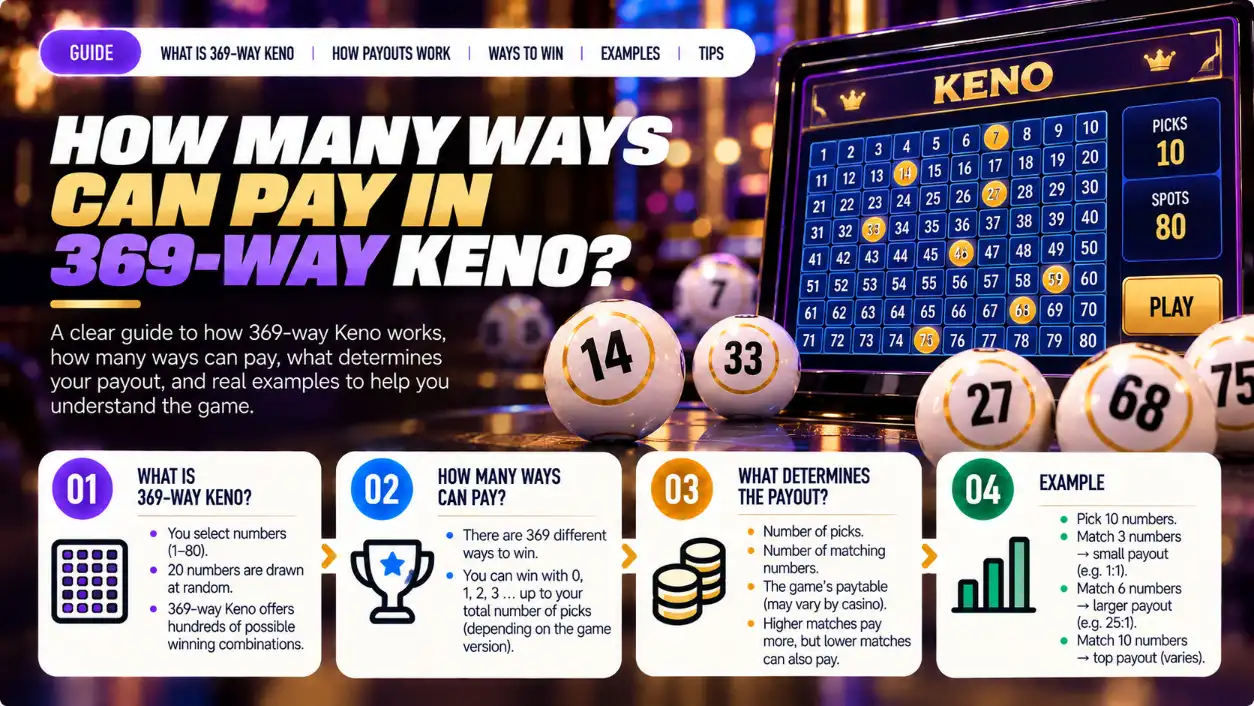
369 denotes 3-, 6- and 9-spot card sizes. Full seven-way play evaluates three 3-spot cards, three 6-spot cards and one 9-spot card. How many receive a positive payout depends on the draw, the active stakes and the posted paytable. The name does not mean 369 paid wins: in full play, between zero and seven cards can receive a positive payout.
369-Way Keno is a named IGT game listed in the official Game King catalog. The rules and teaching example below come from the original Wizard of Odds analysis. Wizard paytable 1 is a source-specific example, not a verified current paytable for every IGT machine. No machine play was observed for this guide, so it does not describe specific game buttons or an actual gambling result.
How A, B and C form seven cards
Three nonoverlapping groups of three selected numbers form seven separately scored cards: A, B, C, A+B, A+C, B+C and A+B+C.
In the analyzed variant, all seven cards share one draw of 20 unique numbers from 80. Each active card is scored by counting its catches—selected numbers that appear in the draw—and applying the relevant paytable row.
| Card | Groups included | Spots |
|---|---|---|
| A | A | 3 |
| B | B | 3 |
| C | C | 3 |
| A+B | A and B | 6 |
| A+C | A and C | 6 |
| B+C | B and C | 6 |
| A+B+C | A, B and C | 9 |
Instructional diagram showing groups A, B and C forming seven 3-, 6- and 9-spot cards
Original instructional seven-card map for the calculated example, not an IGT machine screenshot.
Wizard’s numbered rules contain a duplicated A+B entry. Its introduction describes the intended structure, and the independent seven-card list at MultiCardKeno confirms A+C as the third distinct pair.
These cards are not independent: they share both a draw and selected numbers. Our four-card keno guide explains a similar shared-draw principle, but 369-Way Keno uses this specific A/B/C layout.
Which catches pay under Wizard paytable 1?
Wizard paytable 1 pays for zero catches as well as certain higher catch counts. The complete schedule below shows gross payouts for a stake of one unit per card. These are credited returns, not net profit.
| Catches | 3-spot card | 6-spot card | 9-spot card |
|---|---|---|---|
| 0 | 1 | 1 | 1 |
| 1 | 0 | 0 | 0 |
| 2 | 2 | 0 | 0 |
| 3 | 11 | 2 | 0 |
| 4 | — | 5 | 1 |
| 5 | — | 49 | 5 |
| 6 | — | 1000 | 40 |
| 7 | — | — | 400 |
| 8 | — | — | 1000 |
| 9 | — | — | 5000 |
A dash means that catch count is impossible for that card size, rather than a zero payout.
The zero-catch rows in Wizard paytable 2 do not pay. Do not assume that zero catches return the stake in every version of 369-Way Keno.
Keep these three concepts separate:
- Catch: a selected number appears in the draw. A catch alone does not guarantee a payout.
- Gross payout: the amount credited for the card under the paytable.
- Net round result: total gross payout minus every active stake. A positive result is profit; a negative result is a loss.
A one-unit payout on a one-unit stake simply breaks even on that card.
Worked round: A/B/C catches of 2/1/0
With two catches in A, one in B and none in C, Wizard paytable 1 produces three positive-payout cards and a gross return of five units. With seven one-unit stakes, the net round result is minus two units.
This is a calculated example, not observed game play. It assumes all seven cards are active at equal one-unit stakes and uses the exact integer payouts above, so no rounding is needed. Because A, B and C do not overlap, their catches add together on the combined cards.
| Card | Catch calculation | Total catches | Stake, units | Paytable 1 gross payout, units |
|---|---|---|---|---|
| A | 2 | 2 | 1 | 2 |
| B | 1 | 1 | 1 | 0 |
| C | 0 | 0 | 1 | 1 |
| A+B | 2 + 1 | 3 | 1 | 2 |
| A+C | 2 + 0 | 2 | 1 | 0 |
| B+C | 1 + 0 | 1 | 1 | 0 |
| A+B+C | 2 + 1 + 0 | 3 | 1 | 0 |
| Total | 7 | 5 |
A, C and A+B receive positive payouts. The round settles as:
5 units returned − 7 units staked = −2 units.
The number of catches is not the number of paying cards: C pays with no catches, while A+C does not pay with two catches.
Even seven positive-payout cards need not mean a profit. If A, B and C all have zero catches, every derived card also has zero catches. Under paytable 1, each returns one unit: seven units returned on seven units staked is a break-even round.
What does full play cost, and what should you check?
With seven active cards at equal stakes, the total bet per draw is seven times the stake per card. The actual active cards, stake amounts and cash value of a credit must be checked on the game you are using.
Before staking, verify:
- Game identity. Confirm that the title is 369-Way Keno.
- Active cards and bets. Check the displayed card and bet indicators for A, B, C and the combined cards. The title alone does not establish that all seven are active.
- Posted paytable. Read the available rules or help information for the 3-, 6- and 9-spot cards, paying particular attention to zero-catch payouts.
- Payout basis and total bet. Establish which stake the displayed payouts apply to, what one credit is worth, and whether the active stakes add up to the displayed total bet.
No particular button sequence or denomination is assumed here. If the active stakes or paytable are unclear, this teaching example cannot tell you what that machine will credit.
How to check the return with our keno calculator
The ToolsGambling keno calculator evaluates one card at a time. To reproduce Wizard paytable 1, select 3, 6 and 9 spots in separate runs and edit every payout field for each selected card size.
| Spots | Gross payouts in order, starting at 0 catches | Theoretical RTP |
|---|---|---|
| 3 | 1, 0, 2, 11 | 84.6641% |
| 6 | 1, 0, 0, 2, 5, 49, 1000 | 84.9602% |
| 9 | 1, 0, 0, 0, 1, 5, 40, 400, 1000, 5000 | 84.2528% |
For each run, use the spot-count selector and enter the corresponding values into the payout fields for 0–3, 0–6 or 0–9 catches. Enter gross payouts, not net profit, and replace every row—including zeros—rather than leaving default values in place.
Local ToolsGambling keno calculator showing a 3-spot card with paytable 1 payouts of 1, 0, 2 and 11
Real local calculator UI showing the 3-spot paytable 1 calculation. This is not an IGT machine screen.
For seven equal stakes, weight the three card-size returns 3:3:1:
Seven-card RTP = (3 × 3-spot RTP + 3 × 6-spot RTP + 9-spot RTP) / 7.
The reproducible calculation uses the probability of each catch count for a 20-of-80 draw:
P(k catches on an s-spot card) = C(s, k) × C(80 − s, 20 − k) / C(80, 20).
Multiply each probability by its posted gross payout and sum across all possible catch counts to obtain that card’s expected return per unit staked. Weighting the unrounded card returns gives 84.7322%, matching Wizard’s published analysis. The individual calculator results above are rounded to four decimal places; the combined result is calculated before that rounding.
That figure belongs to Wizard paytable 1 only. It is not the probability of receiving a payout, a prediction for one round, or a universal current IGT machine RTP. Sharing a draw makes the card outcomes dependent, but their expected payouts can still be added.
The calculator does not construct the seven shared-draw cards or show their joint outcome distribution. Its best-spot suggestion is not a valid comparison here unless every payout row for every spot count being compared has been entered correctly; untouched defaults are not a 369-Way Keno comparison.
For broader guidance on paytable selection and gambling limits, see our video keno guide. For settling this named game, the essential rule is simpler: verify the active cards and posted schedule, add their gross payouts, then subtract the entire bet for the draw.
Evgeniy Volkov
Verified ExpertFullstack developer with a background in mathematics. I build the calculators and game-style tools on ToolsGambling with Pixi.js and modern web tech, and every result uses transparent probability formulas you can verify yourself.