












Contents
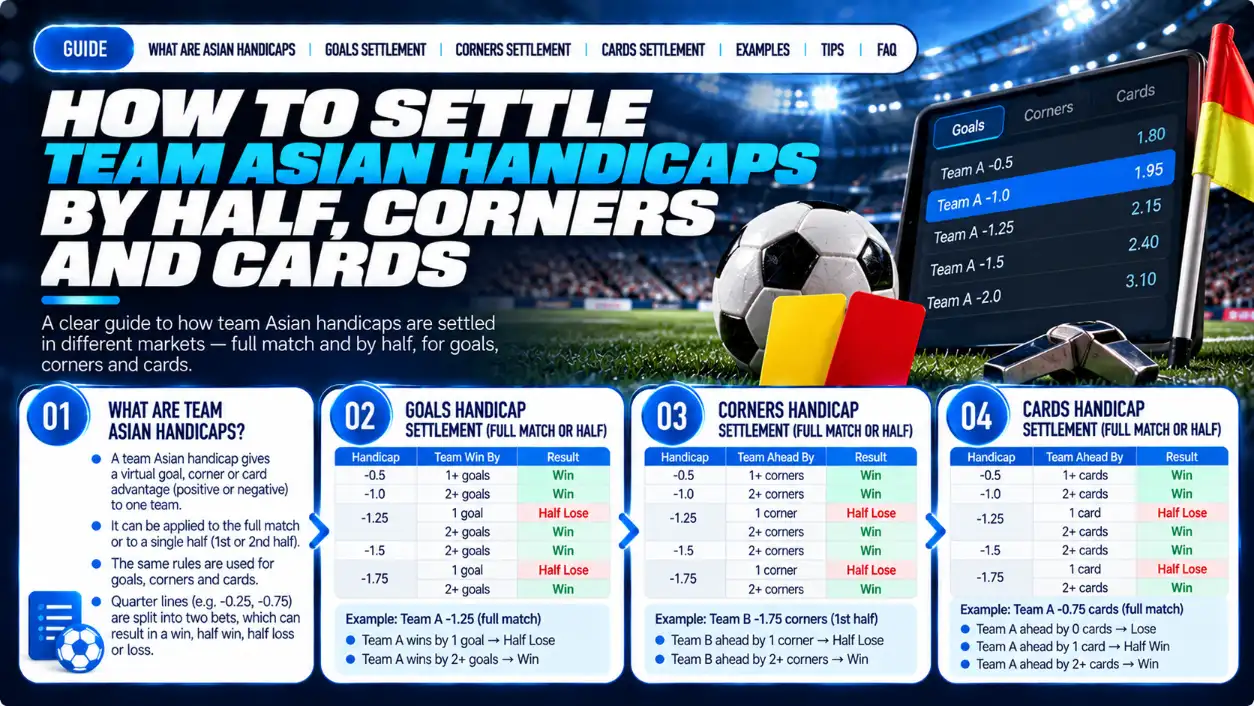
To check an Asian handicap, identify the period, counting object, market type, selected side, line and odds on the accepted betting slip, plus the stake for payout calculations. Compare the teams’ eligible counts for that period, add the handicap to your selected team’s count and settle the result. For a quarter line, split the stake equally between its two neighbouring lines.
This guide uses Bet9ja Sport T&C Part 2 v37, effective 15 October 2026, as a dated Nigerian-operator rule example, alongside Sport T&C v72, effective 5 June 2026. These are not universal bookmaker rules or confirmation that a market is available where you live or for a particular fixture. See the Part 2 rules and general terms.
Which count and period should you use?
Use the difference between the two teams’ eligible counts, not their combined total. A team Asian handicap is not an Asian total.
| Market | What to compare | Period |
|---|---|---|
| First-/second-half Asian handicap on goals | Selected team’s goals against the opponent’s goals | Named half only |
| Asian corner handicap | Corners taken by each team | Named half or match |
| Asian card handicap | Each team’s eligible card units | Named half or match |
Asian Handicap Yellow Cards | Yellow-card counts under that market’s specific terms | Match |
Asian Handicap Yellow Cards is a separately named market in Bet9ja Part 2 v37. Do not automatically apply the generic Cards market’s red-card weight to it. Booking points are another distinct market with their own scale; see the booking points guide.
For a live bet, check the accepted market’s own rules on when counting starts. Do not assume that the pre-match examples below apply, or import another operator’s convention for events after placement.
Which events count?
Count only eligible events in the specified period, using the rules for that particular object. Bet9ja Part 2 v37’s Soccer, Corner Betting and Card Betting sections set the following boundaries:
| Event | Treatment under this rule example |
|---|---|
| Goal in the selected half’s stoppage time | Included in that half’s goals |
| Goal in the other half | Excluded from the selected half |
| Extra-time periods or a penalty shootout | Normally excluded; check any specifically named market exception |
| Corner taken during the relevant period | Included in the corner count |
| Corner awarded but not taken | Excluded |
| Yellow card to a player on the pitch during the relevant period | 1 unit under the generic Cards scale |
| Red card to a player on the pitch during the relevant period | 2 units under the generic Cards scale |
| Dismissal following two yellow cards | Maximum of 3 units for that player under the generic Cards scale |
| Card shown during the half-time break or after the final whistle | Excluded |
| Card to a coach, someone on the bench or an already substituted player | Excluded |
Half-time goals: use only goals scored in the relevant half, including its stoppage time. A second-half handicap uses the second half’s own goal difference, not the full-time score. The general Asian handicap guide covers the underlying goal-line mechanics.
Corners: count corners actually taken within the market’s period. An award alone does not increase the count, even if it appears in a match commentary feed.
Cards: check the recipient and timing before applying the scale. The generic rule of yellow = 1, red = 2 and a maximum of 3 after two yellows does not establish that a red counts as “two yellows” in Asian Handicap Yellow Cards. That separate market needs its own clarification.
A teaching ledger: three separate counts
Team A has a margin of +1 in each example below, but each margin comes from a separate event ledger. This is a hypothetical first half, not a real fixture, price or betting slip.
| Object | Team A’s eligible events | Team B’s eligible events | First-half count |
|---|---|---|---|
| Goals | One goal | No goals | 1:0 |
| Corners | Five corners taken | Four corners taken | 5:4 |
| Card units | One yellow each to two different players on the pitch | One yellow to a player on the pitch | 2:1 |
Two additional events illustrate the exclusions:
- Team A is awarded another corner, but it is not taken before the half-time whistle. The count stays 5:4.
- A Team B player receives a yellow during the half-time break. The first-half card count stays 2:1.
The card example contains no red cards or second yellows to the same player. Its three eligible yellows produce three units without any disputed transfer of rules. Matching margins do not make goals, corners and cards interchangeable.
What does a +1 margin return at −0.75?
A 100-unit stake at decimal odds of 1.90 on −0.75 returns 145 units, for a net result of +45, when the selected team’s eligible margin is +1. This is a half-win: half the stake wins and half is pushed.
For each part of the stake, calculate:
Selected team’s count − opponent’s count + handicap
A positive result wins, zero is a push and a negative result loses. Split the quarter line as follows:
−0.75 → 50 units on −1 + 50 units on −0.5
With a margin of +1:
- −1: the adjusted result is zero, so 50 units are returned.
- −0.5: the adjusted result is positive, so the return is 50 × 1.90 = 95.
- Total return: 50 + 95 = 145.
- Net result: 145 − 100 = +45.
The arithmetic applies separately to the verified teaching counts: 1:0 in goals, 5:4 in corners and 2:1 in card units. It does not validate which events belong in those counts.
For comparison, keep the same 100-unit stake, decimal odds of 1.90 and margin of +1:
| Line | Settlement | Total return | Net result |
|---|---|---|---|
| −0.75 | 50 on −1 pushed; 50 on −0.5 won | 145 | +45 |
| −1 | Entire stake pushed | 100 | 0 |
| −1.25 | 50 on −1 pushed; 50 on −1.5 lost | 50 | −50 |
The final row is a half-loss. A return includes any refunded stake: receiving 50 back is not a profit of 50.
These examples assume that the eligible count has already been established and that the stated odds apply to the accepted stake. No rounding is needed here; check the betting slip’s settlement terms for actual currency precision.
How can you check the arithmetic in ToolsGambling?
Independently establish the first-half score, then enter 1:0 in the Final score field of the Asian handicap calculator with the stated hypothetical bet inputs. The calculator has no half selector: it checks only goal-handicap arithmetic, not the period or whether the event qualifies for the bet.
- Select Team A’s side.
- Set the handicap to −0.75.
- Enter decimal odds of 1.90 and a stake of 100.
- Enter 1 in Team A’s goals field and 0 in Team B’s.
To check the comparison cases, change only the handicap to −1, then −1.25. The expected total returns are 100 and 50, respectively.
Hypothetical local ToolsGambling interface check with first-half goals 1:0, handicap −0.75, stake 100 and decimal odds 1.90
Hypothetical local ToolsGambling interface check for a first-half goal handicap, not a bookmaker screenshot or betting slip.
The calculator does not validate corner or card eligibility, determine the period or check the accepted bookmaker slip. Entering 5:4 or 2:1 in the score fields is only an arithmetic analogy after independently establishing the eligible counts—not validation of a corner or card market.
What should you check when settlement differs?
First locate the mismatch: the accepted terms, event selection or payout arithmetic. Work through this checklist:
- Market and side: confirm the exact market name and selected team.
- Period: confirm match versus half and, for live bets, the applicable counting start.
- Event ledger: separate goals, corners taken and eligible card units; check timestamps and card recipients.
- Bet inputs: confirm the accepted line, decimal odds and stake.
- Rules and match status: check the applicable version, specific market conditions and whether play was interrupted.
An abandoned or postponed match does not automatically mean every bet is refunded. Under Soccer Article 2 of Bet9ja Part 2 v37, if the match is not completed within the stipulated window, markets not yet determined are voided while already determined markets are settled. Check whether your particular market was already determined and which conditions apply to the accepted slip.
Frequently Asked Questions
No. Keep the exact accepted betting slip, including the market name, period, selected team, handicap, odds and stake. A category heading does not replace the terms of the accepted bet.
Send the betting slip number, exact market wording, your eligible-event ledger with periods and card recipients, expected return and applicable rules version. If a market-specific condition conflicts with the general rules, leave the result unconfirmed until support clarifies it.
Evgeniy Volkov
Verified ExpertFullstack developer with a background in mathematics. I build the calculators and game-style tools on ToolsGambling with Pixi.js and modern web tech, and every result uses transparent probability formulas you can verify yourself.