










Contents
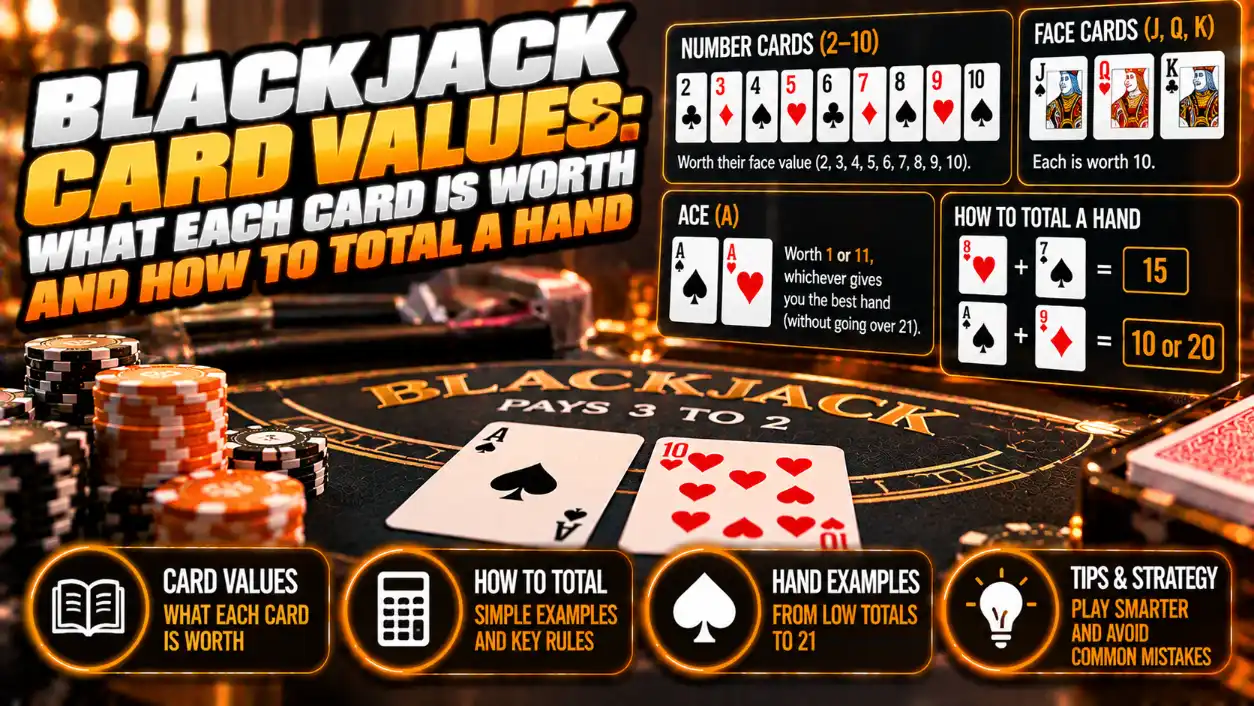
Cards 2 to 10 are worth their face value in blackjack, jack, queen and king are worth 10 each, an ace counts as 1 or 11, and a hand is the sum of its points. Our calculation shows that 4 ranks in 13 are worth 10 (30.77%), so on an infinite deck a hard 16 busts on the next card in 61.54% of cases, while a soft hand cannot bust on one card. This is the general counting rule; a given table, Spanish 21 and side bets can score differently.
Across the tested variants—one deck, six decks, and Spanish 21—the risk of busting on hard 16 stays within 58.04–61.54%, so it remains above half. This is the risk of busting on a one-card draw, not advice on which action to choose.
How many points is each card worth?
Cards 2–9 are worth their face value, a ten and face cards are worth 10 each, and an ace is worth 1 or 11.
| Card | Points | Ranks out of 13 |
|---|---|---|
| 2–9 | Face value | 8 |
| 10, J, Q, K | 10 | 4 (30.77%) |
| A | 1 or 11 | 1 (7.69%) |
Source for card points and the rule that a two-card blackjack outranks other totals of 21: Wizard of Odds blackjack basics.
The face cards are jack, queen and king. A ten is not a face card, although it is also worth 10 points. An ordinary deck contains 16 10-value cards out of 52. Their share is 30.77% in one, six or eight complete decks, as well as in the infinite-deck model.
Equal points do not mean equal ranks: 10 and K add the same amount to a hand, but whether different 10-value ranks may be split depends on the table rules. See the explanation of whether to split tens in blackjack.
How do you count a hand with an ace?
Add the points with every ace initially counted as 1. If the hand contains an ace and the total is no more than 11, add 10 so that one ace counts as 11.
Teaching diagram of counting a blackjack hand in four steps: card points, sum with aces as 1, add 10 for a soft hand, bust above 21Teaching diagram, not a screenshot: the steps and the A+7+9 example follow the New Jersey rule and Wizard of Odds.
Under New Jersey regulation §13:69F-2.2, an ace counts as 11 unless that would take the total above 21, in which case it counts as 1; jack, queen and king are each worth 10.
Hard and soft totals are defined in §13:69F-2.1 of the same regulation. Only one ace in a hand can count as 11, because two elevens already total 22.
| Hand | Total | Type | Reason |
|---|---|---|---|
| K+7 | 17 | Hard hand | No ace |
| A+7 | 18 | Soft hand | 11+7 = 18 |
| A+7+9 | 17 | Hard hand | Ace as 11 would give 27 |
| A+A | 12 | Soft hand | 11+1 = 12 |
| A+A+9 | 21 | Soft hand | 11+1+9 = 21 |
| A+5+5 | 21 | Soft hand | 11+5+5 = 21 |
| K+5+6 | 21 | Hard hand | 10+5+6 = 21 |
| A+2+3+10 | 16 | Hard hand | 1+2+3+10 = 16 |
| 10+6+8 | 24 | Bust | Above 21 |
In A+7+9, the ace counts as 1, so the total is 17 rather than a bust. The same procedure works for any number of cards.
What are soft and hard hands?
A soft hand contains an ace currently counted as 11. A hard hand either has no ace or has all its aces counted as 1.
An ace changes to 1 when counting it as 11 would take the total above 21. Thus A+7 is soft 18, while A+7+9 is hard 17. The hand type depends on how the ace contributes to the current total, not simply on whether an ace is present.
A hard hand whose ace already counts as 1 does not become soft by adding cards. A hard hand without an ace can become soft when an ace arrives: 2+3 followed by A, for example, becomes soft 16.
A soft hand cannot bust on one card. Our calculation checked every soft total from 12 to 21 against all 13 ranks and found 0 busts.
What happens to A+7 after one more card?
| Result | Next card | Probability |
|---|---|---|
| Soft 19, 20 or 21 | A, 2, 3 | 23.08% |
| Hard 12–17 | 4, 5, 6, 7, 8, 9 | 46.15% |
| Hard 18 | 10, J, Q, K | 30.77% |
Base: infinite deck. Each rank is equally likely; percentages are rounded to two decimal places.
You can use blackjack basic strategy flashcards to practise identifying the hand type separately from choosing an action.
The dealer counts points in the same way. Under the rules described by Wizard of Odds, the dealer takes another card on 16 or less; the action on soft 17 is set by the table rules.
Which total of 21 counts as blackjack?
A blackjack is an ace plus a 10-value card in the initial two-card hand. A total of 21 from three or more cards is simply 21; an ace plus a 10-value card after a split usually counts as 21 rather than blackjack.
A two-card blackjack commonly pays 3:2, though 6:5 payouts also exist. At stake 20, the difference in net profit is 6. The blackjack tips guide also explains these payout differences.
| Kind of 21 | Example | Net profit at stake 20 | Total return |
|---|---|---|---|
| Two-card blackjack, 3:2 | A+K | 30 | 50 |
| Two-card blackjack, 6:5 | A+K | 24 | 44 |
| Three-card 21 | K+5+6 | 20 | 40 |
| 21 after a split | A+K | 20 | 40 |
These amounts assume the dealer does not have blackjack. The ordinary 21 examples are winning hands paid at 1:1; the split example assumes it is treated as ordinary 21. Total return includes the returned stake.
In New Jersey, a simple 21 loses to a dealer blackjack, while a player blackjack beats a dealer’s 21 made with three or more cards. Equal scores void the wager, producing a push. Source: New Jersey regulation N.J.A.C. 13:69F-2.3. Blackjack on both sides is also a push, as Wizard of Odds describes.
What is the bust risk for each total?
A hard total of 11 or less cannot bust on one more card. At hard 12, the risk is 30.77%; each additional point then adds one busting rank, or approximately 7.69 percentage points. In the base model, the risk exceeds half starting at hard 15.
| Hard total | Bust on next card | Cards causing a bust |
|---|---|---|
| 11 or less | 0% | None |
| 12 | 30.77% | 10, J, Q, K |
| 13 | 38.46% | 9 and higher |
| 14 | 46.15% | 8 and higher |
| 15 | 53.85% | 7 and higher |
| 16 | 61.54% | 6 and higher |
| 17 | 69.23% | 5 and higher |
| 18 | 76.92% | 4 and higher |
| 19 | 84.62% | 3 and higher |
| 20 | 92.31% | 2 and higher |
| 21 | 100% | Every rank, including A |
Base: infinite deck, with each rank having probability 1/13. Cards on the table are ignored; percentages are rounded to two decimal places. At hard 21, even an ace counts as 1 and produces 22, a bust.
The figures 30.77% and 38.46% also appear in the explanation of blackjack 13 vs 2. Here, they describe only the risk of the next card.
For hard 16, the base risk changes when the remaining deck composition is taken into account. The largest change tested comes from Spanish 21: six decks with a 9+7 hand give 58.04%, which is 3.50 percentage points below the base.
Sensitivity of hard 16 bust risk
| Assumption | Hard 16 bust risk | Change, percentage points |
|---|---|---|
| Infinite deck | 61.54% | 0 |
| One deck; hand 10+6 | 60.00% | −1.54 |
| Six decks; hand 10+6 | 61.29% | −0.25 |
| Six decks; 10+6; dealer K | 61.17% | −0.37 |
| One deck; 10+6; dealer K | 59.18% | −2.36 |
| Spanish 21; six full decks | 58.33% | −3.21 |
| Spanish 21; six decks; 9+7 | 58.04% | −3.50 |
Base: infinite deck. Where a hand is specified, its cards are removed from the remaining decks; where the dealer’s K is specified, it is also removed. Other cards are not accounted for. Values and changes are rounded to two decimal places.
With an ordinary deck, the first hard total whose risk exceeds 50% is 15: the base-model risk is 53.85%. In fresh Spanish 21 decks, hard 15 gives exactly 50.00%, so the first total above half is 16. That 50.00% applies only before any cards have been removed; the cards in a hand already change it.
If the deck is ordinary and table cards are ignored, then hard 16 busts on the next card more often than not. But bust risk does not determine the action: that also depends on the dealer’s upcard and the rules.
How does the tool show hand totals?
Select two player cards and the dealer’s upcard in the "Look up one hand" block. Beneath the action, the tool shows "17" for K+7 and "soft 18" for A+7.
ToolsGambling single-hand lookup: K and 7 against 9 show the label 17 and Stand, A and 7 against 9 show the label soft 18 and HitFrame of our tool, 2026-10-17: cards picked by hand, default rules (six decks, S17, 3:2 payout), hand labels shown as the tool prints them.
The "soft 18" label means a total of 18 with an ace counted as 11. In the K+7 example, "17" represents hard 17.
The displayed actions "Stand" and "Hit" reflect basic strategy under the default rules: six decks, dealer stands on soft 17 (S17), and a 3:2 blackjack payout. They are not derived from bust risk alone.
The tool does not display a detailed points calculation or the chance of busting on the next card; the tables above come from our calculation. For the separate question of choosing an action, consult the blackjack basic strategy chart with the dealer’s card and rules in mind.
What changes in Spanish 21 and side bets?
Spanish 21 uses a 48-card deck: an ordinary 52-card deck with the four tens removed. The face cards—jack, queen and king—remain and are worth 10 each. The game uses six or eight such decks.
Source for deck composition and deck counts: the Spanish 21 page on wizardofodds.com, dated August 3, 2026.
There are 12 10-value cards out of 48, or 25%. The ordinary-deck probabilities therefore cannot be applied without adjustment. The Spanish 21 strategy cheat sheet explains the variant further.
Side bets may score cards differently. In New Jersey, an ace among the first two cards counts as 1 for one additional wager. Source: New Jersey regulation §13:69F-2.2(b)3. Read the main-game rules and the selected side bet’s rules separately.
Frequently Asked Questions
No. Points depend on rank, not suit. When selecting cards in the tool, the suit does not affect the hand total either.
In ordinary blackjack equal totals are a push and your stake is returned; blackjack on both sides is also a push. Exceptions: a dealer blackjack beats a player’s simple 21, and a player blackjack beats a dealer’s three-card 21. In New Jersey an equal score voids the wager. In Spanish 21, how 21 against 21 settles is set by the table rules, so check them.
No: two elevens make 22. In A+A, one ace counts as 11 and the other as 1, making soft 12.
No. The face cards are jack, queen and king. A ten is worth the same 10 points but is a different rank.
Use the same counting procedure regardless of the number of cards. For example, A+2+3+10 = 1+2+3+10 = 16. Counting the ace as 11 would give 26, so this is hard 16.
Evgeniy Volkov
Verified ExpertFullstack developer with a background in mathematics. I build the calculators and game-style tools on ToolsGambling with Pixi.js and modern web tech, and every result uses transparent probability formulas you can verify yourself.