











Contents
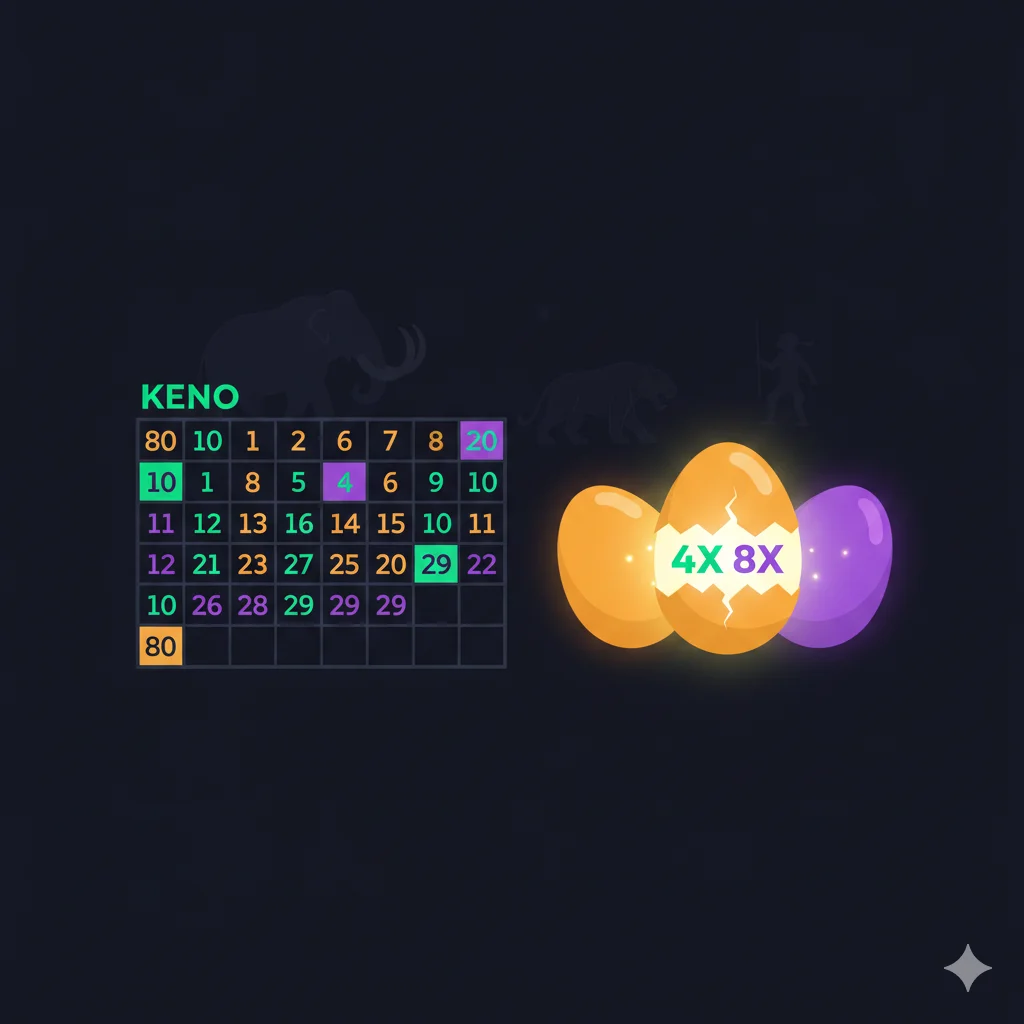
Three dinosaur eggs drop onto the keno board before the draw. Twenty numbers come up, two of the eggs hatch, and your ordinary 3-of-5 catch pays out 4x. The player beside you on standard keno picked the same numbers, caught the same three, and walked away with a quarter of the money. That one mechanic is why Caveman Keno posts some of the highest returns on the casino floor: 91-94% on good machines in 2026, against 85-92% for standard video keno.
The problem: those returns only show up if you know how the eggs really work, how many spots to pick, and how to read a pay table before you sit down. Most players never check, and it quietly costs them.
This guide covers the real caveman keno strategy: how the egg mechanic works mathematically, which spot counts give you the best return, a strategy chart you can reference at the machine, and a step-by-step approach for beginners. No miracle systems. No "lucky number" nonsense. Just the math and decisions that actually affect your results.
Compare paytables the honest way with our keno odds calculator, which shows the true RTP of any ticket.
TL;DR, Caveman Keno Strategy Cheat Sheet
Key Numbers at a Glance
| Factor | Recommendation |
|---|---|
| Best Spot Count | 4-6 spots (5 is the sweet spot) |
| Caveman Keno RTP | 91-94% on casino floor machines |
| Egg Multiplier (2 eggs) | 4x, hits ~13.9% of draws |
| Egg Multiplier (3 eggs) | 8x, hits ~1.4% of draws |
| Expected Multiplier | ~1.51x averaged across all draws |
| Bankroll Per Session | 100-200x your bet size |
| Hot/Cold Numbers | Myth, every number has 25% chance |
| Best Approach | Check pay table → pick 4-6 spots → flat bet → set limits |
What it comes down to: Caveman Keno's egg mechanic gives it a higher expected multiplier (~1.51x) than standard keno, which means better RTP on equivalent pay tables. But the base pays are lower to account for the bonus, so you need those egg hatches to hit the full return. Pick 4-6 spots, check the pay table, and manage your bankroll. Use our session simulator to model typical outcomes, and the bankroll calculator to set proper limits before you play.
What Is Caveman Keno? (And How It Differs from Regular Keno)
Caveman Keno is a video keno variant with one major twist: before each draw, the game places 3 dinosaur eggs on random numbers across the 80-number board. If enough of those egg numbers get drawn, your winnings are multiplied. Everything else, picking spots, the 20-number draw, the pay table, works exactly like standard video keno.
The game was designed by Caveman Games (now part of IGT's keno library) and has become one of the most popular keno variants on casino floors and online platforms. In 2026, you'll find Caveman Keno on most multi-game keno terminals alongside Cleopatra Keno, Superball Keno, and standard video keno.
The Egg Mechanic Explained
Here's exactly how the eggs work, step by step:
- You pick your spots, choose 2-10 numbers from the 80-number board
- 3 eggs appear, placed on 3 random numbers (can be on your picks or not)
- 20 numbers are drawn, standard keno draw from the 80-number pool
- Eggs hatch if drawn, any egg whose number is among the 20 drawn numbers "hatches" into a baby dinosaur
- Multiplier applied, based on how many eggs hatched:
| Eggs Hatched | Multiplier | Probability Per Draw |
|---|---|---|
| 0 | 1x (no bonus) | 41.65% |
| 1 | 1x (no bonus) | 43.08% |
| 2 | 4x | 13.87% |
| 3 | 8x | 1.39% |
The key insight: The eggs hatch based on whether their numbers are drawn, this is independent of your picks. You don't need the egg to be on one of your spots for it to hatch. But the multiplier only matters if you actually win something on that draw. Hatching 3 eggs with zero catches still pays $0.
The expected multiplier across all draws is approximately 1.51x. This means that over thousands of draws, the egg bonus effectively multiplies your base return by about 51%. The pay table accounts for this, Caveman Keno base payouts are lower than standard keno to keep the overall RTP in the target range.
Caveman Keno vs Regular Keno vs Cleopatra Keno
| Feature | Caveman Keno | Standard Video Keno | Cleopatra Keno |
|---|---|---|---|
| Bonus Mechanic | 3 eggs → 4x/8x multiplier | None | Last ball → extra draws |
| RTP Range | 91-94% | 85-92% | 92-95% |
| Volatility | Higher (multiplier swings) | Standard | Higher (bonus rounds) |
| Base Pay Table | Lower (offset by multiplier) | Standard | Lower (offset by bonus) |
| Best For | Players who like random bonus hits | Conservative players | Bonus-round fans |
| Where to Find | Casino floor, online | Everywhere | Casino floor, online |
Caveman Keno sits between standard keno (no bonus, lower volatility) and Cleopatra Keno (bonus draws, highest RTP). The egg mechanic adds excitement without the complexity of bonus round rules. If you want a detailed comparison of all video keno variants, see our video keno strategy guide.
Caveman Keno Odds and Pay Tables
Understanding the actual probabilities is what separates strategic players from people randomly tapping numbers. The odds in Caveman Keno are the same as standard keno for the base draw, the egg multiplier is layered on top.
Return to Player (RTP) by Number of Spots
The base keno probabilities follow the hypergeometric distribution:
In plain English: 20 numbers are drawn from 80, and this formula calculates your chance of matching exactly k of your s chosen spots. Caveman Keno uses the same math, then multiplies your payout by the egg bonus.
Here are the key probabilities for popular spot counts:
4-Spot Probabilities (Caveman Keno):
| Catch | Probability | Base Payout | With 4x Eggs | With 8x Eggs |
|---|---|---|---|---|
| 0/4 | 30.83% | $0 | $0 | $0 |
| 1/4 | 43.27% | $0 | $0 | $0 |
| 2/4 | 21.26% | $1 (1x) | $4 | $8 |
| 3/4 | 4.32% | $3 (3x) | $12 | $24 |
| 4/4 | 0.31% | $56 (56x) | $224 | $448 |
6-Spot Probabilities (Caveman Keno):
| Catch | Probability | Base Payout | With 4x Eggs | With 8x Eggs |
|---|---|---|---|---|
| 0/6 | 16.66% | $0 | $0 | $0 |
| 1/6 | 36.35% | $0 | $0 | $0 |
| 2/6 | 30.83% | $0 | $0 | $0 |
| 3/6 | 13.00% | $1 (1x) | $4 | $8 |
| 4/6 | 2.85% | $4 (4x) | $16 | $32 |
| 5/6 | 0.31% | $40 (40x) | $160 | $320 |
| 6/6 | 0.013% | $1,000 (1000x) | $4,000 | $8,000 |
Notice how the base payouts are lower than standard keno, but the multiplied payouts push them well above. Catching 6/6 with 3 hatched eggs pays $8,000 on a $1 bet, that's the Caveman Keno jackpot dream. The win probability calculator can model your exact odds for any session length and spot count.
| Spots Played | Typical RTP | Zone |
|---|---|---|
| 1 | 75% | Avoid |
| 2 | 72% | Avoid |
| 3 | 74% | Avoid |
| 4 | 86% | Sweet zone |
| 5 | 88% | Sweet zone |
| 6 | 90% | Sweet zone |
| 7 | 91% | Still strong |
| 8 | 92% | Still strong |
| 9 | 90% | Avoid |
| 10 | 87% | Avoid |
Probability of Hatching 2 vs 3 Eggs
The egg hatch math uses the same hypergeometric distribution. Three eggs are placed on 3 of 80 numbers, and 20 numbers are drawn:
In plain English: with 3 eggs on the board and 20 numbers drawn, each egg has a 25% chance of its number being drawn (20/80). The exact probabilities account for the without-replacement nature of the draw.
What this means in practice: Roughly 1 in 7 draws (13.87%) will give you the 4x multiplier. About 1 in 72 draws (1.39%) will give you the 8x multiplier. Over a 200-draw session, you'd expect about 28 draws with 4x and about 3 draws with 8x. The question is whether those multiplied draws coincide with actual catches, that's where the real variance lives.
How Pay Tables Differ Between Casinos
Not all Caveman Keno machines are created equal. The same game name can have dramatically different pay tables:
| Machine Location | Typical Base RTP | With Egg Multiplier |
|---|---|---|
| Casino floor (major property) | 60-62% base | 91-94% effective |
| Casino floor (local/regional) | 56-60% base | 85-91% effective |
| Bar-top | 48-55% base | 73-83% effective |
| Online (licensed) | 60-63% base | 91-95% effective |
Always check the pay table BEFORE playing. Press "Paytable" or "Help" on the machine and compare mid-tier payouts (3/4 or 3/5 catches). If they look lower than the numbers in our tables above, you're on a poor-paying machine. The house edge calculator can convert specific pay table numbers to RTP percentages.
Published Pay Tables: Why There Is No Single Best Spot Count
The floor RTP figures above assume typical mid-range machines. Published pay tables vary far more than that. The Wizard of Odds documents ten official Caveman Keno pay tables returning anywhere from 82.39% to 95.36%, and the best spot count shifts with the table:
| Pay Table | 3-Egg Multiplier | Average RTP | Best Pick | Peak Return |
|---|---|---|---|---|
| 1 | 10x | 88.02% | 8 | 89.63% |
| 2 | 8x | 86.89% | 7 | 88.57% |
| 3 | 8x | 88.00% | 3 | 88.68% |
| 5 | 10x | 90.05% | 5 | 91.64% |
| 7 | 8x | 91.44% | 3 | 92.43% |
| 9 | 8x | 94.09% | 2 | 95.05% |
| 10 | 8x | 95.11% | 3 | 95.36% |
On the most generous tables (9 and 10, common online), low picks of 2-3 actually deliver the top return, the opposite of the floor-machine pattern where mid picks win. The lesson is not a fixed magic number. It is this: the pay table in front of you decides the best spot count, so read it before you commit. Our keno odds calculator converts any pay table into a true RTP in seconds.
Best Caveman Keno Strategy: How Many Numbers to Pick?
The number of spots you pick has the single biggest impact on your expected return, bigger than number selection, egg chasing, or any "system." This section breaks down each viable spot count.
2-Spot Strategy (High Frequency, Low Payout)
Playing 2 spots is the simplest Caveman Keno approach: pick two numbers, hope both get drawn. The catch probability (2/2) is about 6%, paying 12-15x on most machines.
The problem: 2-spot has the lowest RTP in Caveman Keno, typically 75-80%. The pay table can't offer much because the base hit is relatively common (25% for catching at least 1), and the top hit (2/2) isn't rare enough to justify a large payout. The egg multiplier helps, but starting from a low base means even 4x doesn't push you into competitive RTP territory.
Verdict: Not recommended unless you purely want entertainment with frequent small hits and accept a high house edge.
4-8 Spot Strategy (Optimal Balance)
This is the sweet zone, and it's what Google's AI Overview already recommends for Caveman Keno. Here's why:
4-Spot: The entry point. Catching 4/4 pays 56-91x (base, depending on pay table), with egg multipliers pushing that to 224-728x. RTP sits at 86-91%. The hit frequency for any win is about 26%, so you'll catch something roughly 1 in 4 draws.
5-Spot: Often the single best choice for balanced play. Catching 5/5 pays 200-500x base, with 8x eggs pushing that to 1,600-4,000x. But the real value is the mid-tier catch: 3/5 hits about 8.4% of the time and keeps your session alive. RTP: 88-92%.
6-Spot: The highest consistent RTP zone. Catching 6/6 pays 1,000-1,500x base, with 3 hatched eggs, that's $8,000-$12,000 on a $1 bet. The trade-off is lower hit frequency for the top catch (0.013%). RTP: 90-94%.
7-8 Spot: Higher volatility with the potential for maximum RTP (91-94%). The top catches are extremely rare (7/7 hits once in ~41,000 draws, 8/8 once in ~230,000), so your session mostly depends on mid-tier catches and egg multipliers. Best for experienced players with larger bankrolls.
Why More Spots Means More Egg Value
Here's something no other guide explains: the egg multiplier's effective impact increases with more spots. With 2 spots, you rarely catch anything, so the 4x or 8x multiplier usually applies to $0. With 6 spots, you catch something 16% of draws, so the multiplier has more opportunities to boost real winnings. The egg bonus is most valuable when paired with 5-7 spot play.
Optimal Number Selection in Practice
There's no mathematically superior set of numbers. Every number from 1 to 80 has the exact same probability of being drawn: 20/80 = 25%. The RNG treats all numbers identically.
What does matter:
- Spot count, directly affects RTP and hit frequency (pick 4-6)
- Pay table quality, varies by 10-20% between machines
- Consistency, pick numbers you'll remember and stick with (for comfort, not for math)
The numbers themselves are irrelevant. Pick birthdays, lucky numbers, random taps, the expected return is identical regardless. If anyone tells you certain numbers are "due" or "hot," show them the gambler's fallacy simulator. It demonstrates exactly why that intuition is mathematically wrong.
Caveman Keno Strategy for Beginners
If you've never played Caveman Keno before, or you've been playing without thinking about the pay table or spot count, this section is your starting playbook.
Step-by-Step: Your First 10 Games
- Set your budget. Decide the maximum you'll lose before sitting down. This should be entertainment money, not bill money, not savings. $20-$50 is plenty for a first session at $0.25 bets.
- Find a casino floor machine (not bar-top). Casino floor Caveman Keno typically runs 91-94% RTP. Bar-top machines can be as low as 73%.
- Check the pay table. Press "Paytable" or "Help." Look at what catching 3/4 pays. If it's less than 3x your bet, find a different machine, the RTP is poor.
- Start with 5 spots. Five-spot gives you the best combination of reasonable RTP (~90%), decent hit frequency (~34%), and interesting payout potential. Don't overthink which numbers, just tap five you like.
- Watch the eggs. Before each draw, notice where the 3 eggs land. After 10 draws you'll start recognizing the hatch animation and multiplier pattern: ~14% of draws give 4x, ~1.4% give 8x. Most draws are 1x.
- Flat bet every draw. Play the same bet size for all 10 games. Never increase after a loss or a win. Flat betting is the mathematically optimal approach for any negative-EV game.
- Note your results. After 10 draws, check your balance. You'll likely be within 30-50% of your starting bankroll. This gives you a feel for the pace of the game.
Bankroll Management Basics
Rule of thumb: Budget 100-200x your bet size per session.
For a $0.50 per game player, bring $50-$100. At 200 draws per hour, that gives you 30-60 minutes of play.
Key principles:
- Stop-loss at 50%, walk away when your bankroll drops to half your buy-in
- Win goal at 150%, cash out when your balance grows by 50%
- Speed kills, video keno plays at 200-400 draws per hour, burning bankroll fast
At $1 per draw with 10% house edge, you're losing about $20-$40 per hour on average. The loss calculator puts this in perspective when you see the monthly totals. And every betting system ever invented, from Fibonacci to Martingale, fails to change this fundamental math.
Free Play Before Real Money
Many online casinos offer Caveman Keno in demo or free-play mode. Use it:
- Learn the egg animation, so you can instantly recognize hatches during real play
- Test different spot counts, play 50 draws at 4-spot, then 50 at 6-spot. Feel the difference in hit frequency and payout size
- Find pay table differences, compare free-play Caveman Keno across 2-3 platforms. The pay tables genuinely differ, and you want to play on the best one
- Practice bankroll discipline, even with fake money, set a budget and stick to it. Build the habit before real money is at stake
Free play can't replicate the emotional pressure of real-money decisions, but it teaches you the game mechanics without any cost. Use it.
Advanced Caveman Keno Strategies
Once you understand the basics, spot count, pay tables, bankroll management, these advanced approaches can optimize your session experience. None of them change the house edge, but they change how you interact with the variance.
Multiplier Optimization (How to Target the Eggs)
You can't control where the eggs appear or whether they hatch, both are RNG-driven. But you can think about the egg multiplier's impact on your overall session:
Focus on mid-tier catches. The egg multiplier is most valuable when it hits on a real payout. Catching 3/5 (pays 3x base) with a 4x egg = 12x total. Catching 3/5 without eggs = 3x. That's a 4x difference on a catch that happens 8.4% of draws. Over 200 draws, you'll get about 17 mid-tier catches, and roughly 2-3 of those will coincide with a 4x or 8x multiplier.
The math behind expected multiplied payouts:
| Catch | Base Pay | Frequency | Expected with Multiplier |
|---|---|---|---|
| 3/5 | 3x | 8.39% | 3x × 1.51 = 4.53x average |
| 4/5 | 15x | 1.21% | 15x × 1.51 = 22.65x average |
| 5/5 | 500x | 0.06% | 500x × 1.51 = 755x average |
The expected multiplier of 1.51x applies uniformly to all payouts. There's no way to "target" the eggs strategically. But understanding that roughly half your lifetime payouts come from multiplied draws changes how you think about session planning.
Expected Multiplier Distribution Over Sessions
In a 100-draw session:
- ~42 draws: 0 eggs hatch (1x)
- ~43 draws: 1 egg hatches (1x)
- ~14 draws: 2 eggs hatch (4x)
- ~1-2 draws: 3 eggs hatch (8x)
In a 500-draw session, you'd expect about 7 draws with the 8x multiplier. Whether any of those 7 coincide with a meaningful catch is pure luck, but 500 draws gives you a reasonable sample.
Grid Pattern Play (Clusters, Rows, Corners)
Some players organize their number selection by board regions. The keno board is an 8×10 grid of numbers 1-80. Common patterns:
- Cluster: Pick all numbers from a small region (e.g., 31-35)
- Diagonal: Pick numbers along a diagonal line
- Corners: Pick numbers from the four corners of the board
- Columns: Pick one number from each column
The honest truth: None of these patterns change your probability. Each number has a 25% chance of being drawn regardless of position on the board. Patterns are a comfort tool, they give you a consistent approach and make the board easier to read visually. If using a pattern makes your session more enjoyable and keeps you disciplined, use it. Just don't believe it improves your odds.
The volatility calculator can show you that two different 5-number selections (random vs. clustered) produce identical variance over 1,000 draws.
Caveman Keno Plus Strategy (Extra Balls Feature)
Caveman Keno Plus takes the standard egg mechanic and adds an extra ball feature. After the initial 20-number draw, if certain conditions are met (typically catching a specific number of spots), you receive 1-3 bonus draws. These extra numbers can improve your result, turning a 3/6 catch into a 4/6 or 5/6.
How Caveman Keno Plus differs:
| Feature | Caveman Keno | Caveman Keno Plus |
|---|---|---|
| Egg Multiplier | Yes (4x/8x) | Yes (4x/8x) |
| Extra Balls | No | Yes (1-3 bonus draws) |
| RTP | 91-94% | 92-95% |
| Volatility | High | Very High |
| Base Pay Table | Lower than standard | Even lower (offset by both bonuses) |
| Best For | General players | High-variance seekers |
Strategy adjustment for Plus: The extra ball feature increases variance further. Your session results become more "spikey", longer dry spells punctuated by bigger hits when the extra balls connect. Budget 150-250x your bet (not 100-200x) to account for the higher volatility. The session simulator can model how the extra balls affect your session outcomes.
Caveman Keno Strategy Chart
This is the reference table you can save and check at the machine. It combines spot count, egg impact, and practical recommendations:
Spot-by-Spot Recommendation Guide
| Spots | RTP Range | Egg Impact | Hit Frequency | Volatility | Recommendation |
|---|---|---|---|---|---|
| 2 | 75-80% | Minimal, few catches to multiply | 6% any win | Very Low | Not recommended |
| 3 | 78-84% | Low | 26% | Low | Below average |
| 4 | 86-91% | Moderate, 26% catch rate × multiplier | 26% | Medium | Good, sweet zone starts |
| 5 | 88-92% | Strong, best balance of catches + multiplier | 34% | Medium | Best all-around |
| 6 | 90-94% | Excellent, frequent mid-tier catches | 34% | Medium-High | Excellent balance |
| 7 | 90-93% | Good, relies on mid-tier catches | 39% | High | Strong for experienced |
| 8 | 91-94% | High, max RTP potential | 39% | Very High | Max RTP, high variance |
| 9 | 89-92% | High | 43% | Very High | Diminishing returns |
| 10 | 86-90% | Highest, but top catches nearly impossible | 43% | Extreme | Too volatile for most |
How to use this chart:
- Find your comfort level with volatility (Low → High)
- Pick the spot count that matches
- Check the pay table on your machine, if the RTP is in the lower end of the range, try a different machine
- Combine with egg multiplier awareness: 14% of draws give 4x, 1.4% give 8x
Our pick: 5-spot for most players, 6-spot for players comfortable with higher variance who want maximum expected return. Both pair well with the egg mechanic because they produce enough mid-tier catches for the multiplier to matter. Use the cashback calculator if your casino offers loyalty rewards, even a 0.5% cashback meaningfully reduces the effective house edge over hundreds of draws.
Best Numbers for Caveman Keno
This section exists because "best numbers for Caveman Keno" is one of the most searched phrases around this game. The answer is straightforward, but important.
Hot vs Cold Numbers, The Verdict
Every number from 1 to 80 has the exact same probability of being drawn: 20/80 = 25%. This is a mathematical fact, not an opinion. The RNG has no memory and no bias.
"But I've seen number 17 come up four draws in a row!" Yes, and that's completely normal. In 1,000 draws, each number appears about 250 times. But those appearances cluster and gap randomly. A number hitting 4 draws in a row is a normal statistical event, not a signal.
Tracking hot and cold numbers in Caveman Keno is a waste of time that has zero effect on your expected return. The draw doesn't know what happened last game. The machine doesn't "owe" you anything.
If you want to see why this intuition is so persistent (and so wrong), our article on AI lottery prediction covers the same principle in detail, even the most sophisticated algorithms can't find patterns in truly random data.
How to Choose Your Spots Consistently
Since all numbers are mathematically equal, pick numbers based on comfort and consistency:
- Birthdays and anniversaries, easy to remember, emotionally meaningful
- Visual patterns, a row across the board, a diagonal, a cluster
- Random taps, genuinely random is mathematically identical to any "system"
- The same numbers every session, creates familiarity and reduces decision fatigue
One practical tip: Avoid picking numbers above 31 exclusively. Many players use birthdays (which max at 31), creating a mild statistical clustering in the 1-31 range on multi-player machines. On Caveman Keno this doesn't affect your odds at all, but varying your range gives you better visual coverage of the board.
The bottom line: spend your energy on spot count and pay table selection (which affect RTP by 10-20%), not on number selection (which affects RTP by 0%).
Common Caveman Keno Mistakes to Avoid
Three mistakes cost Caveman Keno players the most money. All are completely preventable.
Over-chasing the 8x Multiplier
The 8x multiplier hits about 1.4% of draws, roughly once every 72 draws. Some players fixate on it, extending their sessions far beyond their bankroll to "wait for the 8x." This is the gambler's fallacy in action: the next draw has the same 1.4% chance regardless of how long you've been playing.
Fix: Treat the 8x as a bonus when it happens, not something you play toward. Your stop-loss limit exists for exactly this reason. When you hit it, walk away, even if you haven't seen a 3-egg hatch all session.
Ignoring the Pay Table Before Playing
Two Caveman Keno machines sitting side by side in the same casino can have a 15% RTP difference. One pays 56x for catching 4/4 base, the other pays 91x. Over 200 draws at $1, that's the difference between losing $12 and losing $40.
Fix: Check the pay table every time you sit at a new machine. It takes 30 seconds. Compare 3/4 and 4/4 payouts (for 4-spot) or 3/5 and 4/5 payouts (for 5-spot) against our tables above. If the numbers look low, move to a different machine. The house edge calculator can quantify the difference precisely.
Changing Numbers Every Spin
Switching numbers between draws makes no mathematical difference, each draw is independent. But it does two harmful things: (1) it wastes time between draws, which some players compensate for by playing faster, and (2) it creates a false sense of "trying something new," which can lead to abandoning a sound spot-count strategy in favor of chasing random patterns.
Fix: Pick your numbers once per session. Stick with them. The mental energy you'd spend on number selection is better spent monitoring your bankroll and watching the pay table. Every draw is a fresh independent event, your numbers from 5 draws ago have zero effect on the next draw.
Caveman Keno egg multipliers (2x-8x) can turn a moderate hit into a four-figure win. Check the keno 1000 guide for a complete state-by-state payout comparison.
Want to see how the same probability math applies to multi-card play? Our 4 card keno strategy guide covers overlapping numbers, cluster patterns, and bankroll management for the multi-card format. And for a broader look at how losing streaks work mathematically, the variance concepts apply directly to keno sessions.
Frequently Asked Questions
Before each draw, 3 dinosaur eggs are placed on random numbers. If 2 egg numbers are drawn, your winnings get a 4x multiplier. If all 3 are drawn, you get 8x. The eggs hatch independently of your picks — you just need their numbers among the 20 drawn.
Pick 4-6 spots on machines with the highest pay table RTP (90%+). You can't predict which numbers hit — every draw is independent. But you control spot count, game selection, and bankroll management. The 4-6 range offers the best RTP-to-hit-frequency balance.
No. Keno uses certified RNG that produces cryptographically random results. Each draw is statistically independent of all others. No AI, neural network, or pattern recognition can predict future draws — this is a mathematical certainty, not an opinion.
Caveman Keno offers 91-94% RTP on good machines vs 85-92% for standard video keno. The egg multiplier adds excitement and higher variance — you get occasional 4x or 8x payouts. The trade-off: base pays are lower to account for the multiplier bonus.
Caveman Keno Plus adds an extra ball feature on top of standard Caveman Keno. When you catch certain numbers, you receive 1-3 bonus draws that can improve your result. It slightly increases RTP (by ~0.5-1%) and adds another layer of variance to the game.
To hit a million-dollar keno jackpot, you'd need to catch all spots on a max bet with a progressive jackpot in play. Catching 10/10 has a 1 in 8.91 million probability. It's mathematically possible but extraordinarily rare — play for entertainment, not as an income strategy.
None. Every number from 1 to 80 has the identical 25% chance of being drawn, and the RNG has no memory, so no number is ever hot, cold, or due. What actually changes your return is the pay table and how many spots you play, not which numbers you pick. Choose numbers you will stick with and put your attention on the pay table instead.
It depends on the machine. Across the ten pay tables documented by the Wizard of Odds, returns run from 82% to 95%. On the most generous tables the best return comes from picking just 2-3 spots, up to 95.36%; on typical casino-floor machines, 4-6 spots give the best balance. Always check the pay table before playing rather than trusting one rule.
Yes. Many licensed online casinos offer Caveman Keno in a free demo mode with no real money. It is the best way to learn the egg mechanic, compare pay tables, and get a feel for different spot counts before you bet real money.
The top prizes come on higher spot counts when you catch every number and hatch all three eggs for the 8x or 10x multiplier, which can pay several thousand times your bet. Catching a full 10 of 10 is possible but astronomically rare, roughly 1 in 8.9 million, so treat the jackpot as entertainment, not a plan.
No. Each draw is an independent event, so past results tell you nothing about the next one. Board patterns like rows, corners, and clusters do not change any number's 25% draw chance. Patterns are fine as a comfort habit, but they give you zero mathematical edge.
Evgeniy Volkov
Verified ExpertFullstack developer with a background in mathematics. I build the calculators and game-style tools on ToolsGambling with Pixi.js and modern web tech, and every result uses transparent probability formulas you can verify yourself.