










Contents
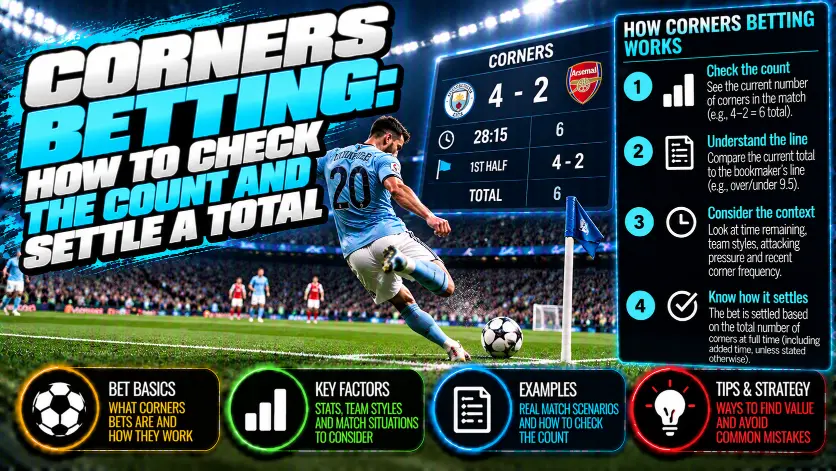
Corners betting is a wager on how many corner kicks a team or match will take, and the final score does not matter. At odds of 1.90, an Over 10.5 corners bet turns a profit only if your chance of winning is above 52.6%. That is arithmetic, not a forecast. The operator’s rules decide which corners count.
For example, Bet9ja counts only corners taken; a corner awarded but not taken is excluded (Bet9ja, Sport T&C’s Part 2, version 37, help.bet9ja.com). That distinction determines which count you compare with the betting line.
What is corners betting, and which markets are available?
Corners betting covers total corner kicks, one team’s count, or comparisons between teams and halves. Goals do not determine the outcome.
The main types are:
- Total over/under: whether the match’s counted corners finish above or below the line.
- Corners by team: a bet based on one team’s corner count.
- 1X2 on corners: which team takes more corners, with a draw as a separate outcome.
- First corner: which team is awarded the first corner of the match.
- Odd/even corners: whether the final corner count is odd or even.
- Half Most Corner: Bet9ja’s market comparing the two halves, with outcomes 1HT / X / 2nd.
Asian corner handicap is a separate sub-market comparing teams’ corner counts after a handicap, rather than the match total. See Asian corner handicap settlement for those rules; the examples below concern totals.
Which corners count?
Under Bet9ja’s rule, only corners taken count. A corner awarded by the referee but not taken is excluded.
The exact wording is: "Only corners taken count towards the final total count. Corners awarded but not taken do not count toward the final count."
Source: Bet9ja, Sport T&C’s Part 2, version 37, effective 15 October 2026, CORNER BETTING, General Rules, domain help.bet9ja.com. Its 1X2 & Over/Under Corners section also states: "Corners are settled according to the official statistics provider."
Other operators can word their rules differently. Check your own operator’s terms rather than assuming the market name defines the count.
How does the total over/under settle?
The counted corners are compared with the line: an Over bet wins when the count exceeds it. The example below assumes a 100-unit stake at odds of 1.90 and a market that returns the stake on an exact whole-number result.
All results are net, in units: a win earns +90, a loss costs −100, and a void/push returns the stake for a net result of 0.
| Corners taken | Over 9.5 | Over 10 | Over 10.5 |
|---|---|---|---|
| 8 | Loss −100 | Loss −100 | Loss −100 |
| 9 | Loss −100 | Loss −100 | Loss −100 |
| 10 | Win +90 | Void/push 0 | Loss −100 |
| 11 | Win +90 | Win +90 | Win +90 |
| 12 | Win +90 | Win +90 | Win +90 |
A whole-number line can produce a void/push on an exact count; a half line cannot, because the corner count cannot equal it. The over/under betting guide explains the same total mechanics. Whether a tie results in a stake refund depends on the market’s terms, not just on the line being a whole number.
What are the break-even win rate and expected value?
At odds of 1.90, the break-even win rate is 1 / 1.90 = 52.6%, rounded. Your probability estimate is the key assumption: if your estimate is below 52.6%, the bet does not pay. Use the implied probability calculator to convert your own odds into a probability.
Expected value (EV) is the average net result implied by your probability estimate. For a 100-unit stake at 1.90 with no void/push outcome, the calculation is:
EV = probability of winning × 90 − probability of losing × 100
| Your estimated win probability | Expected value (EV) per 100 units |
|---|---|
| 50% | −5 |
| 52% | −1.2 |
| 52.63% | 0 |
| 55% | +4.5 |
| 60% | +14 |
The 52.63% row represents zero after rounding; the headline threshold is rounded to 52.6%. This table applies to a half line without a void/push outcome. A whole-number line requires the probability of a void/push to be accounted for separately.
Under these assumptions, a 55% estimate gives positive EV of +4.5 units per 100 units, while 52% gives negative EV of −1.2. The value bet calculator helps check EV at your own probability estimate. The sign depends on the accuracy of that estimate, not just the odds.
How does the counting rule change the result?
The same Over 10.5 bet can lose or win depending on whether taken or awarded corners count. Consider 10 corners taken and 11 awarded, with a 100-unit stake at odds of 1.90.
| Counting rule | Count used | Outcome | Net result |
|---|---|---|---|
| Taken corners only | 10 | Loss | −100 units |
| If awarded corners counted | 11 | Win | +90 units |
The 190-unit difference assumes only the counting rule changes: the net result flips from −100 to +90. Under Bet9ja’s taken-only rule, this bet loses. Check which corners the operator counts before running any calculation.
Diagram: an awarded corner that is not taken does not count; with 10 taken corners, Over 10.5 loses
Teaching diagram: with 10 taken and 11 awarded corners, Over 10.5 loses or wins depending on the counting rule
How does Half Most Corner settle?
Bet9ja’s Half Most Corner compares the corner counts in the first and second halves. A tie between halves is a separate outcome, X, rather than an automatic loss for the market.
| First-half : second-half corners | Half with more corners | Winning outcome |
|---|---|---|
| 4:3 | First half | 1HT |
| 3:3 | Equal | X |
| 2:5 | Second half | 2nd |
At 3:3, a bet on X wins; a bet on either half taking more corners loses. This is a Bet9ja market, and other operators may not offer it.
Where should you check statistics, and what are their limits?
Start with the operator’s own feed and the official statistics provider named in its rules. Bet9ja’s 1X2 & Over/Under Corners section names the official statistics provider as the source. Check the rules of other markets.
Check that the data cover the same period and use the same counting definition as the bet. Awarded-corner data cannot substitute for taken-corner data under a taken-only rule.
League averages do not replace match-specific data: they determine neither a match’s final corner count nor its precise chance of clearing a line. A prediction guarantees neither a winning bet nor profit.
What should you check before betting?
Confirm the counting rule, the betting period and the statistics provider. Without all three, the calculation is incomplete.
- Which corners count? Corners taken, or corners awarded by the referee?
- Which period applies? The full match or a particular half?
- Which statistics provider is used? Whose count determines settlement?
Only then can you compare the relevant count with the line and assess the odds. Check your market’s rules against the three points in the checklist.
Frequently Asked Questions
It is a wager on corner kicks rather than goals. Depending on the market, you can bet on a total, a team’s corner count or a comparison between teams or halves.
Not under Bet9ja, Sport T&C’s Part 2, version 37: only corners taken count. Check your own operator’s terms before assuming the same rule applies.
You need at least 11 counted corners to win. A 100-unit stake earns 90 units net if it wins and loses 100 units if the count is 10 or fewer. A half line has no equality void/push.
Bookmakers may define counted corners differently. The betting period and statistics provider also need to match: settlement follows the terms of the particular market.
Evgeniy Volkov
Verified ExpertFullstack developer with a background in mathematics. I build the calculators and game-style tools on ToolsGambling with Pixi.js and modern web tech, and every result uses transparent probability formulas you can verify yourself.