










TG
file-metadata.sys
SectionCasino
AuthorEvgeniy Volkov
PublishedMar 01, 2026
Read Time16m
DifficultyAdvanced
Status
Verified
CategoryStrategies
Down Under Blackjack: Rules, Strategy & Calculator (2026)

Down Under Blackjack: Rules, Strategy & Calculator (2026)

down under blackjackdown under blackjack rulesdown under blackjack strategydown under blackjack strategy chartsdown under blackjack house edgedown under blackjack calculatordown under blackjack scanner
> Contents

Down Under Blackjack: Rules, Strategy & Calculator (2026)

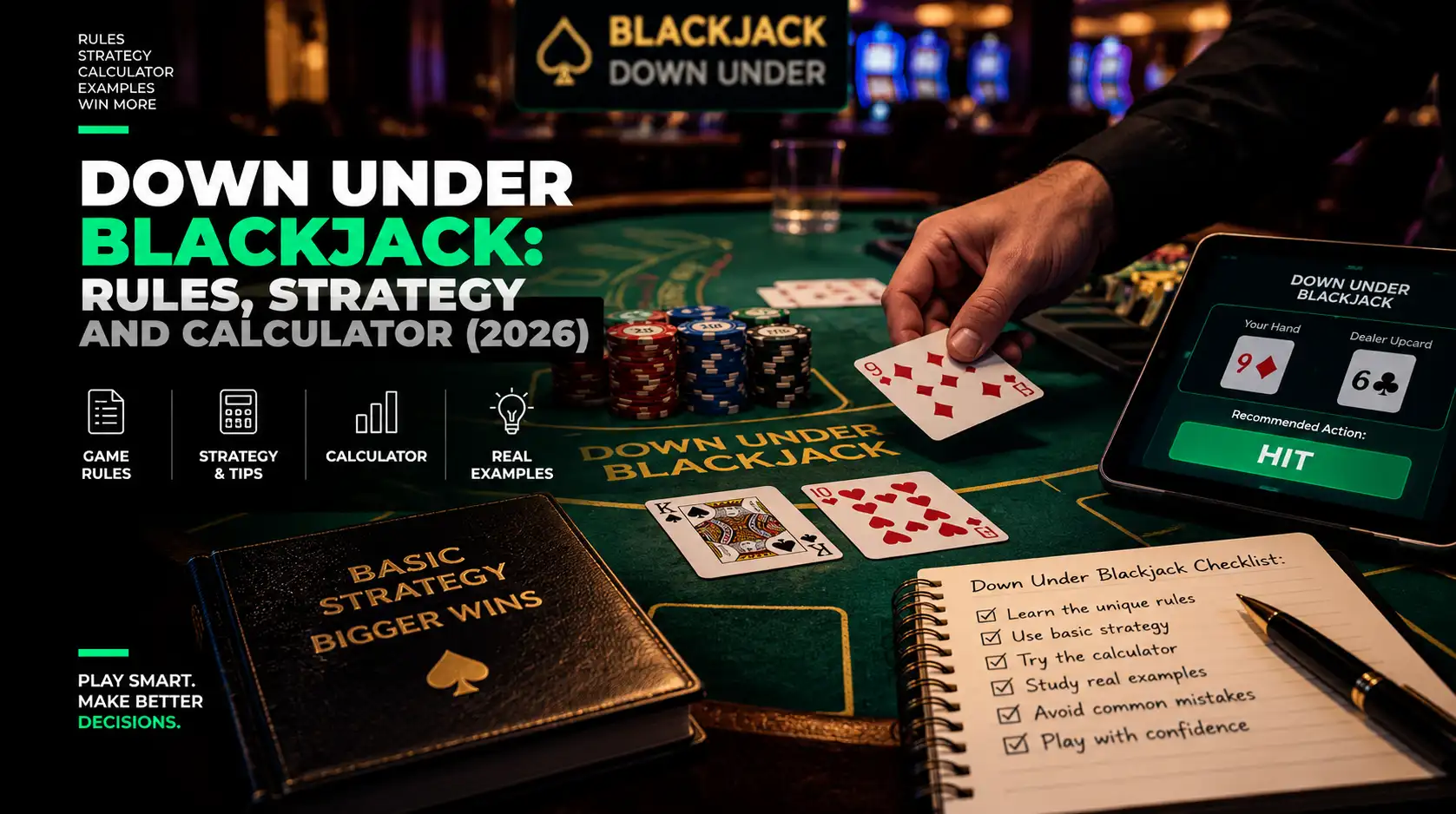
Picture this: you're sitting at a blackjack table, cards are dealt, and before you make any decision — an electronic scanner reveals something about the dealer's hidden card. Not the exact card, but whether it's low, medium, or high. Suddenly, that gut-wrenching "should I hit my 16?" dilemma gets a lot easier.

That's Down Under Blackjack in a nutshell. Invented by Australian game designer Kyle Morris, this variant gives you partial intel on the dealer's hole card through a color-coded scanner. It sounds like a dream for card players, and in many ways it is — but there's a catch (there always is). A rule called Push 22 balances the scales, and you need three separate strategy charts to play optimally.

In this guide, you'll get the complete Down Under Blackjack rules, all three strategy charts in HTML format (not blurry PNGs), the math behind the 0.57% house edge, and an interactive strategy checker that tells you the optimal play for any situation. Whether you've seen this game at a casino or just heard the name, you'll walk away knowing exactly how to play it in 2026.

TL;DR — Down Under Blackjack at a Glance

Key Numbers You Need to Know

FeatureDetails
House Edge (3:2)0.57%
House Edge (6:5)1.92%
Scanner CategoriesBlue (2-5), Red (6-9), Gold (10-A)
Decks8 (continuous shuffle)
Dealer RuleStands on all 17s
Special RulePush on dealer 22
Blackjack Payout3:2 (avoid 6:5!)
InventorKyle Morris (Australia)

The scanner is the star of the show — it tells you if the dealer's hidden card falls in the Small (2-5), Medium (6-9), or High (10-A) range. This single piece of information creates 60 strategy deviations from standard basic strategy across the three charts. Play the wrong chart and you're handing the casino an extra 0.3-0.5% edge.

What Is Down Under Blackjack?

Down Under Blackjack is a blackjack variant that adds one key twist: before you act on your hand, an electronic scanner reads the dealer's face-down hole card and tells you its category — not the exact card, just whether it's small, medium, or large.

Think of it like a weather forecast for your hand. You don't know if it'll rain at exactly 3pm, but you know there's a 70% chance of rain in the afternoon. That changes how you plan your day.

The "Down Under" Mechanic: How the Scanner Works

The scanner uses RFID or barcode technology embedded in the cards. When the dealer slides the hole card face-down into the scanner slot, it reads the card's value and displays one of three colors on a screen visible to all players:

  • Blue light — Small card (2, 3, 4, or 5)
  • Red light — Medium card (6, 7, 8, or 9)
  • Gold light — High card (10, J, Q, K, or A)

The scanner never reveals the exact card. You know the range, not the rank. This is what keeps the game balanced — partial information is powerful but not game-breaking.

Color-Coded Cards: Blue (2-5), Red (6-9), Gold (10-A)

Why do these specific ranges matter? It all comes down to dealer bust probability:

Scanner ReadingCardsDealer Bust LikelihoodYour Strategy Shift
Blue (Small, 2-5)2, 3, 4, 5Higher — dealer must hit morePlay aggressively: more doubles, splits
Red (Medium, 6-9)6, 7, 8, 9Moderate — mixed outcomesBalanced: some deviations both ways
Gold (High, 10-A)10-ALower — dealer likely has 17-21Play conservatively: fewer doubles

When the scanner shows Blue, the dealer's hidden card is weak (2-5). Combined with most upcards, this means the dealer will need to hit multiple times, increasing bust probability. That's when you get aggressive — doubling and splitting in spots where standard basic strategy says to play safe.

Who Invented Down Under Blackjack?

Kyle Morris, an Australian game designer, created Down Under Blackjack. The "Down Under" in the name refers to Australia, where the game originated. Morris designed the scanner mechanic to add strategic depth while maintaining a casino-friendly house edge through the Push 22 rule.

The game has since spread to select casinos internationally, including some Las Vegas properties and live dealer online platforms.

Down Under Blackjack Rules — Complete Breakdown

Here's every rule you need to know, organized so you can reference them at the table.

Deck Configuration and Table Setup

Down Under Blackjack uses 8 standard decks shuffled in a continuous shuffle machine (CSM). The CSM means every hand is dealt from a fresh-ish shoe — this prevents card counting from being effective but ensures the scanner remains the primary strategic advantage.

The table layout resembles standard blackjack with one addition: a scanner display screen visible to all seated players. Minimum bets typically start at $10-$25, depending on the casino.

The Electronic Scanner Explained

Here's the step-by-step of how the scanner integrates into each hand:

  1. Dealer deals two cards to each player (face up) and two to herself (one up, one down)
  2. The face-down card slides into the electronic scanner
  3. Scanner reads the RFID/barcode and displays the color category
  4. Players see: dealer's upcard + scanner color (Blue/Red/Gold)
  5. Players make decisions based on ALL three pieces of info: their hand, dealer upcard, scanner reading

The scanner reading is displayed before any player acts. This is crucial — it's not a reveal that happens mid-hand. You have all the information upfront.

Player Actions: Hit, Stand, Double, Split

All standard blackjack actions are available:

  • Hit — Take another card
  • Stand — Keep your current hand
  • Double Down — Double your bet, receive exactly one more card (any two cards)
  • Split — Split matching cards into two hands (re-split up to 3 times, no re-splitting aces)
  • No Surrender — Surrender is NOT available in Down Under Blackjack

The Push-22 Rule and Why It Exists

Here's the critical rule that balances the scanner advantage: if the dealer busts with a total of exactly 22, all remaining player hands push (tie) instead of winning.

Without Push 22, the scanner information would tilt the game too far in players' favor. By nullifying your win when the dealer busts at 22 specifically, the house claws back approximately 8-9% of its edge. This is what makes the game economically viable for casinos while still giving players a unique strategic experience.

Note: A dealer bust at 23, 24, 25, or 26 still results in a player win. Only 22 triggers the push.

Blackjack Payouts: 3:2 vs 6:5 — Critical Difference

This is the single most important rule to check before sitting down:

PayoutYour $10 BJ WinsHouse Edge Impact
3:2$15House edge: 0.57%
6:5$12House edge: 1.92%

The difference is massive. A 6:5 table costs you $3 per blackjack on a $10 bet. Over hundreds of hands, this adds up to roughly $13.50/hour extra at a $25 average bet. Always seek 3:2 tables — the scanner advantage is largely negated at 6:5.

For context, regular blackjack with perfect basic strategy has a house edge around 0.50%. At 3:2, Down Under Blackjack's 0.57% is extremely competitive.

How to Play — Step by Step

Step-by-Step Walkthrough

Let's walk through a complete hand so you see how everything fits together:

Step 1: Place Your Bet Put your chips in the betting circle. Optional: place a Match the Dealer side bet.

Step 2: Receive Cards + Read the Scanner You get two face-up cards. Dealer gets one face-up, one face-down into the scanner. Scanner displays Blue, Red, or Gold.

Step 3: Adjust Strategy by Hole Card Category This is where Down Under differs from standard blackjack. You consult one of three strategy charts based on the scanner color:

  • Blue → Small chart (more aggressive plays)
  • Red → Medium chart (moderate adjustments)
  • Gold → High chart (more conservative plays)

Step 4: Showdown and Payouts Dealer reveals hole card, hits as needed (stands on all 17s). If dealer busts at 22 → Push. If dealer busts at 23+ → You win. Standard comparison otherwise.

Worked Example: 5 Real Hand Scenarios

Scenario 1: You have Hard 16, Dealer shows 10, Scanner = Gold Standard basic strategy says: Hit (or surrender if available). Down Under strategy (Gold/High): Stand. The dealer already has 10 up + a High hole card (10-A), giving a likely 20-21. But standing on 16 gives you a better expected value here because the Push 22 rule means even if the dealer hits and gets 22, you don't lose. Your 16 stands a reasonable chance of winning via push.

Scenario 2: You have Hard 7, Dealer shows 5, Scanner = Blue Standard basic strategy says: Hit. Down Under strategy (Blue/Small): Double Down. The dealer has 5 up + a small hole card (2-5), meaning a dealer total of 7-10 and they MUST hit. High bust probability. Your 7 doubling here has positive expected value because the dealer is in deep trouble.

Scenario 3: You have Pair of 10s, Dealer shows 7, Scanner = Blue Standard basic strategy says: Stand (never split 10s!). Down Under strategy (Blue/Small): Split. Yes, really. With the dealer showing 7 and a small hole card (total 9-12), the dealer will likely bust. Splitting 10s is normally taboo, but here the scanner confirms the dealer's weakness. Two hands of 10 against a busting dealer is more profitable than one hand of 20.

Scenario 4: You have Soft 18 (A-7), Dealer shows 9, Scanner = Gold Standard basic strategy says: Hit (some charts say stand). Down Under strategy (Gold/High): Stand. Dealer has 9 + High (likely 19-20). Your 18 is decent and hitting risks busting a reasonable hand against a dealer who probably won't bust.

Scenario 5: You have Hard 11, Dealer shows A, Scanner = Red Standard basic strategy says: Hit. Down Under strategy (Red/Medium): Double Down. Dealer has A + Medium (total 15-18). While an Ace upcard looks scary, the Medium reading means the dealer doesn't have blackjack and has a moderate total. Your 11 doubles here for positive EV — any 10-value card gives you 21.

Down Under Blackjack Strategy Charts

This is the heart of the guide. Unlike competitors who only provide blurry PNG images, here are the complete strategy charts as searchable, mobile-friendly HTML tables. You need to memorize — or bookmark — all three.

Strategy Chart — Small Hole Card (Blue, 2-5)

When the scanner shows Blue, the dealer's hole card is 2-5. The dealer is weak. Play aggressively.

Hard Totals (Blue/Small):

Your Hand2345678910A
5-6HHHHHHHHHH
7DDDDDHHHHH
8DDDDDDHHHH
9DDDDDDDHHH
10DDDDDDDDDH
11DDDDDDDDDD
12SSSSSHHHHH
13SSSSSHHHHH
14SSSSSHHHHH
15SSSSSHHHHH
16SSSSSHHHHH
17-21SSSSSSSSSS

Soft Totals (Blue/Small):

Your Hand2345678910A
A-2HHDDDHHHHH
A-3HHDDDHHHHH
A-4HHDDDHHHHH
A-5HHDDDHHHHH
A-6DDDDDHHHHH
A-7SDDDDSSHHH
A-8SSSSDSSSSS
A-9SSSSSSSSSS

Pairs (Blue/Small):

Your Hand2345678910A
2-2PPPPPPHHHH
3-3PPPPPPHHHH
4-4HHPPPHHHHH
5-5DDDDDDDDDH
6-6PPPPPHHHHH
7-7PPPPPPHHHH
8-8PPPPPPPPPP
9-9PPPPPSPPSS
10-10SSSSSPSSSS
A-APPPPPPPPPP

Key: H = Hit, S = Stand, D = Double (hit if not allowed), P = Split

Strategy Chart — Medium Hole Card (Red, 6-9)

When the scanner shows Red, the dealer's hole card is 6-9. Mixed situation — some hands play standard, others deviate.

Hard Totals (Red/Medium):

Your Hand2345678910A
5-7HHHHHHHHHH
8HHHDDHHHHH
9DDDDDHHHHH
10DDDDDDDDHH
11DDDDDDDDDD
12SSSSSHHHHH
13SSSSSHHHHH
14SSSSSHHHHH
15SSSSSHHHHH
16SSSSSHHHHH
17-21SSSSSSSSSS

Soft Totals (Red/Medium):

Your Hand2345678910A
A-2HHHDDHHHHH
A-3HHHDDHHHHH
A-4HHDDDHHHHH
A-5HHDDDHHHHH
A-6HDDDDHHHHH
A-7SSDDDSSHHH
A-8SSSSSSSSSS
A-9SSSSSSSSSS

Pairs (Red/Medium):

Your Hand2345678910A
2-2PPPPPPHHHH
3-3PPPPPPHHHH
4-4HHHPPHHHHH
5-5DDDDDDDDHH
6-6PPPPPHHHHH
7-7PPPPPPHHHH
8-8PPPPPPPPPP
9-9PPPPPSPPSS
10-10SSSSSSSSSS
A-APPPPPPPPPP

Strategy Chart — High Hole Card (Gold, 10-A)

When the scanner shows Gold, the dealer's hole card is 10, J, Q, K, or A. The dealer is strong. Play conservatively.

Hard Totals (Gold/High):

Your Hand2345678910A
5-8HHHHHHHHHH
9HDDDDHHHHH
10DDDDDDDHHH
11DDDDDDDDDH
12HHSSSHHHHH
13SSSSSHHHHH
14SSSSSHHHHH
15SSSSSHHHHH
16SSSSSHHHSH
17-21SSSSSSSSSS

Soft Totals (Gold/High):

Your Hand2345678910A
A-2HHHDDHHHHH
A-3HHHDDHHHHH
A-4HHDDDHHHHH
A-5HHDDDHHHHH
A-6HDDDDHHHHH
A-7SSSDDSSHHH
A-8SSSSSSSSSS
A-9SSSSSSSSSS

Pairs (Gold/High):

Your Hand2345678910A
2-2PPPPPPHHHH
3-3PPPPPPHHHH
4-4HHHHPHHHHH
5-5DDDDDDDHHH
6-6PPPPPHHHHH
7-7PPPPPPHHHH
8-8PPPPPPPPPP
9-9PPPPPSPPSS
10-10SSSSSSSSSS
A-APPPPPPPPPP

Key Deviations from Regular Basic Strategy

Here's the real insight. Each scanner reading creates a different set of deviations from what you'd do in standard blackjack:

ScannerAggressive DeviationsConservative DeviationsTotal Deviations
Blue (Small)~18 moves~5 moves~23
Red (Medium)~8 moves~12 moves~20
Gold (High)~3 moves~14 moves~17

The pattern is clear: the weaker the dealer's hole card, the more aggressive you play. Blue = attack. Gold = defend. Red = somewhere in between.

The most dramatic deviations on the Blue chart:

  • Double hard 7 against dealer 2-5 (standard says hit)
  • Split 10s vs dealer 7 (standard says NEVER)
  • Double hard 8 vs dealer 2-6 (standard only doubles 8 vs 5-6)

Common Mistakes: When Players Misread the Scanner

The #1 mistake? Using standard basic strategy regardless of the scanner. This costs you 0.3-0.5% per hand in expected value. The scanner info is free — not using it is like leaving money on the table.

Other common errors:

  • Forgetting that Blue = aggressive (players are cautious by nature)
  • Over-splitting on Gold readings (the dealer is strong, don't expand your exposure)
  • Doubling soft hands on Gold when the chart says hit
  • Playing at 6:5 tables and thinking the scanner compensates (it doesn't)

Strategy Deviations by Scanner Reading

Each scanner reading shifts your strategy differently. Blue (Small) means more aggressive plays (lime), while Gold (High) means more conservative plays (red). The chart shows how many moves change vs standard basic strategy.

Small Devs
23
Medium Devs
20
High Devs
17
House Edge
0.57%

Deviation counts are approximate and based on optimal strategy analysis for 8-deck Down Under Blackjack with 3:2 payout and Push 22. Individual table rules may affect exact counts.

House Edge and Math Analysis

House Edge at 3:2 vs 6:5 (0.57% vs 1.92%)

Let's break down where the 0.57% house edge comes from. Use our house edge calculator to model this:

The house edge in Down Under Blackjack is a balance between two opposing forces:

Player Advantage (scanner info): Knowing the hole card category lets you avoid costly mistakes and find profitable doubles/splits. This is worth roughly -8% to -9% in the casino's favor compared to no scanner.

House Advantage (Push 22): The Push 22 rule gives back approximately +8% to +9% to the house. When the dealer busts at exactly 22, you don't win — your hand pushes.

The net result: a house edge of 0.57% at 3:2, which is remarkably close to standard blackjack (~0.50%).

At 6:5, the reduced blackjack payout adds another 1.35% to the house edge, resulting in 1.92%. To check how this compounds over a session, try our RTP calculator.

HE6:5=HE3:2+Δpayout=0.57%+1.35%=1.92%HE_{6:5} = HE_{3:2} + \Delta_{payout} = 0.57\% + 1.35\% = 1.92\%

In plain terms: for every $100 you bet at a 3:2 table, you'll lose about $0.57 long-term. At 6:5, you'll lose $1.92 — more than triple.

EV Comparison: Down Under vs Classic vs Free Bet Blackjack

How does Down Under stack up against other blackjack variants you might find on the casino floor?

VariantHouse EdgeUnique FeatureBest For
Down Under BJ (3:2)0.57%Scanner + Push 22Players who enjoy strategic decisions
Classic BJ (8-deck)0.43-0.65%Pure basic strategyTraditional players
Free Bet BJ1.04%Free doubles/splitsCasual players who want action
Spanish 210.40%No 10s, bonus payoutsExperienced variant players
Blackjack Switch0.58%Switch cards between handsPlayers who like novel mechanics

Down Under Blackjack sits in the sweet spot — low house edge with added strategic depth. Run your own scenario through our session simulator to see how each variant performs over 500+ hands.

Match the Dealer Side Bet

Many Down Under Blackjack tables offer a Match the Dealer side bet. This is a bet that one or both of your initial cards will match the dealer's upcard in rank.

Payout Table by Deck Count

Match Type8-Deck PayoutProbability
One non-suited match4:1~5.9%
One suited match11:1~1.5%
Two non-suited matches8:1~0.37%
One suited + one non-suited15:1~0.19%
Two suited matches29:1~0.02%
No matchLoss~92.0%

Side Bet House Edge Analysis

The Match the Dealer house edge varies by deck count:

DecksHouse Edge
46.14%
64.34%
83.48%

At 8 decks (standard for Down Under BJ), the side bet house edge is 3.48% — not terrible for a side bet, but significantly worse than the main game's 0.57%. You can analyze side bet profitability using our win probability calculator.

Bottom line: Play the side bet for fun with small stakes, but don't make it your primary wager. Use the bankroll calculator to determine how much you can allocate without risking your session bankroll.

Down Under Blackjack vs Regular Blackjack

Here's a side-by-side comparison to help you decide which game suits you better:

FeatureDown Under BlackjackRegular Blackjack
House Edge0.57% (3:2)0.43-0.65%
Decks8 (CSM)1-8 (shoe or CSM)
Hole Card InfoScanner shows categoryNone
Push 22Yes — all hands pushNo
SurrenderNot availableAvailable at some tables
Card CountingIneffective (CSM)Possible (shoe games)
Strategy Charts3 (one per scanner color)1
EngagementHigh (scanner adds decisions)Standard

When to choose Down Under BJ: You want a low house edge game with extra strategic depth, you enjoy making decisions based on partial information, or you want something fresh that isn't standard blackjack.

When to stick with regular BJ: You already know basic strategy, you want to practice card counting, or you prefer the simplicity of one strategy chart.

For bankroll management in either game, consider the Fibonacci system for low-volatility sessions, and model your risk with the volatility calculator.

Where to Play Down Under Blackjack in 2026

As of March 2026, Down Under Blackjack is available at:

Australia:

  • Crown Melbourne and Crown Sydney — where the game originated
  • Select Star Entertainment properties in Brisbane and Gold Coast

Las Vegas:

  • Select tables at major Strip casinos (availability rotates — call ahead)
  • Downtown Las Vegas: some Fremont Street casinos trial new variants

Online (Live Dealer):

  • Select live dealer platforms featuring specialty blackjack games
  • Availability depends on your jurisdiction — check regulated platforms in your region

Tips for finding tables:

  • Call the casino's table games department before visiting
  • Ask for "specialty blackjack" or "Down Under Blackjack" by name
  • Peak hours (Friday/Saturday evening) are more likely to have tables open
  • Online live dealer lobbies usually list variant names — search for "Down Under"

If you're a serious blackjack strategist like Dana White, having all three charts memorized before you sit down will give you the full 0.57% edge. Don't learn at the table — practice with our strategy checker above first.

Related guides you might find useful:

Frequently Asked Questions

author-credentials.sysE-E-A-T
Evgeniy Volkov

Evgeny Volkov

Verified Expert
Math & Software Engineer, iGaming Expert

Over 10 years developing software for the gaming industry. Advanced degree in Mathematics. Specializing in probability analysis, RNG algorithms, and mathematical gambling models.

Experience10+
SpecializationiGaming
Status
Active

Was this article helpful?

Share Article
launch-tools.sh

Ready to Calculate Smarter?

Use our free professional calculators to make data-driven decisions.