










Contents
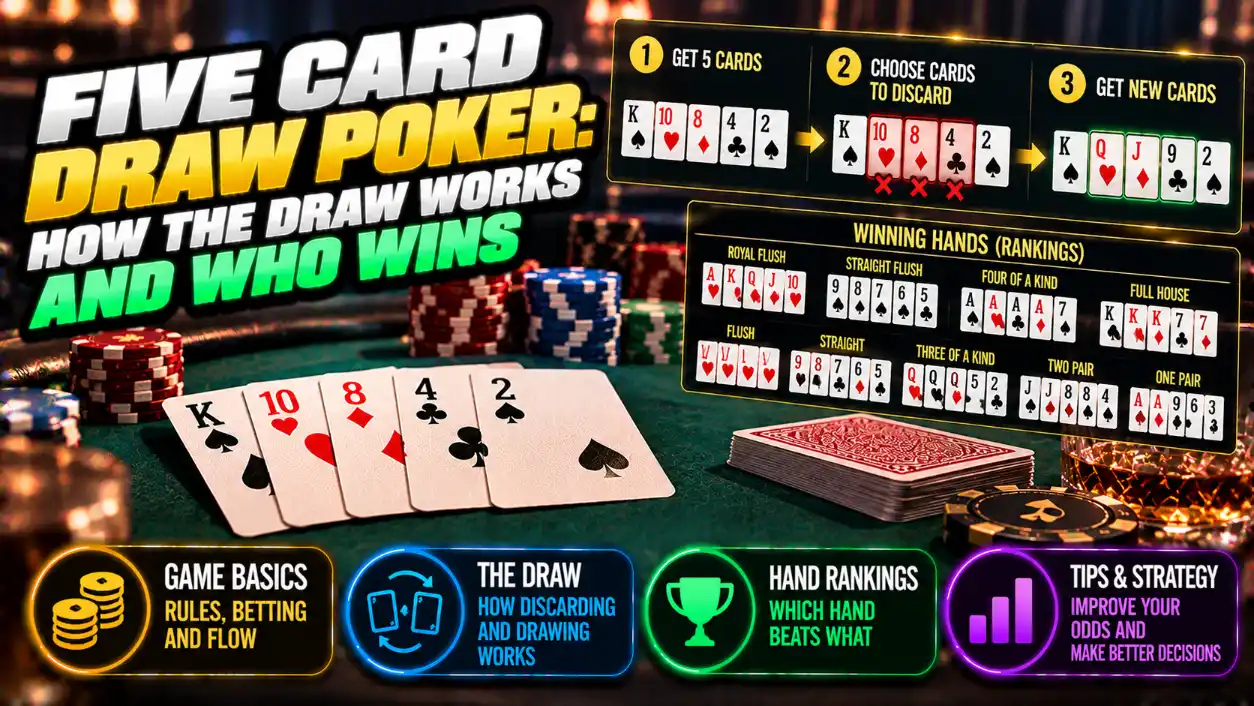
Five card draw (also called draw poker with a five-card hand) works like this: every player gets five private cards, bets, replaces up to three of them once (some tables allow four or five), bets again, and the best five-card hand wins at the showdown. With one pair, drawing three cards gives two pair or better in 28.71% of exchanges, and 25.90% if you keep an ace and draw two. Below: the exchange limits by house rule, exact chances for the common draws and a checked way to compare two hands.
Draw poker is the family of games with a card exchange; “flush draw” and “straight draw” mean an incomplete hand; “the draw” alone means the card exchange.
How One Hand Goes
You receive five private cards, play a betting round, complete the draw, then play another betting round before the showdown. The standard game below uses 52 cards without jokers.
| Step | What happens |
|---|---|
| 1. Forced bets | Everyone pays an ante, common at home; or players post small and big blinds, common online and in casinos. |
| 2. Deal | Deal one card at a time clockwise until everyone has five private cards. |
| 3. First betting round | Check, bet, call, raise or fold as applicable. With antes, action starts left of the dealer; with blinds, left of the big blind. Fixed-limit games, with prescribed bet sizes, usually allow one bet and three or four raises (Card Player: three; Pagat: up to four). |
| 4. The draw | Starting with the first active player left of the dealer, announce a number, discard face down and receive that many replacements. Choose zero to stand pat. |
| 5. Second betting round | With antes, Pagat has the first-round opener start (Card Player: left of the dealer); with blinds, the first active player left of the dealer starts. Fixed-limit bets usually double; this does not apply to pot-limit or no-limit games. |
| 6. Showdown | If two or more remain, show hands starting with the second round’s last aggressor. The best five-card hand wins. |
Diagram of one Five Card Draw hand with four players: deal, first betting round, the draw, second betting round and showdown; players A and B both hold a pair of queens and an ace, A's kicker 4 beats 2.Worked example from the calculation, not a game interface: 25 distinct cards, the deal checked by code. Conclusion: with the same pair, ace and nine, the last card decides.
In this ante hand, D deals, starting with A:
- A: Q♠ Q♦ 8♦ 6♥ 3♠.
- B: Q♥ Q♣ A♣ 7♥ 4♠.
- C: 9♣ 8♠ 7♦ 5♥ 2♣.
- D: K♠ J♥ 10♦ 6♣ 4♦.
C and D fold after the first round. A keeps the pair of queens (Q♠ Q♦) and draws three cards: A♥ 9♥ 4♣. B keeps the queens and ace and draws 9♦ 2♠. This uses 25 cards, leaving 27. The matching ace and nine are chosen for comparison, not as a typical result.
Under Pagat’s rules, before the second round you may ask how many cards an opponent drew and receive an honest answer. This public information does not reveal the whole hand. Under Pagat, if everyone checks the second round, the first-round opener shows first; Card Player says the player left of the dealer.
How Many Cards You Can Exchange
The basic limit is zero to three, but some tables allow four or five. Establish which rule applies before playing.
| Table rule | Allowed discards | Source |
|---|---|---|
| Pagat’s basic rule | 0 to 3 | Pagat |
| Three-or-four limit | 3 or 4 | Card Player: some tables cap replacements at three or four |
| Keep an ace | Up to 4, keeping an ace | Pagat and Wikipedia |
| Unrestricted | 4 or all 5 | Pagat; Card Player allows all five |
| Casino: no five consecutive replacements | Deal four, serve others, then deal the fifth; if nobody else draws, burn a card first | Wikipedia, Five Card Draw article |
The 0-to-3 rule appears in the Pagat rules reference. When players take turns choosing games, Dealer's Choice rules extend this principle: announce the game and conditions before dealing.
Deck capacity assumes everyone receives five cards and takes the maximum replacements.
| Maximum replacements | Cards per player, worst case | Maximum players, no burn (cards left) | Maximum players, one burn before the draw (cards left) | Maximum players, burn before each player’s replacements |
|---|---|---|---|---|
| 3 | 8 | 6 (4) | 6 (3) | 5 |
| 4 | 9 | 5 (7) | 5 (6) | 5 |
| 5 | 10 | 5 (2) | 5 (1) | 4 |
The check is 5·n + n·d ≤ 52; add one burn card for the middle capacity column. Six players drawing up to three need 48 cards, leaving 4. Pagat gives six as the usual maximum; if cards run out, shuffle and cut the discards to form a new deck.
The four- and five-card rows are upper bounds: four may require an ace, and drawing five is uncommon. The last column assumes stricter burning. Sources specify no universal burn procedure; Wikipedia describes burning before replacements.
What the Draw Gives You: Exact Odds
Drawing three to a pair gives two pair or better in 28.71% of exchanges with 52 cards. The biggest change shown is a 32-card deck: 46.02%, up 17.31 percentage points; keeping an ace and drawing two gives 25.90%, down 2.81 points.
Before the draw, one pair or better occurs in 49.88% of deals, high card in 50.12%. Across 2,598,960 hands: one pair 42.26%, two pair 4.75%, three of a kind 2.11%, straight or better 0.76% combined—straight 0.39%, flush 0.20%, full house 0.14%, four of a kind 0.024%, straight flush 0.0015%.
The calculation enumerates replacements from 47 unseen cards: 52 − 5 = 47. These are chances of reaching the named target, not winning.
| Cards kept; discards | Cards drawn | Target | Chance |
|---|---|---|---|
| Pair 9♥ 9♦; discard A♣ 7♠ 3♦ | 3 (16,215 possibilities) | Two pair or better | 28.71% (4,656): two pair 15.99%, three of a kind 11.43%, full house 1.02%, four of a kind 0.28%; one pair remains 71.29% |
| Pair and ace 9♥ 9♦ A♣; discard 7♠ 3♦ | 2 (1,081 possibilities) | Two pair or better | 25.90% (280): two pair 17.21%, three of a kind 7.77%, full house 0.83%, four of a kind 0.09% |
| Two pair 9♥ 9♦ 5♣ 5♠; discard K♦ | 1 | Full house | 4 of 47 = 8.51% |
| Three of a kind 9♥ 9♦ 9♣; discard K♠ 3♦ | 2 (1,081 possibilities) | Full house or four of a kind | 10.36%: full house 6.11%, four of a kind 4.26% |
| Flush draw A♥ J♥ 8♥ 4♥; discard K♣ | 1 | Flush | 9 of 47 = 19.15% |
| Open-ended straight draw 5-6-7-8; discard K♦ | 1 | Straight | 8 of 47 = 17.02% |
| Gutshot 5-6-8-9; discard K♦ | 1 | Straight | 4 of 47 = 8.51% |
| Edge straight draw A-2-3-4; discard K♦ | 1 | Straight | 4 of 47 = 8.51%; only a five completes it |
| A♠ only; discard K♦ 8♣ 5♥ 2♦ | 4 (178,365 possibilities) | One pair or better | 50.76%; high card remains 49.24% |
For the pair calculation, discarding three distinct non-pair ranks gives the same distribution; two different starting hands were checked.
| Assumption | Headline result | Difference |
|---|---|---|
| Baseline: pair, draw three, 47 unseen | 28.71% | — |
| Keep pair and ace, draw two | 25.90% | −2.81 percentage points |
| Burn card / bottom card withheld / unknown opponents’ cards | 28.71% | 0: every removed card is equally likely |
| 32-card deck, seven through ace, 27 unseen | 46.02% | +17.31 percentage points |
Under these assumptions, a pair improves about once every 3.5 exchanges. Use 25.90% when keeping an ace and drawing two, and 46.02% for the short deck.
PokerNews describes four cards to a flush or straight as roughly 4 to 1 against improving; Card Player rounds to 17% and 19%. Here the exact figures are 17.02% and 19.15%. These calculations do not choose your discards, betting strategy or interpretation of opponents’ replacements.
The Price of a Draw: Is the Pot Big Enough
A call needs a pot large enough for the chance of completing your target. For call c and probability p, the pot after the opponent’s bet must be at least c × (1 − p) / p.
| Draw | Chance | Minimum pot after bet (call 4) | Minimum pot before bet | Pot odds at least |
|---|---|---|---|---|
| Flush draw, 9 outs | 19.15% | 16.89 | 12.89 | 4.22 to 1 |
| Open-ended straight draw, 8 outs | 17.02% | 19.50 | 15.50 | 4.88 to 1 |
| Gutshot, 4 outs | 8.51% | 43.00 | 39.00 | 10.75 to 1 |
Example: the pot is 12 before an opponent bets 4; calling costs 4. In the Pot Odds Calculator, enter 12 as the pot before the bet and 4 as the bet to call. The result block shows the required equity, 20.0%, and the pot after the call, $20. The tool prints a dollar sign; here the numbers are chips.
A flush hits 19.15%, missing the requirement by 0.85 percentage points, so the call fails on direct price. The tool displays 19.1%. In the example the pot after the bet is 16, excluding your call; the calculator’s result ($20) includes it. Exact percentages are shown to two decimal places; tool displays retain their on-screen precision.
ToolsGambling Pot Odds Calculator with pot 12 and bet 4: required equity 20.0%, and outs-table rows 4, 8 and 9 in the "Turn (1 card)" column: 8.5%, 17.0%, 19.1%.Observed on screen: the calculator asks for 20.0% and a flush draw (9 outs) hits 19.1% of the time. Both tools are built for Hold'em: "Turn" is only a column name, and the “Turn (1 card)” column fits a one-card draw: it gives the chance on one next card.
With 13 in the pot before the bet, the requirement is 19.05%: calling passes because 19.15% > 19.05%. On these numbers, the minimum pre-bet pot is 12.89. This considers only the current call, excluding losses to stronger hands and additional second-round winnings.
In the Poker Outs Calculator, find “Outs to percentage chart (1 to 20)”. The “Turn (1 card)” column gives 8.5%, 17.0% and 19.1% for 4, 8 and 9 outs. Do not use “Max price”: it assumes two cards, not one replacement.
How Hands Are Compared at Showdown
Compare the category first, then ranks within it; suits confer no advantage. Highest to lowest: straight flush, including royal flush; four of a kind; full house; flush; straight; three of a kind; two pair; one pair; high card. See the full ladder of hand rankings for further examples.
| Category | Comparison order | Winner versus loser | Deciding factor |
|---|---|---|---|
| One pair | Pair, then three kickers descending | Q Q A 9 4 versus Q Q A 9 2 | Last kicker: 4 beats 2 |
| Two pair | Higher pair, lower pair, kicker | K K 9 9 7 versus K K 9 9 4; K K 9 9 4 versus K K 8 8 Q | 7 beats 4; nines beat eights despite the queen |
| Straight | Highest card; five in A-2-3-4-5 | 2-3-4-5-6 versus A-2-3-4-5 | The A-2-3-4-5 straight (five-high) is lowest |
| Flush | Cards descending | A 9 7 5 2 versus A 9 6 5 4 | Third card: 7 beats 6 |
| Full house | Three of a kind, then pair | 8 8 8 2 2 versus 7 7 7 A A | Three of a kind takes priority |
A flush A 9 7 5 2 beats a mixed-suit straight K Q J 10 9; one pair beats high card; 9 9 9 9 K beats 8 8 8 8 A. Compare straight flushes like straights.
In the example, A has Q♠ Q♦ A♥ 9♥ 4♣; B has Q♥ Q♣ A♣ 9♦ 2♠. A wins with the four after matching queens, aces and nines.
Matching all five ranks means players split the pot: Q♠ Q♦ A♣ 9♥ 4♠ ties Q♥ Q♣ A♦ 9♠ 4♦. Pagat’s ranking rules note that identical three-of-a-kind or four-of-a-kind ranks cannot occur twice in one joker-free deck.
House Variants and Boundaries
House rules can change opening requirements, exchanges, the deck and rankings. The following are separate variants, not one combined rule.
| Variant | Change | Explanation |
|---|---|---|
| Jacks or Better opening requirement | Without a qualifying hand, pass before the first bet | To open the betting means to make the round’s first bet. Two pair 5-5 3-3 qualifies. If discarding qualifying cards, declare this and show them at showdown; Pagat variant |
| Two draws | Draw up to three, bet, then draw up to one or two | Pagat variant |
| Restricted joker | Substitutes only for an ace or a missing straight or flush card | 53 cards; earlier odds and comparisons no longer apply |
| Wild cards, such as deuces | A wild card substitutes for any card | Earlier tables do not apply |
| 32-card deck, seven through ace | Flush beats full house; maximum five players | Pagat; pair improvement chance 46.02% |
2-7 Single Draw rules use the same one draw and two betting rounds, but the lowest hand wins: aces are high, and straights and flushes count against you. Badugi rules use four cards and a different comparison.
Video poker is played against a machine using a paytable. Five Card Draw pits players against each other for a pot; video-poker payout calculations do not transfer.
Frequently Asked Questions
Pagat’s basic rule allows 0 to 3. Some tables allow four if you keep an ace, or up to five unconditionally; the casino procedure does not deal five replacements consecutively. Check the limit before the deal.
To stand pat means to keep all five cards without discarding any. It is not the same as checking and does not by itself prove that a hand is strong.
Two to six. With a maximum exchange of three cards, six players use 48 of the 52 cards; seven players may exhaust the deck.
Two pair or better occurs in 28.71% of exchanges. Keeping the pair and an ace and drawing two gives 25.90%.
If all five card ranks match, the players split the pot equally. Suits do not break ties.
Evgeniy Volkov
Verified ExpertFullstack developer with a background in mathematics. I build the calculators and game-style tools on ToolsGambling with Pixi.js and modern web tech, and every result uses transparent probability formulas you can verify yourself.