












Contents
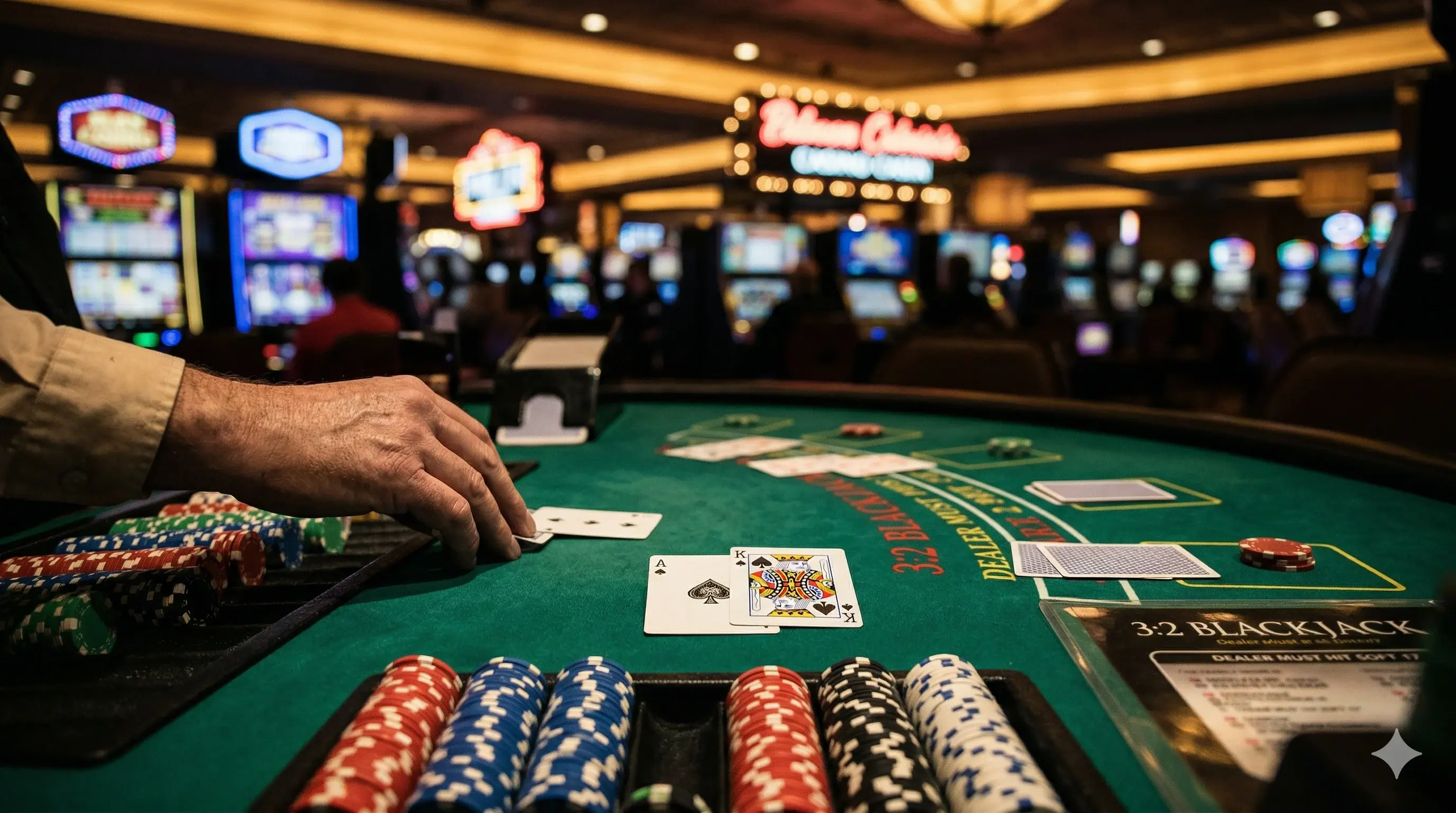
You step off the Expressway into Borgata, scan the main floor, and see 40 blackjack tables, $15 minimums, $25 minimums, a few $50 signs glowing in the high-limit room. They all look the same. They're not. One table gives the casino a 0.36% edge. The one next to it gives up 1.04%. Same building, same green felt, completely different math.
Atlantic City blackjack rules are some of the most player-friendly in America. New Jersey gaming regulations mandate late surrender, 3:2 payouts on main-floor games, and consistent dealing procedures across all nine casinos. But the details between tables, deck count, minimums, side bets, Free Bet variants, can cost you hundreds per session if you pick wrong.
This guide covers every Atlantic City blackjack rule in 2026, gives you a free rule checker calculator, and shows you exactly which tables to sit at and which to walk past.
TL;DR, Atlantic City Blackjack Rules at a Glance
Quick Rules Summary Table
| Rule | Standard AC Game | Best AC Game | Vegas Comparison |
|---|---|---|---|
| Decks | 8 | 6 | 2–8 |
| Dealer | Stands on Soft 17 | Stands on Soft 17 | S17 or H17 |
| BJ Payout | 3:2 | 3:2 | 3:2 or 6:5 |
| Double After Split | Yes | Yes | Varies |
| Late Surrender | Yes (mandated) | Yes (mandated) | Rare |
| Re-Split Aces | No (most tables) | Yes (some) | Varies |
| House Edge | 0.44% | 0.36% | 0.28–1.74% |
The AC Advantage You Should Know
New Jersey gaming law mandates late surrender at every blackjack table in Atlantic City. This single rule is worth 0.08% off the house edge, and most Las Vegas casinos don't offer it at all. Combined with guaranteed 3:2 payouts on standard tables, AC delivers one of the most consistent blackjack experiences in the country.
Standard Atlantic City Blackjack Rules Explained
Every AC casino follows the same core rules set by the New Jersey Division of Gaming Enforcement. Here's what you'll find at any standard table.
Deck Count and Dealing Procedure
Most main-floor AC tables use 8 decks dealt from a shoe. The cards come face-up, players never touch them. Some properties offer 6-deck games, usually at $25+ minimums. You'll occasionally find double-deck games in high-limit rooms, but they're rare on the main floor.
The dealer deals two cards to each player and two to themselves (one face-up, one face-down). If the dealer's upcard is an Ace or 10-value, they peek for blackjack before players act.
Dealer S17 Rule
In Atlantic City, dealers stand on all 17s, including soft 17 (Ace + 6). This is the S17 rule, and it's one of the most important player-friendly rules in AC. Some Vegas casinos use H17 (dealer hits soft 17), which adds 0.22% to the house edge. You won't find H17 at standard AC tables.
Doubling Down Rules
AC allows you to double down on any two cards. This includes soft hands (Ace + another card), which opens up profitable doubling opportunities on A-2 through A-7 against weak dealer upcards. You can also double after splitting (DAS), which saves an additional 0.14% compared to no-DAS games.
Splitting Rules
You can split any pair up to three times (making four hands total). After splitting, you can double down on any hand, that's the DAS rule mentioned above. The exception: split Aces receive only one card each at most tables. Re-splitting Aces (RSA) is available at some AC properties but isn't standard.
Here's when to split, and when not to. The golden rule: always split Aces and 8s. Never split 10s, a hard 20 is already one of the best hands in the game.
Late Surrender, AC's Secret Weapon
Late surrender is the rule that separates Atlantic City from almost every other blackjack market. After the dealer checks for blackjack, you can forfeit your hand and get back half your bet. This is mandated by New Jersey gaming regulations, every AC casino must offer it.
When to Use Surrender
Surrender saves you money on the worst hands in blackjack. The correct surrender plays with standard AC rules:
| Your Hand | Dealer Upcard | Action |
|---|---|---|
| Hard 16 | 9, 10, Ace | Surrender |
| Hard 15 | 10 | Surrender |
| Hard 16 (8-8) | 9, 10, Ace | Split (not surrender) |
That's it, just two hand/upcard combinations. But these come up often enough to save you 0.08% on the house edge over time. Most players never surrender because it "feels like giving up." The math says otherwise.
Atlantic City Casino Blackjack Comparison (2026)
Not all AC blackjack tables are equal. The difference between a 6-deck game at Borgata and Free Bet Blackjack at a neighboring property can be nearly 3× in house edge. Here's how they stack up.
| Casino / Game Type | House Edge (%) |
|---|---|
| Borgata (6-Deck) | 0.36 |
| Hard Rock (6-Deck) | 0.36 |
| Ocean Casino (8-Deck) | 0.44 |
| Caesars (8-Deck) | 0.44 |
| Bally's (8-Deck) | 0.44 |
| Tropicana (8-Deck) | 0.44 |
| Free Bet Blackjack | 1.04 |
| Average Player (No Strategy) | 2.0 |
House Edge by Casino
| Casino | Decks | Dealer | Payout | DAS | Surrender | Min Bet | House Edge |
|---|---|---|---|---|---|---|---|
| Borgata | 6 | S17 | 3:2 | Yes | Yes | $25 | 0.36% |
| Hard Rock | 6 | S17 | 3:2 | Yes | Yes | $25 | 0.36% |
| Ocean Casino | 8 | S17 | 3:2 | Yes | Yes | $15 | 0.44% |
| Caesars | 8 | S17 | 3:2 | Yes | Yes | $15 | 0.44% |
| Bally's | 8 | S17 | 3:2 | Yes | Yes | $10 | 0.44% |
| Tropicana | 8 | S17 | 3:2 | Yes | Yes | $15 | 0.44% |
Rules current as of March 2026. Minimum bets vary by day and time, weekday mornings are cheapest, weekend evenings highest.
Best Tables by Budget Level
$10–15 Minimum Tables
If you're on a budget, Bally's and Caesars offer the most affordable tables. These are 8-deck shoe games with standard AC rules (S17, 3:2, DAS, surrender). The 0.44% house edge is solid, you'll lose about $3.50 per hour at $10 minimum with perfect basic strategy.
At 80 hands per hour: $10 × 80 × 0.0044 = $3.52 expected hourly loss.
$25–50 Minimum Tables
Borgata and Hard Rock offer the best rules in AC at $25 minimums: 6-deck games with the full S17/DAS/surrender package. The 0.36% edge is among the best you'll find anywhere in America. Your expected hourly loss: $25 × 80 × 0.0036 = $7.20.
The 6-deck advantage over 8-deck saves you 0.08%, that's $1.60/hour at $25 bets. Over a weekend with 20 hours of play, that's $32 saved just by choosing the right table.
Free Bet Blackjack in Atlantic City
You'll see "Free Bet Blackjack" signs at several AC casinos. It sounds amazing, free doubles and splits!, but the math tells a different story.
How Free Bet Works
In Free Bet Blackjack, the casino covers the cost of doubling on hard 9, 10, and 11, and splitting any non-10 pair. You put up zero extra money. The dealer places a special token on your doubled/split bet. If you win, you get paid as if you'd bet the full amount. If you lose, only your original bet is taken.
Why the House Edge Is Nearly 3x Higher
The catch is the "push on 22" rule. If the dealer busts with exactly 22, all remaining player hands push instead of winning. In standard blackjack, the dealer busting is your biggest source of profit. Taking away a chunk of those wins increases the house edge to 1.04%, nearly three times the 0.36% of the best standard AC game.
In plain English: at $25 minimum and 80 hands per hour, Free Bet Blackjack costs you $25 × 80 × 0.0104 = $20.80/hour. The standard 6-deck game at the same minimum costs $7.20/hour. That's $13.60 more per hour for the "free" bets.
AC Blackjack Rule Checker Calculator
Not sure about the rules at your table? Plug them in below and get the exact house edge, hourly cost, and bankroll recommendation.
How to Use the Calculator
Select the rules posted on the table placard: deck count, dealer rule (S17 vs H17), blackjack payout, and whether DAS and surrender are available. The calculator shows your house edge with perfect basic strategy, expected loss per hour at 80 hands, projected 4-hour session cost, and the recommended bankroll to survive normal variance.
Atlantic City Basic Strategy Tables
With AC rules (8-deck, S17, DAS, late surrender), here's the mathematically correct play for every situation. Practice these with our strategy flashcard trainer until they're automatic.
Hard Totals Strategy
| Your Hand | 2 | 3 | 4 | 5 | 6 | 7 | 8 | 9 | 10 | A |
|---|---|---|---|---|---|---|---|---|---|---|
| 8 | H | H | H | H | H | H | H | H | H | H |
| 9 | H | D | D | D | D | H | H | H | H | H |
| 10 | D | D | D | D | D | D | D | D | H | H |
| 11 | D | D | D | D | D | D | D | D | D | D |
| 12 | H | H | S | S | S | H | H | H | H | H |
| 13 | S | S | S | S | S | H | H | H | H | H |
| 14 | S | S | S | S | S | H | H | H | H | H |
| 15 | S | S | S | S | S | H | H | H | Rh | Rh |
| 16 | S | S | S | S | S | H | H | Rh | Rh | Rh |
| 17+ | S | S | S | S | S | S | S | S | S | S |
Key: H = Hit, S = Stand, D = Double (hit if not allowed), Rh = Surrender (hit if not allowed)
Notice 12 vs dealer 2 is a hit, one of the most commonly misplayed hands. The dealer busts only 35.3% with a 2 showing, so standing costs you more than hitting.
Soft Totals Strategy
| Your Hand | 2 | 3 | 4 | 5 | 6 | 7 | 8 | 9 | 10 | A |
|---|---|---|---|---|---|---|---|---|---|---|
| A-2 | H | H | H | D | D | H | H | H | H | H |
| A-3 | H | H | H | D | D | H | H | H | H | H |
| A-4 | H | H | D | D | D | H | H | H | H | H |
| A-5 | H | H | D | D | D | H | H | H | H | H |
| A-6 | H | D | D | D | D | H | H | H | H | H |
| A-7 | S | Ds | Ds | Ds | Ds | S | S | H | H | H |
| A-8 | S | S | S | S | Ds | S | S | S | S | S |
| A-9 | S | S | S | S | S | S | S | S | S | S |
Key: H = Hit, S = Stand, D = Double (hit if not allowed), Ds = Double (stand if not allowed)
Pair Splitting Strategy
| Your Pair | 2 | 3 | 4 | 5 | 6 | 7 | 8 | 9 | 10 | A |
|---|---|---|---|---|---|---|---|---|---|---|
| 2-2 | P | P | P | P | P | P | H | H | H | H |
| 3-3 | P | P | P | P | P | P | H | H | H | H |
| 4-4 | H | H | H | P | P | H | H | H | H | H |
| 5-5 | D | D | D | D | D | D | D | D | H | H |
| 6-6 | P | P | P | P | P | H | H | H | H | H |
| 7-7 | P | P | P | P | P | P | H | H | H | H |
| 8-8 | P | P | P | P | P | P | P | P | P | Rp |
| 9-9 | P | P | P | P | P | S | P | P | S | S |
| 10-10 | S | S | S | S | S | S | S | S | S | S |
| A-A | P | P | P | P | P | P | P | P | P | P |
Key: P = Split, H = Hit, S = Stand, D = Double, Rp = Surrender (split if not allowed)
Never split 5s (double instead) and never split 10s, these are two of the most common mistakes in AC casinos.
The 5 Most Misplayed Hands in AC
These five hands cost AC players the most money due to incorrect play:
| Hand | Dealer | Wrong Play | Correct Play | Cost per Error |
|---|---|---|---|---|
| 16 vs 10 | 10 | Stand | Surrender | $0.05/$1 bet |
| 12 vs 2 | 2 | Stand | Hit | $0.04/$1 bet |
| A-7 vs 9 | 9 | Stand | Hit | $0.03/$1 bet |
| 11 vs A | A | Hit | Double | $0.05/$1 bet |
| 8-8 vs 10 | 10 | Stand | Split | $0.06/$1 bet |
At a $25 table, misplaying just these five hands costs you approximately $5.75 extra per hour. Learn these first before memorizing the full chart. For all 20 essential blackjack tips, see our complete strategy guide.
Card Counting in Atlantic City
Card counting is uniquely positioned in AC compared to every other gambling jurisdiction in America. Here's why.
The Uston v. Resorts Ruling (1982)
In 1982, professional blackjack player Ken Uston sued Resorts International Casino in Atlantic City after being barred for card counting. The New Jersey Supreme Court ruled that casinos cannot ban skilled players from table games. This ruling still stands in 2026 and applies to all AC casinos.
This means AC is the only major US casino market where you have a legal right to count cards. Vegas casinos can and do ban counters. Tribal casinos set their own rules. But in Atlantic City, the worst they can do is use countermeasures, they can't ask you to leave for being too good.
Casino Countermeasures in AC
Since they can't ban you, AC casinos use other methods to neutralize counters:
- Frequent shuffling, pit bosses can instruct dealers to shuffle earlier when they suspect counting
- Reduced penetration, cutting off 1.5-2 decks instead of the usual 1 deck
- Continuous shuffle machines (CSMs), eliminate counting entirely (avoid these tables)
- Bet spread restrictions, some casinos limit how much you can increase your bet mid-shoe
- Flat betting requests, asking you to keep the same bet every hand
For serious counters, card counting software can help simulate AC-specific conditions and optimize your spread. For the famous Mikki Mase approach to high-stakes blackjack, AC's legal protections make it the ideal testing ground.
Atlantic City vs Las Vegas Blackjack
Rule Differences
| Rule | Atlantic City | Las Vegas |
|---|---|---|
| Surrender | Mandatory (law) | Rare |
| 6:5 Tables | Not on main floor | Everywhere |
| Card Counter Bans | Illegal | Standard practice |
| Deck Count | 6 or 8 | 1, 2, 6, or 8 |
| Dealer Rule | Always S17 | S17 or H17 |
| Best House Edge | 0.36% (6D) | 0.28% (2D) |
| Worst Main Floor | 0.44% (8D) | 1.74% (1D 6:5) |
| Consistency | Very high | Wildly variable |
Which City Offers Better Odds?
It depends on your skill level and budget.
AC wins for: Casual players who want consistent, good-quality games without worrying about 6:5 traps. The floor is more predictable, you know what you're getting before you sit down.
Vegas wins for: Experienced players willing to hunt for the best games. Vegas has a wider range, including amazing double-deck 3:2 games with rules you'll never find in AC. But you need to know what to look for, or you'll end up at a 6:5 table paying three times the edge.
If you're exploring blackjack early payout options, some online platforms now let you cash out mid-hand, a feature not available at AC tables.
Bankroll Management for AC Blackjack
By Minimum Bet Level
| Table Min | 4-Hour Bankroll | Weekend Bankroll | Hourly EV Loss (0.44%) |
|---|---|---|---|
| $10 | $600–$1,000 | $1,500–$2,500 | $3.52 |
| $15 | $900–$1,500 | $2,000–$3,500 | $5.28 |
| $25 | $1,500–$2,500 | $3,000–$5,000 | $8.80 |
| $50 | $3,000–$5,000 | $6,000–$10,000 | $17.60 |
| $100 | $6,000–$10,000 | $12,000–$20,000 | $35.20 |
These ranges assume 80 hands per hour and standard variance for blackjack losing streaks. The lower end covers a smooth session; the upper end protects against a bad run.
Session Planning Math
The bankroll formula for a single session:
Where is 60–100 for recreational players (covers 99%+ of sessions without going broke).
In plain English: bring 60–100 times your minimum bet. At a $25 table, that's $1,500–$2,500. This isn't how much you'll lose, it's how much you need to ride out normal variance. Your actual expected loss over 4 hours is only $7.20–$14.08 depending on the table rules.
If you hit a Dana White-level high-stakes session, the math scales linearly, $500 minimum requires $30,000–$50,000 behind you.
And don't forget taxes, New Jersey has its own gambling tax rules that kick in at certain thresholds.
Side Bets at AC Blackjack Tables
Common Side Bets and Their House Edge
| Side Bet | House Edge | How It Works |
|---|---|---|
| 21+3 | 3.24% | Your two cards + dealer upcard form a poker hand |
| Perfect Pairs | 5.79% | Your two cards are a pair (same suit pays most) |
| Lucky Lucky | 2.66% | Your two cards + dealer upcard total 19, 20, or 21 |
| Bet the Set | 6.56% | Your two cards are a pair |
| Match the Dealer | 3.06% | Your card(s) match dealer upcard rank |
| Insurance | 7.40% | Bet that dealer has blackjack when showing Ace |
Why You Should Avoid Them
Every side bet has a significantly higher house edge than the main game. Even Lucky Lucky at 2.66% is 6× worse than the standard 0.44% main game. Insurance is the worst, at 7.40%, it's one of the most expensive bets in the casino.
The 6-card Charlie rule sometimes appears as a side bet variant in AC, pay attention to the specific payout structure before betting.
There's one exception: if you're counting cards, the 21+3 and Lucky Lucky side bets can occasionally become positive EV at extreme counts. But for 99% of players, skip them entirely.
Atlantic City rules change the right play. Check each hand on our blackjack basic strategy chart.
Atlantic City rules are liberal, but for a different low-edge option compare them against Spanish 21 in our Spanish 21 rules and strategy guide, which pits a 48-card game against 3:2 blackjack.
If you are weighing the tables against the slot floor on the same trip, Atlantic City slot payback by casino gives the other half of the math.
Frequently Asked Questions
Standard AC blackjack uses 6 or 8 decks, dealer stands on soft 17 (S17), double on any two cards, double after split (DAS), late surrender allowed, and 3:2 blackjack payout. House edge is 0.36-0.44%.
Yes. Basic strategy says hit 12 vs 2 in all standard AC games. The dealer only busts 35.3% with a 2 showing, making standing too costly. You lose less long-term by hitting.
For a 4-hour session at $25 minimum, bring $1,500-$2,500 (60-100 bets). For a weekend trip, $3,000-$5,000 covers variance. Expected hourly loss is $4.50 at a 0.36% edge game.
Yes — in standard AC rules (S17), always double 11 regardless of dealer upcard, including against an Ace. This is one of the most profitable plays in blackjack with positive EV in every scenario.
Never hit hard 17 or higher. Never hit soft 19 or 20. In AC specifically, also never hit 13-16 vs dealer 2-6 (stand). These are the most expensive mistakes players make.
In 2026, AC blackjack minimums range from $10 (weekday off-peak at Bally's, Caesars) to $25-50 (weekend peak at Borgata, Hard Rock). $15 tables are common mid-week. High-limit rooms start at $100-500.
Yes. New Jersey gaming regulations mandate late surrender at all AC casinos. This is a huge player advantage worth 0.08% off the house edge. Always surrender 16 vs 9/10/A and 15 vs 10.
Both. Most main-floor tables use 8 decks from a shoe. Some casinos offer 6-deck games at higher minimums ($25+). A few properties occasionally spread double-deck in high-limit rooms.
Free Bet Blackjack lets you double on 9-11 and split non-10 pairs for free — the casino covers the extra bet. The catch: dealer 22 pushes all hands. House edge is 1.04%, nearly 3x standard AC blackjack.
Borgata and Hard Rock generally offer the best rules: 6-deck S17 with 3:2, DAS, and late surrender at $25 minimum. Ocean Casino also has competitive tables. Always check the placard before sitting.
Legally yes — New Jersey courts ruled in 1982 (Uston v. Resorts) that casinos cannot ban card counters. However, casinos use countermeasures: shuffling more often, limiting bet spread, and using CSMs.
With standard AC rules (8-deck, S17, 3:2, DAS, late surrender) and perfect basic strategy, the house edge is 0.36%. Without surrender, it is 0.44%. The average player gives up 1.5-2% due to errors.
AC has one major advantage: mandatory late surrender by law. Vegas varies wildly — you can find 6:5 traps alongside great double-deck 3:2 games. For consistent rules, AC is safer. For the best possible game, Vegas high-limit wins.
Common AC side bets include 21+3 (poker-style, 3.24% edge), Perfect Pairs (5.79% edge), Lucky Lucky (2.66% edge), and Bet the Set (6.56% edge). All carry much higher house edges than the main game.
Yes, splitting 10s is allowed in AC. But basic strategy says never split tens — a hard 20 is already one of the strongest hands. Only card counters split 10s in specific high-count situations.
Evgeniy Volkov
Verified ExpertFullstack developer with a background in mathematics. I build the calculators and game-style tools on ToolsGambling with Pixi.js and modern web tech, and every result uses transparent probability formulas you can verify yourself.