












Contents
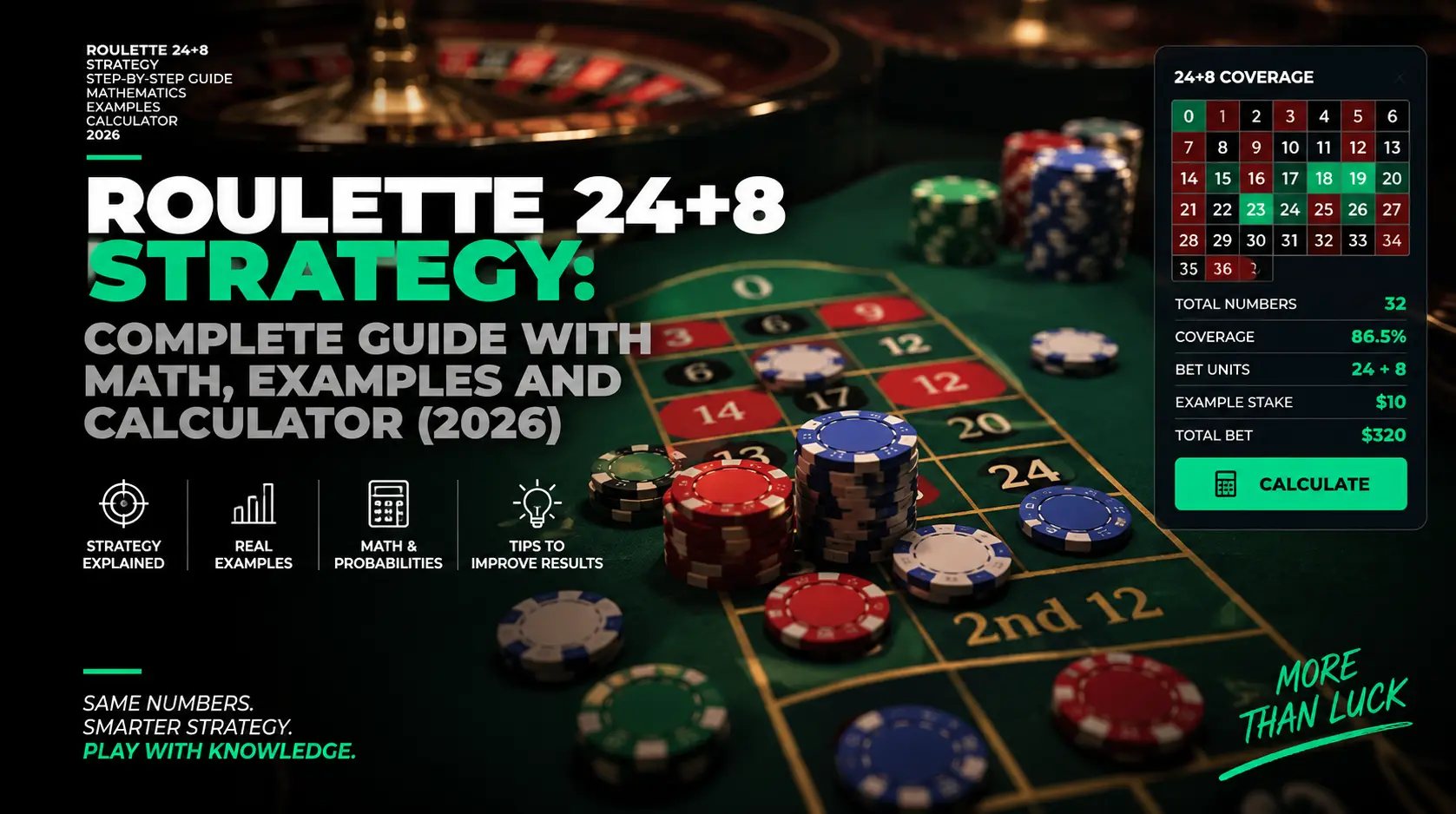
The 24+8 roulette strategy combines two dozens with eight distinct straight-up bets from the remaining dozen, covering 32 numbers. But coverage is not the probability of net profit: a winning bet can still leave the whole spin at a loss. With standard payouts, the model retains a negative expected value regardless of the stake ratio.
In the main example, you place $5 on each of two dozens and $1 on each of eight individual numbers. The total stake is $18 per spin. On a European wheel, a bet pays out on 86.49% of spins, but only 21.62% produce a positive net result.
How to place the ten 24+8 bets
Place $5 on the first dozen, $5 on the second dozen and $1 on each number from 25 through 32. These are ten separate bets, not one bet covering eight numbers.
Before placing them, verify that the table pays the standard 2:1 on dozens and 35:1 on straight-up bets. Check the inside and outside per-bet minimums and maximums so that every chosen stake is permitted, and make sure the entire $18 outlay fits within your remaining planned loss budget.
- Place $5 on the first-dozen betting area, covering 1–12.
- Place another $5 on the second-dozen betting area, covering 13–24.
- Place $1 on each of these numbers: 25, 26, 27, 28, 29, 30, 31 and 32.
- Put each straight-up chip in the middle of its numbered cell, not on a boundary.
- Check the total:
2 × 5 + 8 × 1 = 18.
The uncovered numbers are 33, 34, 35, 36 and 0. American roulette also leaves 00 uncovered.
The eight straight-up bets must be outside the two backed dozens. Overlapping them with either dozen breaks the 32-distinct-number model, so the calculations below no longer apply.
Two columns plus eight distinct numbers from the unbacked column offer a same-count alternative, not the same numbered layout. See the first and third column strategy guide for the column arrangement.
Under independent, equally likely outcomes, choosing particular hot or cold numbers does not improve expected value. Treating past results as a signal about the next independent spin is the gambler’s fallacy.
Payout, gross return and net result
A payout on one winning bet is not necessarily net profit for the spin. Gross return includes the winning profit and returned winning stake; net result subtracts the entire spin’s outlay from that return.
A standard dozen bet pays 2:1 profit plus the returned stake, while a straight-up bet pays 35:1 profit plus the returned stake. These ratios appear on page 2 of the official Loto-Québec roulette rules. This is a historical English-language document with metadata dated 2020-02-06, not confirmation of current 2026 rules or any casino’s actual limits. The arithmetic below is our own standard-payout model.
Excerpt from page 2 of the Loto-Québec roulette rules showing dozen and straight-up payouts; metadata dated 2020-02-06, historical English-language original, not current table rules
Source: Loto-Québec roulette rules, page 2, metadata date 2020-02-06. This historical English-language original documents standard payouts, not current casino rules or betting limits.
When a backed dozen hits, the winning $5 bet earns $10 and returns its $5 stake. The gross return is $15, but the spin cost $18: 15 − 18 = −3.
When a selected straight-up number hits, its $1 bet earns $35 and returns the $1 stake. The gross return is $36, giving net profit of 36 − 18 = +18.
The three outcomes at a 5/1 stake ratio
At 5/1, a dozen hit loses $3 overall, a selected straight-up hit earns $18, and an uncovered number loses the full $18.
Here, 5/1 means $5 per dozen and $1 per straight-up bet. The table assumes a European wheel with 37 independent, equally likely outcomes, standard payouts and no additional charges or multipliers. Probabilities are rounded independently to two decimal places.
| Spin outcome | Probability | Gross return | Net result |
|---|---|---|---|
| Either backed dozen | 24/37 = 64.86% | $15 | −$3 |
| One of the eight selected singles | 8/37 = 21.62% | $36 | +$18 |
| An uncovered number | 5/37 = 13.51% | $0 | −$18 |
This produces three different measures:
- 86.49% payout coverage: a bet wins and returns money.
- 21.62% positive net results: the return exceeds the whole spin’s stake.
- 78.38% negative net results: the spin loses money overall.
The table’s rounded probabilities add up to 99.99%. The exact fractions add up to 100%; there is no missing outcome.
How stake ratios change the result
Both covered outcome categories produce net profit only when 8s < d < 14s, where d is the stake on each dozen and s is the stake on each of the eight straight-up bets.
For ten non-overlapping bets:
- Total stake:
T = 2d + 8s - Net result on a dozen hit:
d − 8s - Net result on a selected straight-up hit:
28s − 2d - Net result on an uncovered number:
−T
At d = 8s, a dozen hit is a push: the gross return equals the entire spin’s outlay, with no net profit. At d = 14s, a selected straight-up hit pushes. Beyond these thresholds, a winning individual bet can still produce an overall loss.
| Stake per dozen / per single | Total stake | Dozen net result | Selected single net result | Uncovered number |
|---|---|---|---|---|
| $1 / $1 | $10 | −$7 | +$26 | −$10 |
| $5 / $1 | $18 | −$3 | +$18 | −$18 |
| $8 / $1 | $24 | $0 | +$12 | −$24 |
| $10 / $1 | $28 | +$2 | +$8 | −$28 |
All four have the same European house edge: 2.7027% of betting turnover. Their total stakes and net-result distributions differ, not their percentage house edge.
At 10/1, 86.49% of spins produce positive net results. Yet one −$28 result outweighs many +$2 results. Expected value (EV), the mean net result under the model, is −28/37 = −0.75676 dollars per spin. Frequent small profits do not make the strategy positive-EV.
European versus American roulette
European roulette has a lower expected loss in this model because its single-zero wheel has 37 outcomes, while the American double-zero wheel has 38.
The comparison assumes independent, equally likely outcomes, standard payouts, no bonus multipliers, no fees and no altered rules. Stakes remain $5 per dozen and $1 per straight-up bet.
| Measure | European roulette | American roulette |
|---|---|---|
| Possible outcomes | 37 | 38 |
| Payout coverage | 32/37 = 86.49% | 32/38 = 84.21% |
| Probability of net profit | 8/37 = 21.62% | 8/38 = 21.05% |
| Probability of an uncovered number | 5/37 = 13.51% | 6/38 = 15.79% |
| House edge | 1/37 = 2.7027% | 2/38 = 5.2632% |
| EV per spin | −18/37 = −0.486486 dollars ≈ −$0.49 | −36/38 = −0.947368 dollars ≈ −$0.95 |
House edge applies to turnover, not the starting bankroll. Turnover is the sum of all stakes placed across completed spins.
For a hypothetical fixed number of completed spins at an unchanged $18 stake:
- 20 spins: turnover is $360. European expected net result is
−360/37 = −9.72973, or approximately −$9.73. - 100 spins: turnover is $1,800. European expected net result is
−1800/37 = −48.64865, or approximately −$48.65. American expected net result is approximately −$94.74.
These are model averages, not session forecasts or guaranteed costs. A finite bankroll may prevent completion of the planned number of spins. The figures are not conditional averages among sessions that survive long enough to finish.
Use the exact fractions when calculating the house edge. Dividing the rounded $0.49 loss by $18 incorrectly gives about 2.72%.
French roulette’s la partage rule applies to even-money bets, not dozens or straight-up bets, as described on Evolution’s roulette page. It therefore does not reduce the house edge for this 24+8 layout. Specialty roulette games with different payouts require their own rules and calculations.
The chart uses the fixed 5/1 stake ratio. Its European/American selector is separate from the calculator below and does not change the calculator’s settings.
How to use the embedded 24+8 calculator
For the main example, select European roulette, enter 5 per dozen, 1 per straight-up bet and 20 spins. Static outcomes update immediately; you do not need to run a simulation to see EV.
The calculator is embedded on this article page.
- Select European roulette.
- Enter 5 in Dozen Bet. This is the stake on each of the two dozens.
- Enter 1 in Straight-Up Bet. This is the stake on each individual number, not the total for all eight.
- Enter 20 in Number of Spins. This field affects the simulation only.
Local English 24+8 calculator inputs showing European roulette, Dozen Bet 5, Straight-Up Bet 1 and Number of Spins 20
Local interface example captured on localhost with settings 5/1/20. This is not a real-money test or verification of the production version.
The total stake should be $18. The net results are −$3 for a dozen hit, +$18 for a selected straight-up hit and −$18 for an uncovered number.
Local English 24+8 calculator results at 5/1/20 showing total stake 18, coverage 86.5%, EV −0.49 and player EV percentage −2.70%
Local European results at 5/1/20, not a real-money session. The interface uses decimal points and rounded values: 64.9%, 21.6%, 13.5%, 86.5%, −0.49 and −2.70%. The two-decimal probabilities in this guide describe the same model.
The standard-edge output refers to the normal house edge, not a player advantage. Its displayed −2.70% is the player’s expected net result divided by turnover—EV%—rather than a negative house edge. The house edge itself is positive 2.70% when rounded to two decimals.
Comparing other stakes
Keep Straight-Up Bet at 1 and change only Dozen Bet, first from 5 to 8, then to 10.
- At 8/1, the total stake becomes $24: a dozen hit gives $0 net, a selected single gives +$12, and an uncovered number gives −$24.
- At 10/1, the total stake becomes $28: a dozen hit gives +$2, a selected single gives +$8, and an uncovered number gives −$28.
- Switching to American roulette lowers payout coverage and increases expected loss at the same stakes.
The screenshots show only the original 5/1/20 settings. The tested values above display valid positive single-hit results. However, the interface always prefixes the single-hit net result with a plus sign, so do not treat that formatting as proof of profit at arbitrary extreme ratios. Check the formula instead.
What the simulation does—and cannot do
The simulation generates a random example, not a prediction of casino spins or a calculation of session-profit probability.
Run Simulation starts with a fixed $100 bankroll. It randomly samples outcomes independently in your browser, runs no more than the requested number of spins and stops when the remaining funds cannot cover the full next stake.
Reset restores European roulette and the 5/1/20 settings.
The calculator cannot:
- Select your actual eight numbers.
- Set a custom starting bankroll.
- Replace eight singles with ten.
- Model a betting progression.
- Account for specialty payouts.
- Calculate the probability of finishing a session in profit.
Bankroll and session results
Your bankroll is the available gambling budget, not a guarantee that you can complete a particular number of spins. High payout frequency does not protect it from net losses.
Consider this synthetic arithmetic example. It is not an actual session or an output reproduced from the calculator’s random simulation. It starts with $100, uses 5/1 stakes and completes 20 spins.
| Outcome | Count | Combined net result |
|---|---|---|
| Dozen hit | 13 | 13 × (−$3) = −$39 |
| Selected straight-up hit | 4 | 4 × $18 = +$72 |
| Uncovered number | 3 | 3 × (−$18) = −$54 |
| Total | 20 | −$21 |
The final bankroll is 100 − 39 + 72 − 54 = 79, and turnover is $360.
One possible first-seven sequence is dozen, dozen, single, dozen, dozen, dozen, miss. The balances are $97, $94, $112, $109, $106, $103 and $85. The remaining 13 spins contain eight dozen hits, three single hits and two misses, and can be ordered so that every stake is affordable and the final balance is $79.
The expected loss for a hypothetical completed block of 20 unchanged-stake spins is about $9.73; this example loses $21. That difference is normal for an individual sequence and is not a test of whether a wheel is fair.
At 5/1, one +$18 straight-up result offsets one −$18 full miss. Six dozen hits do not recover $18: they lose another $18.
Five full misses from $100 leave $10, which cannot fund another $18 spin. You can stop earlier at a chosen loss budget. There is no universally safe bankroll of 30 or 50 stakes, and dividing bankroll by average expected loss does not establish how long it will last.
How modified 24+10 differs from 24+8
The 24+10 layout adds ten distinct straight-up bets from the remaining dozen instead of eight. It covers 34 numbers, but 91.89% coverage does not mean 91.89% profitable spins.
All ten singles must be outside the two backed dozens. With European roulette and standard payouts:
| Layout and stake per dozen / single | Total stake | Dozen net result | Selected single net result | Uncovered number |
|---|---|---|---|---|
| 24+8: $5 / $1 | $18 | −$3 | +$18 | −$18 |
| 24+10: $5 / $1 | $20 | −$5 | +$16 | −$20 |
| 24+10: $10 / $1 | $30 | $0 | +$6 | −$30 |
For 24+10 at 10/1:
- Payout coverage is
34/37 = 91.89%. - Net-profit probability is
10/37 = 27.03%. - Push probability is
24/37 = 64.86%. - The probability of losing $30 is
3/37 = 8.11%.
A dozen hit returns $30; a selected straight-up hit returns $36. EV is −30/37 = −0.81081 dollars per spin. Probabilities are rounded independently.
The embedded calculator is fixed at eight straight-up bets and cannot model 24+10. For a scaled version, see the 150-dollar roulette strategy guide.
Does increasing stakes after a loss help?
Increasing stakes does not remove the house edge or guarantee recovery. Short-term profit is possible, but 24+8 is not a house-beating system.
If you double every component after a full miss at 5/1, the next spin costs $36. A dozen hit then gives a net result of −$6: it does not recover the previous $18 loss and adds another loss.
Three full misses at stakes of $18, $36 and $72 lose $126 in total. The next doubled stake is $144, requiring both sufficient bankroll and suitable table limits.
Flat betting—keeping stakes unchanged—does not automatically increase the outlay after losses, but bankroll and table limits still matter. More coverage does not itself lower the percentage house edge, while a larger total stake increases absolute expected loss.
The practical approach is to separate payouts from net profit, check the stake ratio and set a loss budget in advance. Stop if the full next stake exceeds the remaining planned amount. Do not top up to chase losses: neither number selection nor larger bets can predict the next spin or guarantee recovery.
Frequently Asked Questions
Not under the independent, equally likely outcome model. Any eight distinct numbers outside the two backed dozens have the same probabilities and expected value. Past results do not change the next spin's probabilities.
Yes. Two columns plus eight distinct straight-up bets in the remaining column also cover 32 numbers. With standard payouts and the same stakes, the calculations match, but the numbered layout is different.
Each probability is rounded independently to two decimal places. The exact fractions 24/37, 8/37 and 5/37 add up to 100%; the difference is only rounding.
No. It uses exactly eight straight-up bets and has no control for changing that count. The article provides a separate calculation for 24+10.
Evgeniy Volkov
Verified ExpertFullstack developer with a background in mathematics. I build the calculators and game-style tools on ToolsGambling with Pixi.js and modern web tech, and every result uses transparent probability formulas you can verify yourself.