












Contents
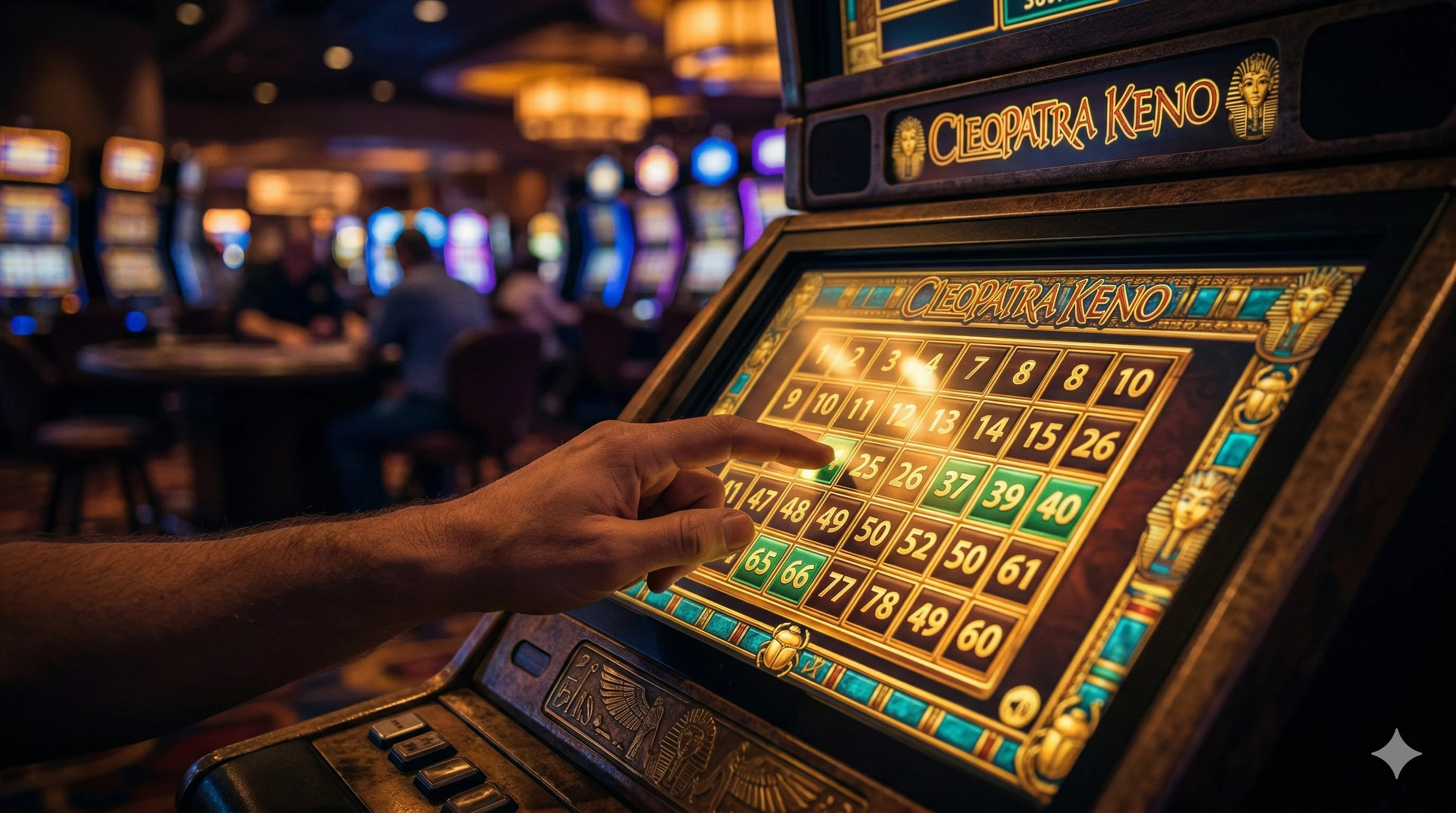
Picture this: you're at a video keno machine, 7 numbers glowing on the board. The draw starts, numbers light up one by one, and then it happens. The last number drawn lands directly on one of your picks. The screen explodes with Egyptian gold, hieroglyphs flash, and suddenly you've got 12 free games with every payout doubled. That's the Cleopatra Keno bonus, and it changes everything about how you should think about keno strategy.
Here's what most guides won't tell you about Cleopatra Keno strategy in 2026: the bonus mechanic isn't just a flashy gimmick. It fundamentally shifts the optimal pick count, changes your expected RTP by 1-4%, and makes certain pick counts mathematically better than others. The difference between picking 4 numbers and picking 7 can mean an extra 1.1% of bonus-adjusted RTP, real money over hundreds of draws.
This guide breaks down the exact bonus trigger probability for every pick count (2 through 10), compares Cleopatra to standard keno, and includes a free simulator so you can test strategies before risking a dollar.
See the exact catch probabilities and RTP for your ticket in our free keno calculator.
TL;DR, Cleopatra Keno Strategy at a Glance
Key Numbers You Need to Know
| Metric | Value |
|---|---|
| Best pick count | 6-8 spots (optimal range) |
| Peak bonus trigger rate | 3.9% at pick 7 (1 in ~26 draws) |
| Total RTP (with bonus) | 92-95% on good machines |
| Bonus reward | 12 free games with 2x payouts |
| Recommended bankroll | 150-200x your bet size |
| Draws per hour (video) | ~200 |
| Hourly loss at $1/draw | ~$10-16 (good pay table) |
| Avoid | Pick 2-3 (low bonus), Pick 10 (low RTP) |
The rest of this article explains why these numbers matter and how to use them.
What Is Cleopatra Keno? (Rules & Key Difference from Regular Keno)
How the Cleopatra Keno Bonus Works (12 Free Games + 2x Multiplier)
Cleopatra Keno plays exactly like standard keno with one critical addition: the last-ball bonus trigger. Here's how it works:
- You pick your numbers (2-10 spots) and place your bet
- The machine draws 20 numbers from a pool of 80, same as regular keno
- The key moment: if the 20th number drawn (the last ball) matches one of your selected numbers, the bonus activates
- You receive 12 free games where every payout is multiplied by 2x
- The bonus can retrigger during free games using the same last-ball mechanic
The last-ball trigger is what makes Cleopatra Keno strategy different from standard keno. In regular keno, you just pick numbers and hope. In Cleopatra, you're also playing for that bonus activation, and the number of spots you pick directly affects how likely it is to trigger.
Cleopatra Keno vs Standard Keno: What Changes Strategically
| Feature | Standard Keno | Cleopatra Keno |
|---|---|---|
| Pick range | 1-10 (or 1-20) | 2-10 |
| Draw mechanics | 20 of 80 | 20 of 80 (identical) |
| Bonus trigger | None | Last ball = your pick |
| Free games | None | 12 free games |
| Payout multiplier | 1x | 2x during bonus |
| RTP impact | Base only | Base + ~1-4% bonus |
| Best pick count | 4-8 | 6-8 (bonus-adjusted) |
The strategic shift is subtle but important: in standard keno, pick 4 and pick 8 have similar RTP. In Cleopatra, pick 7-8 pulls ahead because those spot counts have the highest bonus trigger probability combined with strong base pay tables.
Cleopatra Keno Paytable & RTP Explained
Full Paytable: Catch Payouts for Pick 3-10
Pay tables vary by machine and casino. Here are typical payouts per $1 bet on a good Cleopatra Keno machine:
| Catch | Pick 3 | Pick 4 | Pick 5 | Pick 6 | Pick 7 | Pick 8 | Pick 9 | Pick 10 |
|---|---|---|---|---|---|---|---|---|
| 0 | , | , | , | , | , | , | , | , |
| 1 | , | , | , | , | , | , | , | , |
| 2 | $1 | $1 | , | , | , | , | , | , |
| 3 | $16 | $3 | $2 | $1 | , | , | , | , |
| 4 | , | $55 | $12 | $4 | $2 | $2 | $1 | $1 |
| 5 | , | , | $300 | $70 | $20 | $12 | $4 | $3 |
| 6 | , | , | , | $1,200 | $100 | $50 | $25 | $15 |
| 7 | , | , | , | , | $4,500 | $600 | $200 | $50 |
| 8 | , | , | , | , | , | $10,000 | $3,000 | $500 |
| 9 | , | , | , | , | , | , | $10,000 | $3,000 |
| 10 | , | , | , | , | , | , | , | $25,000 |
Important: These are base game payouts. During the bonus round, every payout is doubled. That $4,500 for 7/7 becomes $9,000 in free games.
RTP by Number of Picks (Which Has the Best Odds?)
RTP varies significantly by pick count. Here's the breakdown for a good pay table:
| Picks | Base RTP | Bonus Contribution | Total RTP | Verdict |
|---|---|---|---|---|
| 3 | 88.3% | +1.5% | 89.8% | Below average |
| 4 | 90.1% | +1.8% | 91.9% | Decent |
| 5 | 91.0% | +2.1% | 93.1% | Good |
| 6 | 91.5% | +2.5% | 94.0% | Very good |
| 7 | 91.2% | +2.8% | 94.0% | Very good |
| 8 | 92.0% | +2.7% | 94.7% | Best |
| 9 | 90.5% | +2.6% | 93.1% | Good |
| 10 | 89.0% | +2.3% | 91.3% | Below average |
Pick 6-8 dominates with 94%+ total RTP on good machines. That extra 2-3% from the bonus mechanic makes Cleopatra meaningfully better than standard keno.
How the Bonus Round Changes Your Total Return
The total RTP formula for Cleopatra Keno:
In plain English: take your base return, then add the probability of triggering the bonus multiplied by 12 free games at 2x payout. The term is what makes pick count matter, higher bonus probability means more bonus contribution to your total return.
For pick 7 on a good machine: $0.912 + 0.039 \times 12 \times 2 \times 0.912 = 0.912 + 0.028 = 0.940$ (94.0% total RTP).
Best Cleopatra Keno Strategy: How Many Numbers Should You Pick? (2026)
Why 5-8 Numbers Is the Optimal Range
The optimal pick count in Cleopatra Keno sits firmly in the 5-8 range because these spot counts balance three competing factors:
- Base RTP: peaks at pick 7-8 on most pay tables
- Bonus trigger rate: peaks at pick 7 (3.9%)
- Payout volatility: manageable at 5-8, extreme at 9-10
Below pick 5, the bonus trigger rate drops too low to contribute meaningful RTP. Above pick 8, the base pay table weakens and the bonus can't compensate.
Pick 4: Low Variance, Decent RTP
Pick 4 in Cleopatra is the conservative choice. You hit paying matches more often (~6.7% of draws) and the bonus triggers at a decent 3.3%. Total RTP sits around 91.9%, solid but not optimal.
Best for: players who want longer sessions with fewer dry spells. The trade-off is smaller maximum payouts.
Pick 6-8: Best Balance of RTP and Payout Potential
This is the sweet spot. Pick 7 has the highest bonus trigger probability (3.9%), while pick 8 has the highest total RTP (94.7% on good machines). Pick 6 balances both nicely at 94.0%.
If you're playing 7-spot keno on a Cleopatra machine, you're already in the optimal range. The only decision is whether you want peak bonus triggers (pick 7) or peak total RTP (pick 8).
Avoid Pick 10: Why More Isn't Better
Pick 10 looks tempting because of the $25,000 top prize, but the math doesn't support it:
- Bonus trigger rate drops to 3.5% (below pick 7's 3.9%)
- Base RTP falls to ~89% (vs 92% for pick 8)
- Win frequency plummets, you'll go 50+ draws without a payout routinely
- Total RTP: only 91.3% vs 94.7% for pick 8
The 3.4% RTP difference means your $100 bankroll lasts roughly 40% longer on pick 8. Always check the house edge calculator to compare specific pay tables.
| Pick | Bonus Trigger |
|---|---|
| Pick 2 | 2.3 |
| Pick 3 | 2.8 |
| Pick 4 | 3.3 |
| Pick 5 | 3.5 |
| Pick 6 | 3.7 |
| Pick 7 | 3.9 |
| Pick 8 | 3.8 |
| Pick 9 | 3.7 |
| Pick 10 | 3.5 |
Strategy for Triggering the Cleopatra Bonus
Which Number of Picks Maximizes Your Bonus Trigger Probability?
The bonus triggers when the last of the 20 drawn numbers matches one of your picks. More picks = more targets for that last ball to land on. But the relationship isn't perfectly linear because of how the 20-ball draw sequence works.
Here's the exact trigger probability for each pick count:
| Pick Count | Bonus Trigger % | 1 in X Draws | Rating |
|---|---|---|---|
| 2 | 2.3% | 43 | Low |
| 3 | 2.8% | 36 | Low |
| 4 | 3.3% | 30 | Moderate |
| 5 | 3.5% | 29 | Moderate |
| 6 | 3.7% | 27 | Good |
| 7 | 3.9% | 26 | Best |
| 8 | 3.8% | 26 | Good |
| 9 | 3.7% | 27 | Good |
| 10 | 3.5% | 29 | Moderate |
Pick 7 wins the bonus trigger race. At 200 draws per hour, you'll trigger the bonus roughly 7-8 times per hour on pick 7, about once every 8 minutes.
How to Select Numbers to Increase Last-Ball Match Chances
Here's an uncomfortable truth: you cannot increase last-ball match chances through number selection. The draw is fully random via RNG. The 20th number drawn has no relationship to where your picks sit on the board.
What you can control is your pick count. Choosing 7 spots gives you the statistically highest probability of that last ball landing on your numbers. No pattern, spread, or clustering technique changes this, it's purely a function of how many picks you have.
For a deeper dive into why pattern-based strategies don't work, see our analysis of whether AI can predict lottery numbers, the same RNG principles apply.
Top 5 Cleopatra Keno Strategies
1. Consistency Strategy: Stick to the Same Numbers
Playing the same numbers every draw doesn't change the odds, each draw is independent. But it does simplify your session and prevents the psychological trap of regretting a number change when your old picks would have hit.
How it works: Pick your 7 numbers once. Play them every single draw. Don't look at hot/cold displays. This removes decision fatigue and keeps you focused on bet sizing and bankroll management.
2. Maximum Round Play: Extend Your Session
The longer you play, the more chances you have to trigger the Cleopatra bonus. Since the bonus is where the real value lives (12 free games at 2x), maximizing draws per session is key.
How it works: Use minimum bet sizes ($0.25-$0.50) with a larger bankroll. Instead of 50 draws at $2, play 200 draws at $0.50. You'll trigger approximately 7-8 bonuses per hour at pick 7, compared to only 2-3 in a shorter session. More bonus triggers = more exposure to that 2x multiplier.
3. Martingale System: High Risk, High Reward
The Martingale (doubling your bet after each loss) is popular but deeply flawed for keno. Unlike roulette where you win ~48% of bets, keno pays on only 5-7% of draws. You could easily double 15-20 times before a paying match.
The math: Starting at $1, after 15 doubles you're betting $32,768 to recover $15. That's not a strategy, it's a bankroll suicide mission. If you want to understand why progressive systems fail here, check the Fibonacci betting system analysis for the same math in a different context.
4. Overlay Strategy: Multi-Card Cleopatra Keno
Playing multiple cards per draw is the most strategically rich approach to Cleopatra Keno. With 4 cards, shared numbers multiply the value of each catch across multiple pay lines.
How it works: See the 4-card section below for detailed card configurations. The key is overlapping 3-4 core numbers across all cards while varying the remaining picks.
5. Pattern Betting: Lines, Clusters & Diagonal Picks
Pattern betting, selecting numbers in lines, X-shapes, or clusters, has zero mathematical impact on outcomes. The RNG treats every number identically regardless of board position.
Why players use it anyway: Visual organization. When drawn numbers land near your pattern, the near-misses create excitement. It makes the game more engaging without hurting (or helping) your odds. The gambler's fallacy page explains why perceived patterns in random data don't indicate real predictability.
4-Card Cleopatra Keno Strategy (Multi-Card Setup)
How to Use Overlapping Numbers Across 4 Cards
Multi-card Cleopatra Keno is where strategy gets genuinely interesting. The principle: share core numbers across cards so each catch benefits multiple pay lines, while unique numbers per card maximize total board coverage.
If you're familiar with 4 card keno strategy, the same overlap principles apply, but Cleopatra's bonus mechanic adds an extra layer. When the bonus triggers, all 4 cards get 12 free games. That means 48 total free draws at 2x payouts. One bonus trigger on a 4-card setup is worth 4x what it's worth on a single card.
Quadrant Method for Cleopatra Keno
Divide the 80-number keno board into 4 quadrants and assign each card a "home quadrant" for its unique picks:
| Card | Home Quadrant | Shared Numbers (all cards) | Unique Numbers | Total Picks |
|---|---|---|---|---|
| 1 | Top-Left (1-20) | 3, 27, 45 | 8, 14, 17, 19 | 7 |
| 2 | Top-Right (21-40) | 3, 27, 45 | 24, 31, 36, 39 | 7 |
| 3 | Bottom-Left (41-60) | 3, 27, 45 | 48, 52, 55, 59 | 7 |
| 4 | Bottom-Right (61-80) | 3, 27, 45 | 64, 71, 76, 80 | 7 |
Example: 4-Card 7-Spot Cleopatra Layout
With 3 shared + 4 unique per card, you're covering 19 unique numbers across the board, nearly matching the 20 drawn per round. This gives you maximum coverage while maintaining overlap that amplifies winning draws.
The shared numbers (3, 27, 45) are positioned in different quadrants themselves, creating cross-board connections. When any of these shared numbers hits, all 4 cards benefit simultaneously.
For detailed multi-card configurations, see our full 4-card keno strategy guide with pattern visualizers.
Bankroll Management for Cleopatra Keno
How to Set a Loss Limit
The bonus feature makes Cleopatra sessions more volatile than standard keno. You'll have longer dry spells punctuated by bonus-fueled spikes. Set these rules before you play:
- Stop-loss: Walk away at 50% of your session bankroll. Brought $200? Leave at $100
- Win limit: Cash out when you've doubled your bankroll. Hit $400? Walk away
- Time limit: Maximum 90 minutes per session regardless of results
Use the loss calculator to model exactly how fast different bet sizes drain your bankroll at various RTP levels.
Bet Sizing for Short vs Long Sessions
The golden rule: never bet more than 0.5-1% of your session bankroll per draw. Cleopatra's bonus triggers roughly once every 26-29 draws at optimal pick counts, your bankroll needs to survive between triggers.
Session Bankroll Table
| Session Goal | Bet/Draw | Min Bankroll | Expected Bonuses/Hour | Hourly Loss (94% RTP) |
|---|---|---|---|---|
| Quick (30 min) | $1.00 | $100 | 3-4 | ~$12 |
| Standard (1 hr) | $0.50 | $100 | 7-8 | ~$6 |
| Extended (2 hr) | $0.25 | $100 | 14-16 | ~$3 |
| High roller | $5.00 | $750 | 7-8 | ~$60 |
Use the bankroll calculator to model your specific scenario.
Never Chase Losses: Why Discipline Beats Luck
After a 30-minute dry spell with no bonus triggers, the temptation to double your bet is enormous. Don't do it. The math doesn't change based on how long you've been losing. The next draw has the same 3.9% bonus trigger probability whether you've been playing for 5 minutes or 5 hours.
Chasing losses with bigger bets only accelerates how fast you hit your stop-loss. The Labouchere betting system article explains why progressive betting strategies fail against a fixed house edge.
Best Casinos to Play Cleopatra Keno (Best Paytables)
How to Find the Best RTP Version of Cleopatra Keno
Not all Cleopatra Keno machines are created equal. The same game can have wildly different pay tables depending on the venue:
| Venue Type | Typical RTP | Bonus-Adjusted RTP | Verdict |
|---|---|---|---|
| Casino floor (newer machines) | 90-92% | 93-95% | Best |
| Online casinos | 91-93% | 94-96% | Best |
| Bar/lounge machines | 82-86% | 84-89% | Avoid |
| Convenience locations | 78-82% | 80-85% | Never |
The single most impactful decision in Cleopatra Keno is which machine you play. A 10% RTP difference means your $100 disappears $10 faster per 100 bets on a bad machine. Always check the pay table before sitting down.
For video keno strategy fundamentals that apply to all keno variants including Cleopatra, check our comprehensive guide. On the 12 free-game bonus at 2x, even mid-level catches can cross the $1,500 keno threshold and trigger a hand pay. If you're playing at an Oklahoma tribal casino, check our Oklahoma gambling tax guide for keno-specific W-2G thresholds and state tax rates.
Common Cleopatra Keno Mistakes to Avoid
Mistake 1: Playing pick 10 for the jackpot. The $25,000 top prize is alluring, but you'll hit it once every ~8.9 million draws. Pick 7-8 gives you 3% better RTP and far more consistent returns.
Mistake 2: Believing the bonus is "due." If you haven't triggered a bonus in 50 draws, the next draw still has a 3.9% trigger rate. The RNG doesn't track your bonus drought.
Mistake 3: Ignoring the pay table. Two Cleopatra machines side by side can have 10%+ RTP difference. Always compare before choosing.
Mistake 4: Playing bar-top machines. Convenience and bar-top Cleopatra Keno has the worst pay tables, sometimes 78% RTP. That's 14% worse than casino floor versions. The convenience isn't worth the cost.
Mistake 5: Using hot/cold number displays. Casino screens showing hot/cold numbers exploit the gambler's fallacy. Each draw is independent. These displays exist to keep you playing longer, not to help you win.
Compare how different keno variants handle bonus mechanics, our Caveman Keno strategy guide shows an egg-multiplier approach that's fundamentally different from Cleopatra's last-ball trigger.
Try the Cleopatra Keno Calculator
Adjust your pick count, bet size, bankroll, and pay table quality below. Run the session simulator to see draw-by-draw results including bonus triggers, free game payouts, and bankroll evolution.
Use the RTP calculator to cross-check expected returns from your local machine's pay table, and the session simulator for more detailed bankroll modeling across different game types.
The Cleopatra 2x bonus multiplier can push a standard win past the $1,000 mark. Learn more about winning $1,000 at keno across different game variants.
Frequently Asked Questions
Cleopatra Keno adds a bonus feature: if your last number drawn matches one of your picks, you win 12 free games with all payouts doubled. This bonus mechanic increases total RTP by 1-4% compared to standard keno with the same pay table.
No specific numbers give better odds. Every number from 1-80 has an equal 25% chance of being drawn. The real strategy is choosing the right number of picks (6-8 spots) and finding machines with good pay tables.
Pick 6-8 numbers for the best balance of RTP and bonus trigger probability. Pick 7 has the highest bonus trigger rate at 3.9%, while pick 6-8 all stay above 3.7%. Avoid pick 2-3 (low bonus rate) and pick 10 (lower RTP).
Bonus trigger probability ranges from 2.3% (pick 2) to 3.9% (pick 7). On average, you'll trigger the bonus once every 26-43 draws depending on your pick count. Pick 7 gives you the best chance at roughly 1 in 26 draws.
When your last drawn number matches one of your picks, you receive 12 free games. During these free games, all payouts are doubled (2x multiplier). The bonus can retrigger during free play, though retrigger odds are the same as the base game.
Base RTP ranges from 88-95% depending on the pay table and pick count. The bonus mechanic adds approximately 1-4% to the total RTP, making good Cleopatra Keno machines slightly better than standard keno at 92-95% total RTP.
Yes, the bonus can retrigger during the 12 free games. If your last drawn number matches again, you get another 12 free games with the 2x multiplier still active. Retriggering is rare but adds significant value when it happens.
No. Martingale (doubling after losses) doesn't work well for keno because wins are too infrequent. You'll only hit a paying match on roughly 5-7% of draws, meaning you could double your bet 15-20 times before a win. That exponential growth destroys bankrolls fast.
Use overlapping numbers across 4 cards with 6-8 picks per card. Share 3-4 core numbers on all cards, then add unique numbers to each. The quadrant method assigns different board regions to each card for maximum coverage.
Budget 150-200x your bet per session. At $1 per draw, bring $150-200. The bonus feature extends sessions slightly compared to standard keno, but you still need enough bankroll to survive dry spells between bonus triggers.
No. Each draw uses an independent RNG. A number drawn 10 times in a row has the same 25% chance next draw. Hot and cold number tracking is a gambler's fallacy that doesn't affect outcomes.
Both offer bonus mechanics over standard keno, but they work differently. Cleopatra Keno gives 12 free games with 2x payouts on a last-ball trigger. Caveman Keno uses egg multipliers (2x-10x) on random catches. Cleopatra typically has more consistent bonus value.
No. Keno uses a cryptographic RNG producing truly random outcomes. No algorithm, AI model, or pattern recognition can predict which numbers will appear. Anyone selling keno prediction software is running a scam.
House edge ranges from 5% to 12% depending on the pay table and pick count. Good machines run 5-8% (92-95% RTP including bonus), while poor machines can hit 12%+ (88% RTP). Always check the pay table before playing.
At $1 per draw with 200 draws per hour and an 8% house edge, you lose about $16 per hour on average. The bonus feature occasionally spikes your bankroll, but over thousands of draws, you'll trend toward losing the house edge percentage.
Evgeniy Volkov
Verified ExpertFullstack developer with a background in mathematics. I build the calculators and game-style tools on ToolsGambling with Pixi.js and modern web tech, and every result uses transparent probability formulas you can verify yourself.